Showing posts with label x-men and identity. Show all posts

Wednesday, February 18, 2015

The X-Men and identity politics #4: Reconsidering Wolverine

A decade ago, I wrote a paper about the X-Men. It's been, amazingly, by at least a few thousand people, which is why I'm now turning it into a book. And which is why I'm not re-evaluating a lot of the things that I said 10 years ago. For instance:
Wolverine’s super-power also serves to essentialize his biological male-ness: he is in peak physical condition, a natural hunter with heightened physical senses and instincts (improved senses being another super-power), must constantly train to be patient and keep his temper in check, and – thanks especially to the recent X-Men movies – projects an animal magnetism that renders him irresistible to the opposite sex. In other words, his very powers reinscribe the singular, biological, and essential notion of traditional white maleness – a muscled, animalistic body that, in addition to his moral code, serves to appeal directly to the desires of adolescent male readers.

First, my apologies for the over-writing of an aspiring grad student.

Second, I over-generalized. Sure, Wolverine is John Wayne given superhero form. He's morally righteous, quick to anger, and a brute. He also sleeps with nearly absolutely every woman who's ever been associated with the X-Men. (Except for the girls who are 16ish and younger. For whom he is a father-figure. For nearly absolutely every girl who's ever been associated with the X-Men.) But that hasn't always been true.

In Geoff Klock's excellent book about Matt Fraction's Casanova, he argues that Casanova Quinn skewers, deconstructs, and refutes the need for the sort of superhero masculinity that Wolverine embodies. Klock writes, for instance, that "death surrounds Casanova, and invades him, and the resulting nihilism is what needs to be conquered when the temptation is to embrace it as part of badass masculine posturing." And if it can't be conquered? Then "why shouldn't we all escape from it?"

These are good questions: questions that need to be asked and answered, over and over, because norms of masculinity are stubborn and enduring things that aren't easily undermined or overturned. But y'know what? Wolverine had already asked them. (Or to paraphrase Jason Powell, whose own book on the X-Men is coming out later this year: Claremont did it first.)

But don't take my word for it. Here are a few examples from the Australia Era, which I've previously described as the most progressive and creative era of the comic.


Uncanny X-Men 233-234

Wolverine is implanted with a Brood egg and is transformed into a hideous alien monster. It isn't the first time - he was also implanted with a Brood egg in UXM 162 - but this time is different. It's also the first indication that something is wrong with the nigh-invincible Wolverine, who had recently and ridiculously been restored to life from a single drop of blood in UXN Annual 10. (Because healing factor.)

Unlike the previous infection, Wolverine appears to lose this one - he transforms into a Brood, even losing control of his mind. (The Brood announces "Behold, human, the shape of your world to come!" It's pretty explicit.) Of course, this is Wolverine we're talking about and as quickly as he loses the battle with the Brood, he miraculously recovers. Wolverine thinks it's his healing factor, but Claremont implies that it's actually the work of a preacher, who may or may not be a mutant himself. "I bring peace and comfort to all those out there," the preacher explains as he holds his wife's arthritic hands, as if to suggest that "comfort" is not just a euphemism. "They say I help them." It's probably not a coincidence, then, that Brood Wolverine reverts to regular Wolverine at the moment the preacher touches him.


So, Wolverine is, basically, killed by the Brood egg - an attack that he had previously survived. More importantly, though, this storyline kicks off a much longernarrative about Wolverine's mortality, which will run for at least the next two years: a series of near-death experiences that push his healing factor to its breaking point. And then break it.


Uncanny X-Men 235-237

Wolverine (and Rogue) are kidnapped and taken to Genosha, where his powers are suppressed and his healing factor ceases to work. Unlike previous power-loss narratives, though, which seemed indifferent to problems like 'doesn't it hurt to use your claws?' or 'is all that metal on your skeleton a good thing?', this one devotes a lot of time to Wolverine stumbling and coughing while Rogue - whose mind is under the control of Carol Danvers' personality - carries him and comments on his impending death.


A particularly vivid scene involves Wolverine popping a claw to pick a lock, which causes his hand to bleed profusely. And then just continue to bleed. Cue Wolverine's cool as ever gift for understatement: "No power, no healin' factor." Later, as Storm holds him and he believes his death is imminent, Wolverine still projects a Klingon-like acceptance of his impending death: "Them's the breaks, darlin'. I had a good run. If this is where it ends... ain't such a bad way to go."

So, two quick things to point out:

  • Wolverine is saved, again at the last minute, through someone else's action. Carol/Rogue puts a gun to the head of Wipeout, who can remove and restore powers, and asks Psylocke to compel Wipeout to save Wolverine. So, again, Wolverine's healing factor fails him. And, again, Wolverine is granted a last-minute reprieve through the intercession of a third party.
  • I may be overstating, but the pathology of Wolverine's non-mutant state - coughing, sweaty, hunched, generally sickly looking, prone to bleeding, and unable to heal - looks an awful lot like an AIDS stereotype. Applied to the most masculine, virile X-Man, no less. This is not to imply that masculine, virile men don't get AIDS, of course. But it does undercut Wolverine's own masculinity and undercut heroic masculinity more generally, yes.

Uncanny X-Men 246

Wolverine takes a leave of absence. What's important here, though, is not the what but the how.

In this brief scene with Storm, Wolverine announces that he's taking a break. And he should, because he looks like absolute hell. This is notable precisely because - outside of stories where Wolverine is getting pummeled, set on fire, blown up, nearly killed, etc. - Wolverine never looks tired. (Fun Fact: in a much later story, a major clue that Wolverine had been replaced by a Skrull was that he said he was tired. Because Wolverine doesn't tire.)


When Wolverine stares into the mirror, his hair - usually standing straight up, like the ears of a wolf - droops sadly to the sides. Normally erect and fearsome, his hair looks weak and flaccid. Sure, it's partly a joke about the Wolverine and Havok miniseries. But if this isn't also a dick joke, I don't know what is.

(Note: This style of hair reappears in Alex Ross's Earth X comics, where Wolverine has become alcoholic and obese - but denies that either is even possible - and it is painfully clear that, yes, the limp hair is a really obvious dick joke.)


Uncanny X-Men 251-253

Wolverine is beaten, crucified on a giant wooden X, hallucinates, and left for dead. It's overkill, but let's unpack the symbolism anyway. This makes sense within Claremont's larger arc for the character - every near-death experience has been more traumatic, more harrowing than the last - and also within the larger X-Men narrative, where the team has gradually become isolated and fractured, to the point that it effectively no longer exists. Basically, Wolverine is the last member of a superhero team that no longer exists.

This might seem like a win for Wolverine's masculinity - last mutant standing! crucified like some sort of mutant Christ! - but Claremont subverts that expectation in several ways. For one, Wolverine is beaten and captured by Donald Pearce and the Reavers with embarrassing ease. For another, he's saved by a 13 year old girl.

Most importantly, though, is the contrast between his outward demeanor and his interior dialogues. While Pearce is enraged by Wolverine's smugness and aloof response to his own torture, Wolverine's true torture is psychological and self-inflicted, as he sees visions of everyone he has disappointed, now dead and blaming him. He's the last one standing, sure, but only because he abandoned everyone else to die.


He's being too hard on himself, sure, but it also turns out that he's wrong. We can read this self-torture can also be read as a manifestation of his masochistic nature - he always runs through bullets, after all, when he could easily avoid them - and the masculine hero's compulsory martyr complex, since he seems to want to die as some act of penance, not because it's truly hopeless. It also reads as a meta-joke about his prominence and popularity, even in 1989: of course it's Wolverine's fault that they're dead because Wolverine is the most important X-Man ever. Of course.


Uncanny X-Men 257-260ish

This is the 'something is still not quite right' storyline that, sadly, goes nowhere. Because that Christ-like imagery from the last storyline? It didn't come with a resurrection. Wolverine continues to hallucinate - though mostly only about his old war buddies, Nick Fury and Carol Danvers - and is demonstrably slower and weaker than he should be, if he's fully healed. In a battle with the Mandarin, Jubilee's blast knocks Wolverine out even though Psylocke and the Mandarin appear merely dazed. Wolverine even collapses in mid-conversation at one point, and thereafter begins to bleed for no discernible reason. It's shocking and unsettling - Jubilee comments that "You'll be dead, you keep this up! You go an' drag me all across the world, mister-- You better make sure you survive to bring me home!"- but... nothing really comes of it. Eventually, he's back to normal. He got better.


I should add that the decision to saddle Wolverine with hallucinatory ghosts of Nick Fury and Carol Danvers is a weird but suggestive one. On the face of it, this is a sort of nostalgic gimmick (that John Wayne, thing again) that merely gestures toward the military and historical elements of Wolverine's masculinity, and there is something very old-fashioned about how Wolverine talks to his ghosts. On the other hand, these ghosts and their conversations are made to seem awfully ridiculous, especially when the hallucinations try to fight the real bad guys. Also, Jubilee thinks that Wolverine is going insane - he probably is - and the only moment in which the ghosts appear to actually do something is when Psylocke, who is tapped into Wolverine's mind and sees their bullets, psychically kills their targets. The scenes are absurd and so to, by extension, are the things that Fury and Danvers represent.

Had Claremont been allowed to follow this storyline through, it was meant to culminate in Wolverine's actual death and resurrection as a bad guy - an idea that was later used not once but twice, for The Twelve storyline and by Mark Millar. (Claremont's only plan is teased at in the scene where he's captured by The Hand, whose brainwashing of Wolverine appears to be working until it suddenly is not. Since Claremont has said The Hand would resurrect him, I'm guessing this would've been revisited.)


In closing

In Geoff Klock's book, he writes that "comic books are often cyclical, stuck in pointless repetitions of, among other things, violence, homoantagonism, misogyny, cheap and easy juvenile bullshit, and the twentieth return of Magneto, and this is what needs to be broken at the end of Avaritia, [the third Casanova miniseries] so we can get something new."

It's worth recalling, again, Magneto was reformed under Claremont, becoming the headmaster of Xavier's and fighting alongside the X-Men before concluding that death follows him everywhere and choosing a life of solitude. Throughout the late 80s, Claremont repeatedly broke with cycles and repetitions - and broke the format of the team itself. So, too, did he systematically undermine the sexy cool masculinity of Wolverine, and start to give us something new. Before the cyclical, pointless repetitions and cheap, easy juvenile bullshit got in the way.

Thursday, May 16, 2013

The X-Men don't represent what you think they represent


I'm very late to the game with this one, but I wanted to get some thoughts down on paper. (Or on keyboard. On the screen. Online? Whichever.)


The X-Men, we've been told many times, are less a team of superhero than they are a metaphor. Their creator, Stan Lee, wanted a group of heroes that would engender fear for the simple fact that they are different. "People fear things that are different," writes Lee, and it's hard to think that Lee, a Jewish-American, wasn't thinking of Jews and Roma during the Holocaust.

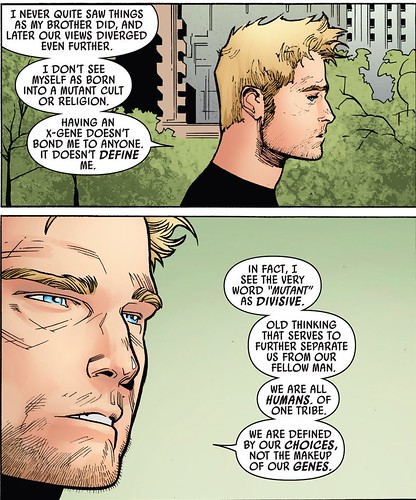
So, I was a bit disturbed when I saw this scene in an issue of Uncanny Avengers. The character speaking in the panels below is Havok, one of the X-Men. He's never been a particularly vocal advocate for mutant rights - he was briefly involved with a mutant terrorist group, but that was revealed to be an undercover job - but that's probably beside the point. Here's the leader of the Avengers' Unity team - a joint X-Men/Avengers effort to improve the standing of the mutant community - effectively telling everyone that he advocates a post-mutant (or, I guess, mutation-blind) society. And it left me cold:


In a subsequent panel, a reporter asks Havok what they should call him if not "mutant". He replies "Alex."

Now, the problem is not that Havok's speech is unrealistic or unconvincing. Havok has never shown himself to be the most dedicated X-Man - he's quit a couple of times, and for the first couple decades of the comic he preferred to be completely uninvolved in mutant politics or superheroics - and it might be compelling to situate him as a conservative voice for a post-mutant America. The rhetoric is certainly familiar: he doesn't want people to see his powers, just as the post-race bunch pretend that they don't see race; he sees himself as the product of his choices, ignoring the systemic realities that restrict those choices, just as many conservatives do.

It might not be an ideology that I value, but it could make for a compelling read. How would mutants with a more progressive take on human-mutant politics react to the choice of Havok for such a prominent role? Would they perceive some agenda on the part of Captain America, who selected him? And what kind of mutant politics erases the "mutant" from its own politics? I imagine that Havok would face a lot of the same criticisms that were lobbed at Condoleeza Rice or Colin Powell when the post-race Bush Administration came to power.

Alas, Marvel and writer Rick Remender weren't planning on taking it in that direction. For them, Havok's rhetoric was not political or even controversial. Funny, the sorts of nonsense you can sell yourself when you're able to write about - and enjoy - oppression from a position of privilege.

Mind you, this isn't new. Marvel has always used the X-Men to encourage people of privilege to experience - and derive some enjoyment from - oppression at a distance, vicariously. But I've never seen them do this, at least not so explicitly. Marvel is using the X-Men to violently undermine the relevance and reality of identity politics, to reduce social categories, from which people derive their sense of self and worth, to dirty words and systems of social inequality to "choices".

That kind of thing is going to make people angry, especially the fans who have been told that the X-Men are a minority like they are. As Ladies Making Comics so aptly put it on Twitter, "Telling people whose rights have been trampled for decades 'But we're all people! Let's get along!': guaranteed to piss them off." Yep, them and everyone else who gets it.

But, wait! said Marvel and Remender. That's not happening at all, because the X-Men aren't actually a metaphor. They're just a fictional category of superheroes, and YOU are reading too much into it. Cue Remender's response to Ladies Making Comics: "Mutants come from all races and sexual orientation. It's not an apt analogy you're making." And fellow X-Men writer Jason Aaron: "It's not the story of what it means to be black or gay in today's society."

In a sense, Aaron is right - the X-Men don't tell us what it's like to black or gay, because the people writing the X-Men are almost always straight white guys who can only guess. But that doesn't mean that they don't pretend that they can. To claim otherwise, as Remender and Aaron (and I can only guess who else) do, is disingenuous, if not dishonest. (Indeed, Racialicious has a huge piece on this story, which includes other writers - and Remender himself - contradicting these comments from Remender and Aaron. You should probably read it.)

But don't take my word for it:
  • "What's fascinating about these two characters [Magneto and Professor X] is that they're really the Malcolm X and Martin Luther King of comic mythology." -Bryan Singer, director of X-Men, X2, and X-Men: Days of Future Past
  • “I know, speaking to Marvel Comics, that it’s not just gay people who identify with mutants – it’s other minorities, too, religious minorities, racial minorities” -Ian McKellan, Magneto in the X-Men films
  • "Every time I would hear one of these ideas, I would always ask myself, 'What's the point of being so specific? A gay mutant? An African American mutant? An HIV-positive mutant? Oxymorons, all of them.' To my mind, mutants are all those thing simultaneously. They're every oppressed minority and disenfranchised subculture, all rolled up into one metaphor." -Joe Casey, former Uncanny X-Men writer

When people are gushing about the property and it's inclusivity, they're quick on the draw to brag about how the comic was always meant to accommodate all these identifications and readings. It speaks to the real world, it allegorizes real people and situations.

But when people start to critique it? When they begin to disagree with the message that Marvel is selling, that it's effectively putting into the mouths of disempowered peoples? Then, the creators deny that it was ever supposed to reflect reality, that it was ever intended to be more than escapist fantasy.

And that's probably the most infuriating part of this whole thing. It's not that they simply deny responsibility for or awareness of the metaphorical reading that everyone is familiar with, it's that they forsake it in one breath but accept any and all kudos in the next. Marvel wants to have it both ways, and they shouldn't get away with it. But they do.

Sunday, July 22, 2012

More backlash politics: fanboys and the "triumph" of Superheroes

I can't believe I missed the whole backlash against AO Scott in The New York Times, because he deigned to criticize The Avengers film, but it seems additionally relevant now - because of the controversy with hardcore gamers that I wrote about last week, but probably also because of what happened in Colorado.

Hawkeye, Captain American, and the Black Widow in Joss Whedon's Avengers.
Zade Rosenthal/Walt Disney Pictures.

Actually, Scott's snarky review was probably meaner to the film's fans that it was to the movie itself. Writes Scott,

this movie revels in the individuality of its mighty, mythical characters, pinpointing insecurities that are amplified by superhuman power and catching sparks that fly when big, rough-edged egos (and alter egos) collide. The best scenes are not the overblown, skull-assaulting action sequences — which add remarkably little that will be fresh or surprising to devotees of the Transformers franchise — but the moments in between, when the assembled heroes have the opportunity to brag, banter, flirt and bicker. 

So, there is a not-flattering comparison to Transformers, though this isn't as nasty as it might first seem - if Transformers did anything competently, if not creatively, it was show things exploding. But there is a certain nastiness in the review, and it's aimed squarely at the fans. For instance:

the true guiding spirit of their movie is Loki, who promises to set the human race free from freedom and who can be counted on for a big show wherever he goes. In Germany he compels a crowd to kneel before him in mute, terrified awe, and “The Avengers,” which recently opened there to huge box office returns, expects a similarly submissive audience here at home. The price of entertainment is obedience.

Yikes. It's not terribly surprising, then, that Scott was flamed over Twitter by fanboys with demands that he be fired. (Having not read them, I can't be certain whether these were people who were responding to ostensible insult of the film or the more real insult to themselves. If it's the former, that's an unfortunate irony, because it proves that Scott's joke, above, isn't just a joke.)

Anyway, I bring this up now, and call it newly relevant, because the insecurity that those fans appear to be speaking from is a lot like the insecurity of hardcore gamers. There's a reason, after all, that fans of Marvel comics, in particular, are called Marvel Zombies. (I doubt that Scott knew this. And, yet, he clearly knew it.)

Painting for the Marvel Zombies comic book, by Arthur Suydam.
Yes, the title is a joke. But everyone loves zombies, so it's win-win.

In the blog about hardcore gamers, I wrote that

every man is made to feel like they're lacking in some way. But not every man is conscious of that lack. Geeks aren't only conscious of it, but they're often reminded of it. And this is a problem for them because [the game] may be the only access that they have to a sense of masculine adequacy. To take that away, then, is to threaten their very sense of themselves as men.

To attack the Avengers film or Avengers fanboys, then, produces a similar effect. But it is also similarly problematic. Because, like most hardcore gamers, fanboys tend to be straight, middle-class white men who enjoy an incredible amount of privilege.

There's an additional layer to the comic book issue, though, one that was recently raised by Freddie deBoer. To pick from the very first line in deBoer's blog, over the past decade fanboys have learned that "our particular geeky obsessions no longer seemed special. Everyone knew about them." That's still not entirely true of gamer culture, I think. I'd wager that few people outside of the gaming community would recognize the N7 insignia that Commander Shepard wears if you slapped it on your coat (in fact, I'm not sure that they would know it has any significance at all); I'm fairly certain that a large minority or small majority of people under 40 would be familiar with Captain American's shield or the X-Men's X.


Because I'm filling this blog with quotes, I'll add another one, this time from Andrew O'Heir at Salon:

at what point is the triumph of comic-book culture sufficient? Those one-time comic-book pariahs are now the dominant force in pop-culture entertainment, and their works are deemed to be not just big but also relevant and important.

The hardcore gamers may feel as if they're under assault by hostile forces, but they remain the gatekeepers of their own online kingdom and firmly in control of their own culture. Not so, for the fanboys, who lost whatever control they once had (if they ever had it) long ago to interests in Hollywood and boardrooms, filled with people who want to diversify and grow the audience, not cater to the base. It's like the fans of the Avengers used to speak a secret language that only they understood, and now everyone and their dad uses it in casual conversation. You might call it "triumph"; one could also plausibly call it "devastating".

O'Heir concludes with the remark that "I think these fans are looking to the stars, for some sort of recognition or respect that simply doesn’t exist, for any of us." But I think that the critical misunderstanding is this - these fans aren't happy with success because they were never looking for and never wanted success. (Kurt Cobain, anyone?) They're defined by the things they appreciate that others never will, and so, in a sense, they're looking for a new defeat to rally around. (As evinced by the response to Scott.) Triumph will never be sufficient, and will never be particularly desirable, because it's difficult to feel special - and it's always been about feeling special, unique, and even superior - when everyone else loves and appreciates the same thing that you do.

Sunday, September 27, 2009

The X-Men and identity politics #3: Jason Powell and the limits of mutant activism

Over on Geoff's blog, Jason Powell has been doing an amazing job of critiquing every issue in Chris Claremont's run on Uncanny X-Men. He's also caused me to reassess some of the things that I wrote in the paper that I have linked in the sidebar - to acknowledge some material that I had either ignored or forgotten. So this is write-up is something of a corrective post-script.

Jason has just wrapped up his analysis of UXM #235-8, a storyline set in the mutant-enslaving African nation of Genosha (not so subtly modeled on South Africa's apartheid state). This is not the same team of apologist and acculturationist X-Men from the Lee/Kirby or Claremont/Byrne days that I complained about. As Jason notes, this is a team that doesn't find a world order that's worth protecting and decides to attack it instead: "Wolverine’s oath to tear down an entire nation built on racism feels utterly right for an X-Men story. As if this is the kind of thing they should have been doing from Day One."

Jason's probably right, though I have to give him additional credit for having revealed both how gradual and convincing the slow transformation of the X-Men - on the level of individual character, Storm and Wolverine, but also the composition of the team itself - from an anti-mutant police force to a pro-mutant terrorist cell is achieved. And there's no denying that the team that tries to destory Genosha is composed of terrorists - sympathetic ones that should encourage us to avoid reductive explanations of terrorism, but terrorists nonetheless. Jason remarks that one of the issues - and I think this comment is applicable to the storyline as a whole - is "the apex of Claremont’s creativity and expression on the Uncanny X-Men series". It's also, sadly, an indication of the concept's limits.

The storyline completes the reversal that began with the old Brotherhood of Evil Mutants becoming the government-sanctioned super-team Freedom Force - the X-Men have, effectively, become the new Brotherhood. That Claremont could pull this off speaks volumes to his skill in building the transformation up slowly and carefully over a period of years, but it's telling that he blows the team up over the next 12 months. You can turn the X-Men into terrorists, but you can't then write an ongoing book about terrorist "heroes" who punish governments for human rights abuses. (At least, not until Warren Ellis and Mark Millar did so with The Authority, which feels as if it owes something to this version of Claremont's X-Men.)

Nor could Claremont, after writing such a convincing and inspiring change of direction, take a step-backward and return to superheroics-as-usual. And so, after the Inferno crossover that has nothing to do with politics and a couple of stand-alone issues, Nimrod reappears to kill Rogue, Wolverine and Longshot leave, Storm is thought dead, and the other four X-Men sacrifice themselves to escape certain death. And then Claremont builds the concept back up from the ground, (and, in so doing, creates something quite unlike what we've seen before) reunites and returns the group to face a different kind of Genoshan threat, and is summarily removed from the book.

But for those few months...

Sunday, February 15, 2009

The X-Men and identity politics #2: Xavier's man Friday

[An exchange on Geoff's blog a couple weeks back with someone who didn't like my X-Men paper had me thinking that I need to start writing about mutants and race (and, obliquely, all aspects of identarian politics) again. For those few people familiar with the old paper, some of this will seem like a retread. But since that paper is long and, by virtue of being written with an academic audience in mind, not accessible enough. Which was one of the reasons I started this series in the first place.]

A paraphrased defense of the X-Men's politics: 'Focusing on fighting other mutants does not make the X-Men anti-mutant, assimilationist, or conservative. Those mutants are evil and would make relations with humans worse, and it's that working relationship which they're trying to build and preserve.'

My short response to this is an unequivocal 'sorry, but I don't buy it'.

The sort of assimilationist practices (and their rationalizations and justifications) that the X-Men engage in are at least as old as the novel format itself, so maybe it would help to historize them. Remember Friday, the slave-turned-servant to Crusoe in Defoe's Robinson Crusoe? Friday is the model non-white citizen of European colonialism - a savage who is so grateful that the white man has undertaken the burden of educating and saving him that he devotes his life to serving that same white man. Quite the opposite of encouraging us to embrace difference or form equitable relationships premised on mutual enrichment and growth, Defoe's story proposes an entirely unilateral transmission and unidirectional relationship. Friday is only worthy of notice because he recognizes his master's superiority and assumes an entirely deferential position relative to him. To do otherwise - to challenge Crusoe's authority or assert an equal standing - would be to threaten the natural order of the world and situate yourself as an enemy to it.

Appropriately, one of the tag-lines for the 2000 X-Men movie was "Trust a few. Fear the rest." And, sadly, the X-Men have participated in a similar politics for much of their publication. Like Defoe, the X-Men's publishers would have us believe that the only mutants who deserve to live in peace with normal humans are those mutants who would unquestioningly protect all of humanity. Yes, even those who would rather see all mutants jailed or dead are more deserving of the X-Men's protection than are the mutants who fight back because they don't want to be jailed or dead. These mutants who reject their oppression and the moral authority of those who oppress them are, at best, ignorant to the natural order and, at worst, evil. Like the hyperbolic island cannibals whose only function is to supply a contrast as the evil Other to Friday's good one, these evil mutants are often made to seem insane or power-hungry, and so undermine the standing of any mutant who objects to the X-Men's approach. Even when an 'evil' mutant, like Magneto, poses legitimate ethical and political concerns, those same concerns are undercut by unnecessary displays of violence and mutant supremacist language - as if these things are ultimately inseperable.

Bryan Singer, echoing the common refrain, suggested that Professor X is a Martin Luther King figure and Magneto was Malcom X. But if it weren't already clear, then I'll make it explicit: if the X-Men comics are meant to be read as any sort of metaphor on the politics of race, then we have to consider that Professor X is actually Crusoe's man Friday.

Friday, January 25, 2008

The X-Men and identity politics, pt. 1

In response to a complaint at the X-Universe Message Board that there are hardly any gay mutants - despite the fact that the mutants in the X-Men's universe are popularly understood as analogous to queer or racially Othered youth - a poster named Tiger Shark wrote the following: "the X-men is already a metephor for minorties everywhere and of all kinds, so there's no need to trot out a 'gay' X-Man just to fill a quota".

There's something immediately appealing about this logic, though I'd suggest that it ultimately fails. It's appealing, I think, because claims to X-Men's metaphoricity are incredibly seductive. Under the logic of metaphor, an implicit comparison allows for the attributes of a to be read on to b. So X-Men is not just a superhero comic - depending on who you talk to, it's also about race relations and civil rights, homosexuality and homophobia, 'the red scare', Jewish-American assimilation, and/or teen alienation.

That said, a metaphorical relation implies equivalence, and some of these metaphors are more equal than others: given the overwhelming normativity - the characters are almost universally whiten, malen, able-bodied, middle-to-upper-class, and heterosexual - of the X-Men, the race and sexuality readings can be contradicted and deconstructed without much effort.

The same poster later accused me of "being too literal" and "lost in minutiae", though these sound like reasonable demands to place on language. We should be skeptical of a comic book that, literally, presents us with dozens of heterosexual characters but asks us to understand (misrecognize?) them figuratively as non-heterosexual. A certain degree of dissimilarity is expected in a metaphor, but this isn't just minutiae that I'm getting stuck on - it's a fairly evident contradiction that's embodied in nearly every X-character.

[This was all inspired by a specific textual incident, but I'll get to that in the next installment. My apologies if you've read my 'Mutant Readers, Reading Mutants' paper, which I posted here, and this sounds redundant. But most people don't want to bother with a 20 page document, and it feels helpful and necessary for me to rewrite some of those arguments in a more concise manner and with some tweaking and more contemporary examples.]