Showing posts with label films. Show all posts

Saturday, May 10, 2014

Amazing Spider-Man 2: Yes, You Can Reasonably Make an Electric Boogaloo Joke


But TL;DR? ASM2 wasn't very good. Looked pretty, though.


And that Andrew Garfield and Emma Stone are so good on screen together? They should hook up in real life, or something. And that's all the good, right there.


Seriously, this is an unerringly dank and depressingly film. And in the moments where it's not? It's just wrong. Having Peter bound up to the stage, with all this attitude and swagger, and then kiss Gwen in front of everyone? You can call that guy Peter Parker, but that's not Peter Parker.


I mean, it's also about responsibility and doing the right thing because you're screwed either way. Or, at least, that's what it's about when Peter Parker is recognizably Peter Parker. Which he wasn't. So it really wasn't about those things. It was about "hope". Except, like I said in that tweet, it wasn't really about that, either. Even though it claimed to be.


Arrgh. Sooooo miserable. Who did they make this for? People who thought that The Dark Knight was too much fun? Who wished that Spider-Man's battles should probably be as needlessly destructive as Superman's in Man of Steel?


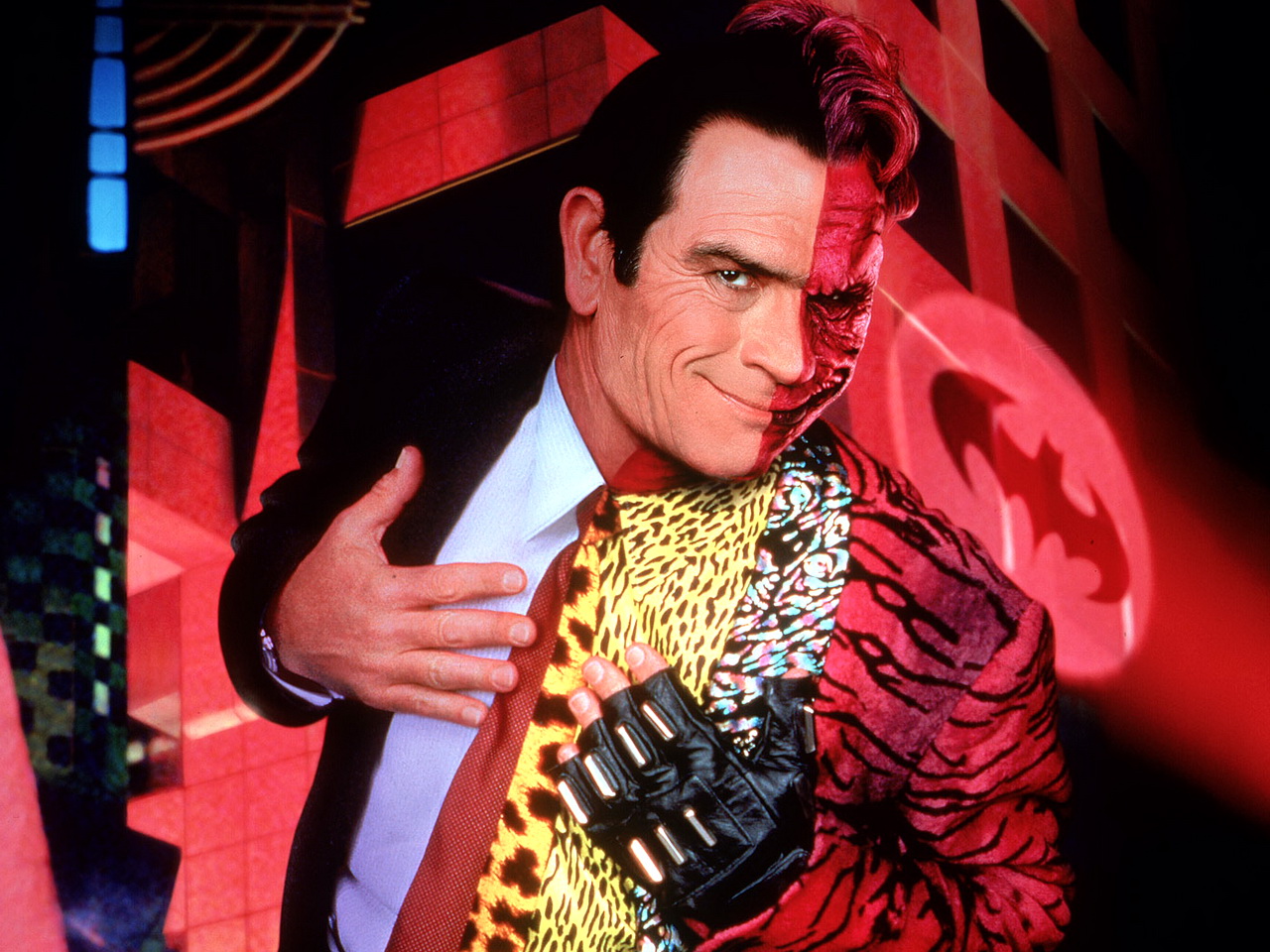
Electro is up there with Tommy Lee Jones as Two-Face for Absolute Worst Super-Villain in a Film. Remember this?:


Electro is a clownish, unbelievable character (is he some kind of thinly veiled shot at Spider-man fanboys? could it actually be any more mean-spirited?) with an equally unlikely transformation into Spider-man's biggest enemy.

And Harry? The less said, the better. There's just nothing there. He gets an intro, a meeting, a conversation with Peter, a conversation with Spider-man, and then he turns evil. And that sounds like a lot, but it's pretty much 5 minutes in total. And do we even have the chance to care? No, no we don't. Because the Peter and Harry relationship is built on their memories of stuff that we never saw and comes as a complete surprise. But we're still supposed to feel something when Peter refuses to help him and Harry gets really, really, unreasonably angry?


Who's the real star of this franchise? Sally Field. I mean, Garfield and Stone are good when they're given very little to work with - the story is awful, and Peter is just awful, so it works best when they aren't trying to advance the story - but Sally Field is great and Aunt May is great.


Sigh.

Wednesday, July 31, 2013

Andrew Garfield on Spider-man, me on Garfield's portrayal of Spider-man

This is what Andrew Garfield recently said about Spider-man and how he needs to be updated in order to remain relevant. Good points, all of them:
"...what I believe about Spider-Man is that he does stand for everybody: black, white, Chinese, Malaysian, gay, straight, lesbian, bisexual, transgender. He will put himself in harm’s way for anyone. He is colorblind. He’s blind to sexual orientation, and that is what he has always represented to me. He represents the everyman, but he represents the underdog and those marginalized who come up against great prejudice which I, as a middle-class straight, white man, don’t really understand so much. And when Stan Lee first wrote and created this character, the outcast was the computer nerd, was the science nerd, was the guy that couldn’t get the girl. Those guys now run the world. So how much of an outcast is that version of Peter Parker anymore? That’s my question."
 
If you've read my blog at any length, you'll know that I'm in complete agreement with a lot of this. The superhero-as-outsider metaphor has always been a bit of a stretch, given that most of the heroes are themselves white men, and that the outsider who identifies with Spider-man or the X-Men is often still white, male, middle-class. But it's become additionally problematic recently, what with the mainstreaming of super-hero culture and the generally increasing economic and political clout of geeks.


In short, Spider-man's ability to represent the underdog or the marginalized, while always a bit suspect, has become pretty much an impossibility.

The irony in these comments, of course, is that Garfield's Spider-man is probably cooler and less marginalized than any other version we've seen in the comics or movies. This is a Spider-man who skateboards, who is snarky rather than awkward, and who just oozes hipster cool. If he's an outsider, it seems like he's an outsider by choice. So even if Garfield's words ring true, his performance seems to be moving in the total opposite direction.

Wednesday, July 10, 2013

Star Trek, old and new

I saw Into Darkness a few weeks ago and just never got around to writing about it. Just before, I re-watched Wrath of Khan. Just after, I watched First Contact. So, having finally found the time to write something, I want to write about it it relation to the second iteration of each of the other two Star Trek movie franchises.

I liked Into Darkness, and I liked it for largely the same reason that I liked Abrams' first Star Trek: it was a really good Star Wars movie. Lots of stuff blew up, it was really exciting, and Cumberbatch's voice boomed with deep, sexy authority. I left wanting to jump from flying car to flying car like some genetically-modified superman. And that's just about all the response that it inspired.

This is actually from Star Trek: Insurrection, but I thought it looked hilarious.

Now, you might be thinking that my Wars/Trek distinction is splitting-hairs. And, sure, there's a lot of overlap between the franchises, especially the pre-1987 versions of each that seem to be the most resonant versions. Both imagine outer space as a basically lawless Wild West frontier, and imagine that cowboys and Zen masters are probably the archetypes best-suited to wrangle it.

But there's still a difference, and I'll go to Star Trek itself to help put a name to it. When, in The Next Generation, Jean Luc Picard locates an AWOL Ambassador Spock behind enemy lines, he refers to his actions (and, implicitly, that of the original Star Trek crew) as "cowboy diplomacy [that] will not easily be tolerated anymore". In Star Wars, cowboy stuff is the subject of the series - though, admittedly, it does cowboy stuff really well. But in the original Star Trek (TOS), "cowboy" is just an adjective, dressing for the deeper political and philosophical questions that it's trying to raise. It often asked the wrong questions or raised them in cheesy ways, sure, but the cowboy stuff was largely a vehicle to sell that higher purpose.

Anyway, and TL;DR: Star Trek Into Darkness is not really a Star Trek movie.

And not only is it not a Star Trek movie, but, contrary to the buzz on the internets, it's not even the best Khan movie. And among the Into Darkness, Wrath of Khan, and First Contact trifecta of Star Trek sequels, it's not even the second-best of the bunch.

In no particular order, then, here are the things about Into Darkness that give me pause. I'll elaborate more afterward.
  1. Like Wrath of Khan, it tries to build its emotional center on the Kirk-Spock friendship. It doesn't work.
  2. There's paying homage, and then there's just straight-up repetition...
  3. ...and when it does something that a previous Trek also did, it does it worse.
  4. When it acknowledges the post-TOS franchises, it misunderstands and mangles them.
  5. When it tries to show us growth and change, it fails.
  6. Khan is white.  Khan should not be white.

*     *     *

1. "You are my friend"

Kirk and Spock weren't friends in the first film. They don't seem to particularly like one another in this one, either. And where the friendship is forced to work... well, it's forced and doesn't work.

Take the scene where Spock looks shocked that Kirk has requested that the former be re-assigned as first officer under the latter. He should be. The movie has given us absolutely no reason to think Kirk should trust Spock, much less like him. The motivating force for their friendship seems to be destiny - they should be good friends because they were best friends in the original series, and Kirk knows this. That's weak. The movie wants that emotional pay-off when Kirk dies, but it hasn't done the work and doesn't earn the right.

2. Homage/repetition

I've been involved in a lot of arguments about the usefulness of homage and repetition in serial storytelling. I don't think I'm alone in suggesting that there's something lazy about reboots, though that doesn't necessarily mean that they're boring. The same rule applies to remakes, though I think these edge closer to being boring by default and need to work hard to prove they're not a waste of time. Because I think that either - the reboot or the remake - can be perfectly enjoyable things. They can be fun, even if they don't cover any new ground and, so, aren't anything more than that. But fun could be enough.


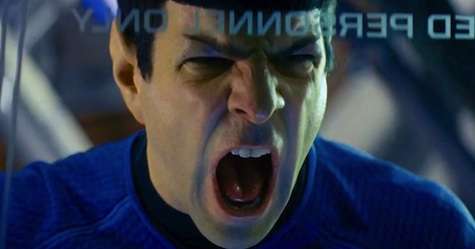
But while Star Trek seemed to pay homage, to wink at the old stuff, while establishing some new story, this film simply repeats a lot of their plot points. The most egregious moment is probably the reversed death scene, where Kirk fixes the warp engine and dies of radiation poisoning while Spock watches, and Spock gets to yell the "KHAAAAAAAN!" line. It a do-over, really, but with the roles reversed, and it doesn't add to or improve the original scene.


3. The same, but worse

In fact, I'd argue that the new radiation death scene is the weaker version. There are a couple of reasons I'm claiming this, so I'll do a simple bullet-list:
  •  In Khan, the death scene follows Khan's defeat. It is the sole occupant of our attention, and its placement in the story is a textbook demonstration of how you tell the story of a pyrrhic victory - the dizzying high, the devastating low. But Kirk's "death" in Into Darkness lacks the emotional weight because we know he isn't actually dead. It also has to be timed to happen before Khan's defeat, so we can't even linger on the moment.
  • In Khan, Spock calmly enters a clean, white, and eerily 2001-esque engine core room and seals himself behind a glass door while the engineering team watches in horror. It's a slow, banal exercise that grows slower and visibly painful as he starts to die. And it's almost totally silent. By comparison, Into Darkness's version shows that less is, indeed, more. The engine room is hilariously monstrous and inaccessible, and Kirk's attempts to climb the tubes/pipes to reach the engine is the real source of drama, here. Kirk's subsequent efforts to re-align the engine by hurling himself against it thusly becomes an apt metaphor for what his movie is trying to do with the source material - hit it really hard and hope everything falls into place.

4. Misreading and mangling

I'll keep this one short. I though it was really cool when the Admiral made a reference to Section 31, the cloak-and-dagger department we were introduced to in Deep Space Nine. Existing outside the official command structure of Starfleet, 31 was so secret that only top-level admirals seemed to know that it was a real thing - and even Admiral Ross would only confirm this when it was a) absolutely clear that Captain Sisko knew 31 was real, b) he had no choice.

Anyway, the novelty of the reference is lost almost immediately, when you realize that Admiral Marcus a) shouldn't know why 31 was using Khan, b) shouldn't be involved in the command structure of 31, c) 31, itself, shouldn't have a command structure, and d) he sure as hell wouldn't be talking about any of this with Kirk.

So, basically, they wanted to drop the name that would earn them cred with the hardcore fans, but without actually making any effort to represent the organization accurately. Super. And par for the course, really.

5. When character growth isn't actually character growth

I'm losing patience as I write, so I'll try to be even shorter. In the supposed climax, where Spock should be demonstrating what he's learned in order to out-fox Khan, the screenwriters take the easy way out instead. He just asks Old Spock what he should do. And then, presumably, does it. Weak.

6. White Khan

I'm not the first to say this, but I'll say it anyway. Khan isn't white, he shouldn't be white, and this constitutes an epic failure on the part of the people who wrote, cast, and produced the film.  (It's telling that no one seemed to think it mattered until the casting decision started to get criticized. Star Trek, it seems, engenders post-racial delusions in the mind of people who don't experience racism.)


Ricardo Montalban played the original Khan. Montalban, it should be said, was a white Mexican - though he passes convincingly as a person of color, so much so that John Cho (Sulu) referred to him as such - and his Khan was styled so as to appear at least somewhat Aboriginal. But we're also told that he was a benevolent dictator who conquered Asia and the Middle East, so it may just be that the producers thought he was close enough to South Asian to pass. (That is, they assumed that 'not white' was good enough.)

Also, his name is Khan Singh. Let's not pretend otherwise: the dude was obviously supposed to be Indian. And for this film, they cast a white, blue-eyed, English guy. And never bothered to explain why. Um, no.


*     *     *

I just realized that I promised a discussion of First Contact - because I claimed it was a better Star Trek film - and that never happened. Next time...

Friday, March 01, 2013

Why Seth McFarlane wasn't funny and why the Onion was

Given that the turnaround for commentary on award shows is now, like, 12 hours, this is at least several days late. So, I apologize for my tardiness.


1. The Seth MacFarlane controversy

Seth MacFarlane was pretty awful, but I don't really have to tell you that. Instead, I can point you in the direction of a few links: you can find a list of sexist jokes here, a description of the sexism fatigue that sets in when one finds him/herself constantly fighting against defenses of sexism, and another perspective that didn't think the jokes were particularly bad but found MacFarlane's reduction of Halle Berry to merely a "beautiful woman" insulting. What emerges, even though many of the articles disagree over the specifics, is a general agreement about the "banality of sexism".

Because the problem isn't any one individual joke or comment that came from MacFarlane, which, in their isolation, might very well have seemed funny. The problem was 1) an unceasing barrage of mean-spirited jokes about women and 2) the relative absence of gendered jokes at the expense of men. And what that contributes to is a feeling that this kind of differential is simply normal. And if it seems like it's not a big deal, that's only because we're numb to what the jokes and comments actually mean. To wit, if we don't think it's problematic to describe Halle Berry only in terms of her beauty, rather than her talent, that's because we're entirely too accustomed to valuing women for their beauty, and only their beauty. It might be a compliment, but it's effectively a back-handed one.


2. The Onion controversy

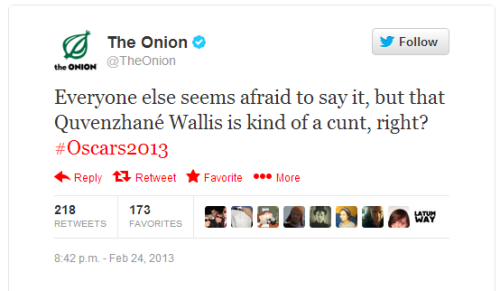
This got less attention. The Onion was live-tweeting the Oscars, and this was one of those tweets:


Quvenzhané Wallis, if you didn't follow the show or watch Beasts of the Southern Wild, is a 9 year-old, and the reaction to the joke was so very swift and very negative that the Onion quickly pulled the tweet and apologized.

The thing is... I actually think this joke is hilarious. For one, the Onion isn't Seth MacFarlane - who made his own joke about Wallis, a worse one, that implied she was nearly old enough for George Clooney to date - and they have substantially more cred when it comes to gender-based humor. For another, the joke is both good satire (this is exactly the kind of crap that tabloids actually write...) and hilariously absurd (...but it's also the basest, most extreme version of that same tabloid crap). The joke works because no one would say that this 9 year-old girl is a "cunt".

And the joke also works because it isn't actually about Wallis - it's actually about the vacuity and mean-spiritedness of entertainment journalism and, more generally, the sort of people who thoughtlessly slap these sorts of misogynist labels on all women. This is also why MacFarlane's jokes are bad - he finds humor in victimization and oppression (see: his Rhianna and Chris Brown joke) rather than poking fun at the oppressors. (Admittedly, this is where the Wallis joke is shakiest. It could be read as making fun of her, certainly. But the best jokes also have to walk that sort of delicate line.)

And, as such, it actually does a pretty effective job of peeling back that layer of banality that insulates discourses of sexism. This might very well be something that no one would say, but it sounds suspiciously similar to things that people say all the time.

Now, admittedly, this is a pretty meta-level justification. And if people find this distasteful and unacceptable, I get it. But that's also kinda the point. Good satire scores political points by way of establishing its similarity to something real that's different in degree, not type. So, if you can't buy into the sexism of this joke, you shouldn't buy into the sexism that underlies those other jokes. That is, you should be able to see that the problem isn't how the Onion called this 9 year-old a "cunt" - the problem is that we think it's cool to call anyone a "cunt". Or sing about their boobs. Or how they had to develop eating disorders in order to fit into their dresses.

Wednesday, October 31, 2012

George Lucas and the feeling that something's been left unsaid


So, George Lucas is selling Lucasfilm to Disney for $4 billion. That's interesting, sure, but not nearly as interesting as the oddly evasive response that he gave when, in a video (the one above) titled "The Future of Star Wars Movies" on the Star Wars Youtube channel, he was prompted by an interviewer to talk about the "big news" concerning Star War:

"Um, I always said I wasn't going to do any more, and that's true, I'm not going to do any more. But that doesn't mean I'm unwilling to turn it over to Kathy [Kathleen Kennedy, co-chair of Lucasfilm] to do more. I have story treatments of 7, 8, and 9, and a bunch of other movies. And obviously there are hundreds of books and comics, and everything you possibly imagine. So, you know, I sort of move that treasure trove of stories and various things to Kathy and I have complete confidence that she's gonna take them and make great movies."

Unfortunately, there's no actual news there. No announcement of any kind, except that there are lots of Star Wars stories and someone else is now responsible for them. We already knew that part. (So, immediately thereafter, Kathleen Kennedy jumps in to provide the "big news" announcement that Lucas so totally botched.)

But you know what's really fucking weird about that whole response? Not once does he say "Star Wars". And that's not an easy thing to do, when he's been primed to talk about Star Wars, he's been asked to talk about a new Star Wars film, and he is, in fact, quite clearly talking about Star Wars. And, yet, he can't bring himself to actually name the baby that he put up for sale. It's evasive in the most Freudian way - he can't name it, for fear that in naming what he's done it'll become real. I may be reading too much into it, (when is that not possible?) but I think there's something deeply revealing about that. And sad.

It doesn't help that Lucas looks, at best, uncomfortable through the whole thing. And, at worst, he looks absolutely miserable. He cracks a joke - which Kennedy totally oversells, thus making it even more uncomfortable - but he doesn't smile throughout the whole video.

It's really unsettling. And maybe it's just that Lucas is feeling seller's remorse, but it also seems like there's something more to this story than a mere passing of the torch.

Thursday, August 16, 2012

Movies I've watched in the last month: Chronicle, Ted, Amazing Spider-man, Moonrise Kingdom


When I finished watching Chronicle on a flight to Newfoundland, I was seriously wondering whether it was the best superhero movie I've ever seen. (In retrospect, I was just really surprised by how good it was and this probably isn't true. Also, it's not quite the compliment that it sounds like, because I'm a grumpy old man when it comes to superhero movies.) A massive amount of credit for its quality has to go to Dane DeHaan, who played Andrew. In the hands of a worse actor, his character could have easily slipped into cliché and felt laughably pathetic. As it is, though, his transformation into a supervillain - especially since it's not initially clear whether his 'origin story' maps more easily on to that of a good guy or bad guy - is probably the most impressive and convincing in the short history of the film genre.


While Ted isn't technically a Frat Pack/Apatow Mafia movie, it feels an awful lot like one. The main character is a 30-something in arrested development, pot-head, dead-end job, hot girlfriend, fart jokes. With one important difference, mind you, as pointed out by my friend Noa: in the end, his girlfriend accepts that he'll never change and he isn't forced to grow up. There's an added wrinkle, of course - this isn't Seth Rogen or Steve Carrell, it's Mark Wahlberg, and every woman in the movie delivers at least one line about how he's really hot and charming. (As opposed to the usual protagonist in the man-child genre, who is average-looking, at best, out-of-shape, and funny in a self-deprecating or depressing way. If he's funny at all.) So, the lesson seems to be that you don't have to be the big wheel so long as you look like one. Okay, then.


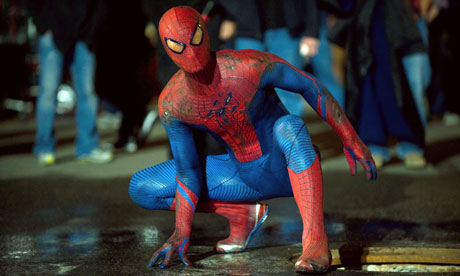
If I had never watched another superhero movie, or if The Amazing Spider-man had been released in 1999, I'm certain that I would have loved it and thought it was the greatest thing ever. As it is, I thought it was good. (Better than I expected. But I saw it a month after it was released, and I expected it to be terrible.) It also shamelessly borrows, steals, and simply rips-off every superhero movie that came before it - it feels more like a mash-up or a Greatest Hits compilation than a film in its own right. It looks like the director was trying to do a Dark Knight version of Spidey; the villain's masterplan is basically Magneto's from X-Men, and visually resembles Loki's from Avengers; the Lizard's face looks like Voldemort's, and he sounds like him, too, (Seriously: compare Rhys Ifans' "pEEtuh pAHkuh" to Ralph Fiennes' "hAIRee pAHtuh". Eerie.) and the way that Peter's origin has been tied to his parents also feels very Potter-ish. Also, James Garfield has Edward Cullen hair. I could also complain about the curious way that, aside from Gwen, the film is both patently unfunny and completely sidelines every female supporting character, including, unforgivably, Aunt May. But I'd rather say one nice thing: Andrew Garfield is a better Spider-man than Tobey Maguire.


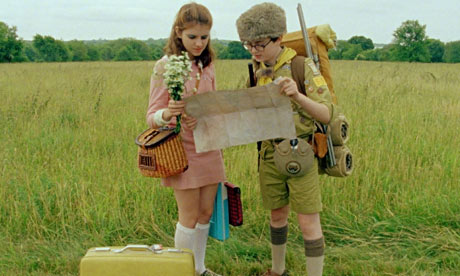
I recently applied for a job where I was asked to name my favorite movie. I never know how to answer this question - I don't have a "favorite" - so I went with The Royal Tenenbaums. But I think that Moonrise Kingdom might actually be Wes Anderson's best movie. Watching it, you get the feeling that Anderson actually gets what it's like to be 12. It is, strangely, his most serious film, but only because he takes the characters so seriously. So, while it might be absurd in places - each adult is reduced to a caricature (most notably, the character known only as Social Services) as they might be imagined by a 12 year old - it's a very respectful kind of absurdity. There's one particularly memorable moment for me, when an enraged Bill Murray effortlessly tears away the tent that the two 12 year olds are cowering inside of. None of them say anything, but Murray stands there silently for just a moment, as if realizing that his reaction was needlessly destructive and totally ridiculous. But he doesn't admit it, and it lasts only for that moment, because grown-ups are like that.

Sunday, July 22, 2012

More backlash politics: fanboys and the "triumph" of Superheroes

I can't believe I missed the whole backlash against AO Scott in The New York Times, because he deigned to criticize The Avengers film, but it seems additionally relevant now - because of the controversy with hardcore gamers that I wrote about last week, but probably also because of what happened in Colorado.

Hawkeye, Captain American, and the Black Widow in Joss Whedon's Avengers.
Zade Rosenthal/Walt Disney Pictures.

Actually, Scott's snarky review was probably meaner to the film's fans that it was to the movie itself. Writes Scott,

this movie revels in the individuality of its mighty, mythical characters, pinpointing insecurities that are amplified by superhuman power and catching sparks that fly when big, rough-edged egos (and alter egos) collide. The best scenes are not the overblown, skull-assaulting action sequences — which add remarkably little that will be fresh or surprising to devotees of the Transformers franchise — but the moments in between, when the assembled heroes have the opportunity to brag, banter, flirt and bicker. 

So, there is a not-flattering comparison to Transformers, though this isn't as nasty as it might first seem - if Transformers did anything competently, if not creatively, it was show things exploding. But there is a certain nastiness in the review, and it's aimed squarely at the fans. For instance:

the true guiding spirit of their movie is Loki, who promises to set the human race free from freedom and who can be counted on for a big show wherever he goes. In Germany he compels a crowd to kneel before him in mute, terrified awe, and “The Avengers,” which recently opened there to huge box office returns, expects a similarly submissive audience here at home. The price of entertainment is obedience.

Yikes. It's not terribly surprising, then, that Scott was flamed over Twitter by fanboys with demands that he be fired. (Having not read them, I can't be certain whether these were people who were responding to ostensible insult of the film or the more real insult to themselves. If it's the former, that's an unfortunate irony, because it proves that Scott's joke, above, isn't just a joke.)

Anyway, I bring this up now, and call it newly relevant, because the insecurity that those fans appear to be speaking from is a lot like the insecurity of hardcore gamers. There's a reason, after all, that fans of Marvel comics, in particular, are called Marvel Zombies. (I doubt that Scott knew this. And, yet, he clearly knew it.)

Painting for the Marvel Zombies comic book, by Arthur Suydam.
Yes, the title is a joke. But everyone loves zombies, so it's win-win.

In the blog about hardcore gamers, I wrote that

every man is made to feel like they're lacking in some way. But not every man is conscious of that lack. Geeks aren't only conscious of it, but they're often reminded of it. And this is a problem for them because [the game] may be the only access that they have to a sense of masculine adequacy. To take that away, then, is to threaten their very sense of themselves as men.

To attack the Avengers film or Avengers fanboys, then, produces a similar effect. But it is also similarly problematic. Because, like most hardcore gamers, fanboys tend to be straight, middle-class white men who enjoy an incredible amount of privilege.

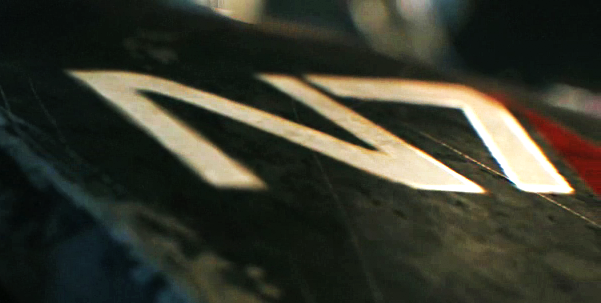
There's an additional layer to the comic book issue, though, one that was recently raised by Freddie deBoer. To pick from the very first line in deBoer's blog, over the past decade fanboys have learned that "our particular geeky obsessions no longer seemed special. Everyone knew about them." That's still not entirely true of gamer culture, I think. I'd wager that few people outside of the gaming community would recognize the N7 insignia that Commander Shepard wears if you slapped it on your coat (in fact, I'm not sure that they would know it has any significance at all); I'm fairly certain that a large minority or small majority of people under 40 would be familiar with Captain American's shield or the X-Men's X.


Because I'm filling this blog with quotes, I'll add another one, this time from Andrew O'Heir at Salon:

at what point is the triumph of comic-book culture sufficient? Those one-time comic-book pariahs are now the dominant force in pop-culture entertainment, and their works are deemed to be not just big but also relevant and important.

The hardcore gamers may feel as if they're under assault by hostile forces, but they remain the gatekeepers of their own online kingdom and firmly in control of their own culture. Not so, for the fanboys, who lost whatever control they once had (if they ever had it) long ago to interests in Hollywood and boardrooms, filled with people who want to diversify and grow the audience, not cater to the base. It's like the fans of the Avengers used to speak a secret language that only they understood, and now everyone and their dad uses it in casual conversation. You might call it "triumph"; one could also plausibly call it "devastating".

O'Heir concludes with the remark that "I think these fans are looking to the stars, for some sort of recognition or respect that simply doesn’t exist, for any of us." But I think that the critical misunderstanding is this - these fans aren't happy with success because they were never looking for and never wanted success. (Kurt Cobain, anyone?) They're defined by the things they appreciate that others never will, and so, in a sense, they're looking for a new defeat to rally around. (As evinced by the response to Scott.) Triumph will never be sufficient, and will never be particularly desirable, because it's difficult to feel special - and it's always been about feeling special, unique, and even superior - when everyone else loves and appreciates the same thing that you do.

Wednesday, June 27, 2012

Some quick hits...


The Cabin in the Woods
It's really kind of impossible to talk about The Cabin in the Woods without spoiling it. I mean, the film's opening scene can't even really be discussed without ruining some element of the surprise - I don't know how reviewers could even write about it. (Note: I'm not normally a person who cares about spoilers, really. If a story is well told, you can't actually "spoil" it. Except when it's kind of the point.) All I'll say is that it is so damned clever-clever, the film actually supplies an explanation for the very existence of the horror film genre. I've heard some disappointment that it's not particularly scary, but that's also not the point - it's smart, and it's unpredictable right until the very last shot.


Mad Men
I wrote elsewhere (or elsewhen, rather) that Mad Men started poorly this season before improving about a third of the way in - and it maintained that momentum right until the end of the season. In the same way that Weiner has typically ended each year, the season finale seemed to be deliberately anti-climactic - it was gently bringing the season's stories and tensions to a close and teasing at what was in store for the next one. And it was particularly ambiguous about what was going to happen with Don and Megan - the final scenes were playfully overdetermined with an absurd load of contradictory and polysemic dialogue and symbolism. No, there was no answer hidden in there - just such an embarrassment of sly, winking material that you could support any answer. And that kind of playfulness betrays an ambivalence and uncertainty, I think. Because I get the sense that Weiner and Co. themselves must not be terribly sure of how it will play out.


Ultimate Avengers, Books 1 to 3
When Mark Millar wrote the first two volumes of Ultimates, it was a pretty incredible ride. (He had difficulty closing - the resolution to Ultimates 2 was particularly weak - but there's a reason that the Avengers film borrowed so heavily from it.) Jeph Loeb's Ultimates 3, on the other hand, was a hideous mess - my hate for it is actually recorded in its Wikipedia entry. So, needless to say, I was excited to read what Millar had produced since returning. And what he produced was... um, underwhelming? Tedious? Just plain bad? The first volume seemed decent enough, until it collapsed into a total rehash of the Evil Doctor story that Millar wrote for The Authority, right down to a pop song being amplified and used as a weapon in both final battles. And it just got worse (and worse) with the subsequent books.


Game of Thrones, Season 2
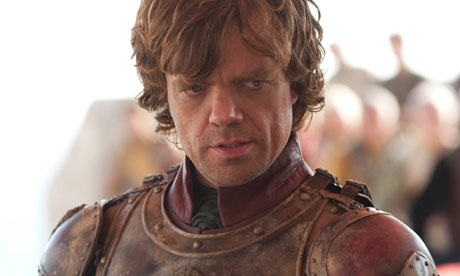
It's pretty awesome that the lead character is, inarguably, Peter Dinklage's Tyrion. And that the next most interesting character, and moral-center of the show since Ned was executed, is the tomboy, Arya. It's still a predictably and stereotypically racist and sexist world that the characters inhabit, but these two make it worth visiting.


Jem and the Holograms, Season 1
My 3 year-old daughter is suddenly really into Jem. (Probably because her mom said it was her favorite show as a little girl.) And the thing that confuses me most? (Yes, "most", because there are many things about the show that don't make sense. But anyway...) The Misfits nearly murder Jem and the Holograms in every episode - and, amazingly, there's usually some sort of proof, like video or eyewitnesses. But there are absolutely no repercussions, ever. They're never arrested, never made to pay for trying to kill people every week. There should be some sort of moral imperative to these cartoons, right? Some sense that bad guys get their comeuppance? Well, not on this show.

Saturday, May 12, 2012

White trash and the monstrous other

It's fashionable to say that fat and fat people constitute the last socially-acceptable category of open derision and discrimination. And it's not that I disagree with the spirit of the statement - certainly, overweight and obese people are mocked and discriminated against, both in media and interpersonally, with a sometimes almost sadistic enthusiasm. It's the "last" part that I disagree with.

Because it's still equally kosher to hate on people who would be considered, for lack of a more precise descriptor, trash. I know, "precise" sounds weird to say, doesn't it? Especially because "trash" sounds unnecessarily pejorative. I use "precise" because the trash label isn't strictly a class thing, as it might first seem - not all poor people are considered trash; not all people who are called trash are necessarily poor. It's also a cultural- and/or social-capital thing. (Calling someone "new money" is, after all, a bit like saying they're trash with cash.) And, I'd add, a race thing - because trash is so overdetermined, implicates so many different levels, to call someone trash is to put them on a level so far below the racial norm that they're basically occupying another category altogether.

But why am I saying this? Mostly, I'm saying it in response to the trailer for Chernobyl Diaries, the supernatural/radioactive-monster horror movie that's being released later this month.

Glad to see that the Scary Kid trope is still alive, too!

Now, I fully admit that I could be reading this particular film wrong. It might not be about evil mutated Ukrainian Euro-trash that not-so-subtly equates the class and culture of poor Eastern Europeans with being a homicidal monster (and I use "monster" both literally and figuratively). It might not be like The Crazies. Or The Hills Have Eyes. Or The Texas Chainsaw Massacre. And let's not even talk about the kinds of characters who pop up as sociopathic serial killers on Criminal Minds or the X-Files. (I don't know Jason or Freddy all that well, but I suspect that they'd fit the thesis, too.)

Creepy dude in the shadows! Watch out, attractive American cultural tourist!

So, my point, simply, is that this is flying under the radar, and has been for a long time. Maybe only Nazis are used more often when the plot calls for an insanely evil white person. (Maybe.)

But prove me wrong, Chernobyl Diaries. Prove me wrong.

Monday, May 07, 2012

Chocolate-covered Avengers (or, why i decided to stop worrying and love the Avengers)

One of the first things I did when I got home from seeing The Avengers on Friday was tweet about how it was both awesome fun and entirely superficial.


And that's still true. The film is utterly unrelenting in its action - most of the movie is one extended, real-time, multi-site battle - but absolutely lacking in subtext.

The battle direction is superb, and one continuous shot where the Avengers work together to kill the invading alien horde is surely the single greatest teamwork sequence that I've ever seen. The storytelling is sharp and every seemingly arbitrary storytelling choice - is there any particular reason that Loki's staff must pierce them through the heart? why yes, yes there is - has some sort of satisfying purpose behind it. And the dialogue is written by Joss Whedon, so it's hilarious and wonderful.


But, yeah, it still has all the substance of a marshmallow. There's a shadowy global security organization that wants to nuke New York, but that's what passes meaningful political dialogue. Certainly, there's nothing that approaches the thoughtful engagements with international terrorism, American neocolonialism, and realpolitik that made the source material, Mark Millar's The Ultimates, so compelling. There's no character-work here, either, save for Cap's intro (which they never build on in any meaningful way - that's for his solo sequel, I guess) and a few throwaway lines from Bruce Banner and the Black Widow. In fact, as my friend Noa noted, there's nothing relatable about any of the heroes, and they're all larger-than-life demigods. (I think, again, that Whedon recognized this and tried to make the Black Widow more accessible. But it totally didn't work.)

All that said... I'm starting to think that I missed the forest for the trees. To quote some guy who I saw re-Tweeted on the internets:

This.

Over on the facebook, Geoff Klock said that he "loved the Avengers as a tonic to the dread seriousness of Nolan's Batman". And he's right, because we do need movies like this - and that's especially clear when you see the trailers that precede the Avengers, which are for the next Dark Knight film and the new Spider-man movie. (Unfortunately, it looks like the new Spidey is taking its cues from the Nolan films rather than the Raimi Spider-man series. And I'm gonna make the call right now: that's a big mistake.) 

If every other super-hero film is aiming for overwrought, despair-inducing gravitas, then we should applaud Joss Whedon for going in the total opposite direction. It might "only" be "chocolate covered orgasms rolled in happiness", but if you're going to eat anyway, you can do a whole lot worse than chocolate covered orgasms.

Tuesday, March 27, 2012

Quick "Hunger Games" Thoughts

1.

I read the complete Hunger Games Trilogy over the course of a few weeks, shortly before the movie came out. One of the things that no one seems to mention (granted, I haven't looked very hard) but that I actually find most interesting and unexpected are the politics of the book - Katniss is an anarchist. She's tasked with assassinating the Bad despot, murders the ostensibly Good dictator, and has a generally fractious relationship with every other person in a position of authority. Except Boggs, maybe, though he's really just a soldier. (Even her mom is criticized for being a poor family matriarch, though she redeems herself as the series goes on.)

That might feel like standard teen rebellion stuff, but, of course, the book shows her to be right to distrust them in pretty much every instance - and really gives her no figure of authority to trust, or who proves worthy of trust. (She trusts Haymitch, in a way, but he's certainly no authority figure; and she begins to mistrust Gale - again, we learn, with good reason - just as he begins to gain actual power and influence within District 13.)

And Katniss resists taking any leadership role herself, and resents being thrust even into the position of symbolic figurehead. It's not even until (SPOILER ALERT) the epilogue that she's willing to become a mother and the head of her own family, which she agrees to only after a decade of cajoling by Peeta.

The one desirable type of community, it turns out, is the post-war District 12 of the epilogue, which is populated by about a thousand people who do their own thing, each of whom appear to live there precisely because it's beyond the reach and notice of the government. That's one hell of a surprising lesson about society to take away from a book ostensibly written for an audience of teenage girls. And the same teenager girls, no less - at least, according to the marketers - that devoured the absolutely awful and unapologetically conservative Twilight books.

2.

What has been getting a bit of discussion - little of it in the mainstream media, though - is the gendered double-standard that's apparent from the "is this too violent for kids?!" fear-mongering. Because no one asked this about Spider-man, where Uncle Ben is shot and the Green Goblin impaled and Spider-man gets the shit beaten out of him. Really, no one asks this question (except for the obligatory and generalized "the question must be asked..." type articles that pop up every so often) at all about teen boys' movies. No, what the question doesn't state explicitly, but what it's actually asking, is whether this is too violent for girls.

Added the next day: All that said, the movie really isn't much less violent or graphic than the book itself. (With the possible exception of, say, the exploding boils that are produced by tracker jackers.) What they have changed, though - possibly because of the teen girl audience - is Katniss' relationship with Peeta. And by that, I mean that they downplay it to a huge degree - there's virtually no romance, here, and certainly very few suggestions that Katniss is only pretending to love Peeta. Which might strike people as counter-intuitive, I'm sure - why would a movie with a majority female audience eliminate the romance? - except that it isn't, actually. Because Katniss is, during many moments in the novel, thoroughly unlikable for her willingness to manipulate the audience and lie to Peeta. And that is probably why it had to go. (On the other hand, she's redeemed to a significant degree when, after they win, Peeta is dying and taken away from her and she screams for him to come back. But maybe they thought that was too disturbing to include in the film.)

In any case, the violence discussion is a red herring. Clearly, it wasn't the violence that producers felt might be problematic - it was Katniss' ambivalence, her Machiavellian streak, and her rage. They couldn't risk the possibility that tween and teen girls might find her mean or cruel, and might actually dislike her.

3.

And then there's the horrifying
Twitter responses of racist fans of the book who a) didn't read it closely enough to recognize that some of the characters aren't white, and b) are enraged that some of the actors are black. Not that it should matter if characters who are explicitly described as white happen to be played by black actors, (I've written about why this is even desirable, before) but it speaks poorly - sometimes hilariously so, but often just depressingly - of both their reading comprehension and the subtle ways in which racism and white supremacist thinking works itself into the most unconscious operations of our brains. From an article on Jezebel:

The ubiquity of whiteness in popular media is so overwhelming that, in the absence of any racial signifiers, I would guess that the majority of white people and a significant number of non-white people automatically assume that characters are white. I know I do. (To be clear: I am a white lady.) I mean, Jesus, the impulse to default to white is so strong that the above child prodigies defaulted to white even when explicitly told not to.
It's a good lesson to take away from this horrible thing, at least. That is, the recognition that a lot of us default to white when we're not told otherwise, and that this is not an unmotivated or unproblematic process, even if it is so automatic that we don't have to think about it. In fact, lemme rewrite that last part for emphasis: "especially because it's so automatic that we don't have to think about it". (And now the question is, what do we do about it?)

Tuesday, August 09, 2011

Thinking about Rise of the Planet of the Apes

I caught Rise of the Planet of the Apes yesterday with a friend, and we both reached the same basic conclusions:

1 - On the whole, it was better than we expected. The revolution plot was well-constructed and Caesar (as an adult) looked shockingly real and made for a surprisingly compelling and sympathetic lead.
2 - But it was just as racist as we expected.

I don't know what it is about monkeys and apes, but corporate media doesn't seem capable of writing stories about them without stumbling into racist clichés, representations, and/or rhetoric.

In the new Apes film, the opening scene takes place in Africa, where poachers are capturing the apes for scientific research. The poachers, of course, are generic African mercenaries with rag-tag clothing and cleaver-like swords.

Now, it's not really clear why this is necessary - and the scene is so unnecessary that the Wikipedia summary of the movie omits it entirely. What I'm guessing is that it was meant to show how similar humans and apes are in the first place. As the apes run from the poachers, they hoot and scream - and so do the poachers who chase them. The only obvious inference is that we're supposed to note their similarity, or even note how difficult it is to tell them apart.

But this doesn't really resonate in the intended way, I think. Because if they thought they were saying something about how animalistic humanity is, they probably should have said it in a way that isn't quite so outrageously cliché and recognizably white supremacist. I mean, really - you can't make this point in a way that doesn't display a stunning lack of creativity and, worse, have centuries of racist symbolic weight attached to it?

Tuesday, December 21, 2010

Idris Elba, Mickey Rourke, and how race matters in casting

The Thor movie trailer has come out and, predictably, some fans are protesting that Idris Elba, who is black, shouldn't have been cast as a Norse god, all of whom are white. Elba as Heimdall is pictured below:

Thankfully, most responses have been supportive of the Elba casting. That said, a lot of them still miss the point of casting him. Take this summary of the issue by Monika Bartyzel at Moviefone:

At some point we all have to realize that changing the skin color of a fictional character is not an affront to anyone, and should be seen no differently than a different hairstyle, a modernized wardrobe or any of the other changes that fall on fictional figures...

Unfortunately, it's precisely this kind of fallacious "color-blind" theorizing that allows critics of the casting-decision to turn around and accuse the author of the Moviefone critique of being a hypocrite:

Could Bartyzel be any more of a hypocrite? She thinks it’s wrong to put whites in the roles of non-whites [she criticized a decision to cast Mickey Rourke as Genghis Khan in another film] but more than acceptable to put non-whites in the roles of whites. In fact she says it’s “racist” to object to putting non-whites in the roles of whites.

Which is a fair enough response - in spite of the fact that most of the arguments on the site are racist gibberish - given how terribly Bartyzel articulated the reasons for opposing the Rourke casting but supporting the Elba decision.

But Bartyzel is ultimately right, even if she goes about explaining it the wrong way. What it actually comes down to isn't color-blindness - as if that's possible or even desirable - but representation and power. We should support decisions like casting Michael Clarke Duncan as the Kingpin or Elba as Heimdall because a) actors of color are under-represented in Hollywood film and TV, and b) the source texts of comic book adaptations are often 50 or more years old, and so were made for all-white audiences and, predictably, feature all-white casts. (And, often, these are subtly racist texts that were produced for an explicitly racist audience. Reproducing those texts exactly, just for the sake of creating a faithful adaptation, means reproducing those racist politics or representation, too. Fidelity for its own sake is often a bad idea.)

Hollywood is full of these kinds of adaptations and full of films populated by exclusively or almost exclusively white casts. What Hollywood is not full of - aside from the films created by Tyler Perry and a few other films marketed specifically for black-audiences (films that often still manage to find space for white actors, mind you) - are meaningful roles for non-white actors.

I'll simplify it, even, and say that representation is power. It's empowering to see images of heroes that look like you, that you can imagine to be you, and disempowering to feel that you either can't identify with them or actively disidentify with the people who look most like you. There are plenty of white male superheroes, wizards, demigods, and so forth, and comparatively few black men playing similar roles - virtually none once you remove any that have been played by Will Smith.

Idris Elba isn't stealing from a scarce supply of white male fantasy roles, but he is contributing to a scarce list of black male fantasy characters. And that's valuable and interesting in a way that, say, Sam Worthington as Heimdall would not be.

Thursday, December 02, 2010

Two totally, completely, absolutely unrelated stories

#1

This story about the (ex-)casting director of the Hobbit's already a couple days old, but I wanted to respond to one part of what's been the popular response. It comes in the headline on Salon, actually:

A woman says she was denied a job as an extra for not being light-skinned -- was it wrong or just authentic?

Clearly, "authentic" is being deployed problematically, here. First, this is a fictional myth, and so the standard of authenticity is highly interpretive. But more importantly, "authentic" shouldn't be used to cover-up or ignore the racist politics of the source text. And, headline aside, Salon gets this part right:

The kerfuffle over "The Hobbit's" tactless casting call -- with its obvious and utterly unnecessary skin tone limiting of would-be applicants -- serves an uncomfortable reminder of the not-so diverse realm of the Tolkienverse. [...] As my colleague Laura Miller says, 'There's a criticism that there's a crypto racial thing in the darker-skinned orcs and the southern men.'

My only disagreement would be with the "crypto" part. Really? "Crypto" makes me think that it's subtle and/or unintentional. And I don't think it's either.


#2

This story, which is about the racialized casting of Victoria Secret models, is a bit older but hasn't, as far as I can tell, gotten as much play.

The Victoria Secret Fashion Show, which aired last night on CBS, opened with a complete line up of light skinned models.While dark skinned models were sprinkled throughout the show, they seemed to have lined them up so they could all be part of the “Wild Things” segment of the show [...] Yes, wild things… that included tribal dancers and all the models of color in the show.

I'm not aware of CBS or Victoria Secret's response to the complaint that dark-skinned models were uniformly exoticized - and that the white models were uniformly not - but I wouldn't be surprised if the same defense of "authenticity" were made.

Sunday, September 05, 2010

The Scott Pilgrim movie

Thankfully, I liked the Scott Pilgrim movie more than I have the books. Some quick thoughts:
  • Kieran Culkin as Wallace steals every scene that he's in.
  • The recurring bed gag is great. (I'm not sure whether the bed actually increases in size every time Scott wakes up and there's another guy in it, but it certainly seemed like it did.)
  • I'm not sure that Scott himself is more likable, but he's certainly less unlikable. In Wright's effort to streamline the story, he's dropped most of what made Scott seem like a directionless jerk (his personal life outside Ramona is effectively reduced to him being in a band, but in the movie a) the band is good, and b) so is Scott!) and compressed the timeline significantly, which makes him seem like less of a loser for never learning or growing - it's only been a few weeks! But this Scott clearly does learn and grow, even if the proof in the final battle scene is a bit precious and too explicit. I think Wright is also cashing-in on Cera's own in-built nice-guy type. But anyway... he's still a bit bland, but I actually want this Scott to win.
  • The major goof, I think, is that Envy is built up to be this major nemesis, but she appears, she plays, she and Scott have a moment, and then she's gone for the second-half of the film. Weird. Would it have been too much if she was also under Gideon's control at the end, and was also part of the fight with Ramona and Knives? Maybe.
  • Wright's version of the Nega-Scott battle - its foreshadowing, its placement, its hilarious and wholly appropriate resolution - is faaaaaar better than O'Malley's.
  • I had trouble with the film's grammar in places, which wasn't like a comic nor was it much like a movie. There are spots where the scene and time change rapidly from shot to shot, to show that Scott is in a daze, but it left me completely disoriented and confused. Which was maybe the point, but I found it aggravating rather than appropriate.
  • And it was nice to see my hometown in a movie without it being passed off as some other city.

Wednesday, August 18, 2010

Representing 'Evil'

Erin has written this fantastic post on, well, evil in films that ties together Chigurh (from No Country for Old Men), Hannibal Lecter, and black widow spiders. You should read it because, like I said, it's fantastic. If the line "It takes a man to style himself like a seven-year-old girl" doesn't have you wanting to read it right now, then nothing will.

I wrote a comment on Erin's blog, and wanted to repeat myself here, just a little bit. In comparing these three, Erin labels them "creature[s] of nature", though she rightly qualifies and complicates Hannibal a bit - but, at least in Silence of the Lambs, Hannibal has no history, and this is just as good as being a creature purely of nature. She also notes that it would be unsatisfying to 'explain' Chigurh, just as the origin provided in the novels set chronologically before Silence of the Lambs only seem to damage Hannibal's character. It seems as if art's most persuasive and frightening villains are diminished in being understandable - in being made human.

For instance, from the pilot of Family Guy, we get this 'origin' for Adolf Hitler:


It's particularly absurd, but I think it manages to express, in 10 seconds, what was wrong-headed about trying to 'explain' where Hannibal Lecter comes from. No matter the explanation, the origin will always be too banal and too mundane, even too relatable or too sympathetic - nothing short of showing Hitler emerging from Hell itself will be satisfying, because we don't want our villains to be explicable - we want them to be exceptional.

And this expectation and satisfaction is horribly problematic. Because this is exactly how politicians and pundits get away with constructing The Terrorists as evil entities that exist somehow outside politics and history. Because our art teaches us that we shouldn't want to know where evil comes from, and that in any case it emerges directly from nature and is merely acting on that nature, like a black widow or a tornado. We don't need to know why a suicide bomber is a suicide bomber anymore than we need to know why Chigurh kills - they just do.

I don't remember where or when, but Geoff once made the comment on his blog that there was something in the hypervisible misogynistic violence of the Sin City film that he found appealing, and it was a bit troubling because it was so gratifying as a film experience and obviously disgusting as a gender politics. And I feel the same sort of unresolvable ambivalence about these evil characters in No Country for Old Men and Silence of the Lambs.

Thursday, August 05, 2010

Checking out early reviews of the Scott Pilgrim movie

The early reviews are largely good at Rotten Tomatoes - though only 3 'top critics' have weighed in so far, two disliking it and one ambivalent - but here's a negative review from the Hollywood Reporter. And it repeats a lot of my complaints about the characters in the book series, which isn't a good sign:

What's disappointing is that this is all so juvenile. Nothing makes any real sense. The "duels" change their rules on a whim, and no one takes the games very seriously [...] Certainly Cera doesn't give a performance that anchors the nonsense. His character sort of drifts, not really attached to any idea or goal other than winning the heart of an apparently heartless woman...

So, yeah. Doesn't sound like Cera or Wright has tried to do much to address the great big black hole that is Scott's character. Or that the latter has tried to limit the magic realism/fantasy in any way that makes it reasonably consistent and not wholly nonsensical.

Monday, July 26, 2010

The Avengers movie


I realize that it's early, and that there's a very good chance that they're not done putting the team for this movie together... but really? Marvel has already cast 8 people for the Avengers movie, and only one of them - and he's not even an actual member of the team - is not white? And only one of them is a woman? There have been something like 100 members of the Avengers, and you couldn't find room for, like, Luke Cage or Warbird?

And when they realize this and start adding more women and non-white people, it'll look like blatant tokenism and/or an afterthought, since they've already made their priorities and key players clear. My guess? They'll go the route of The Ultimates and kill two birds with one stone by casting an Asian woman as The Wasp. (Cynicism Win.)

Sunday, July 25, 2010

The Bechdel Test

I can't believe that I had never heard of this before: http://bechdeltest.com/

In short, it's a quick little test to assess a) whether women are actually present in films, and b) whether they are given a purpose outside of their relationships with men. It sounds like it should be easy enough for film studios to pull this off, right? And, yet, it's amazing to see how many films - especially the stuff that's not explicitly marketed at either men or women, and so usually taken to be gender-neutral - fail it miserably. (Just check out the link.)

Now, it's super-important to add that passing the test doesn't indicate that a film is feminist and failing it doesn't make a film misogynist. Nor does a particular result make a movie good or bad. It simply does what it purports to do - measure the presence of women in our movies.

The test has three questions:
1) are there at least two female characters with names?
2) do they talk to each other, and not only men?
3) do they talk about something other than men?

It's not the most rigorous criteria, and my memory isn't perfect, so there's bound to be some room for disagreement. But let's run the test on the last 10 movies that I've either seen in a theater or rented:

3/3
The Kids are Alright
The Lovely Bones

Zombieland

2/3
-

1/3
The Girl With the Dragon Tattoo
Kick-Ass
(I can't recall whether the teenage girls ever talk to one another)
The Messenger
A Serious Man (do the mom and daughter ever speak?)
A Single Man (though only Julianne Moore speaks, so it could just as easily be a 0)

0/3
Crazy Heart
Inception (imho, I don't think that Mol counts)

Fyi, if I changed the test to measure for men, every film would get a 3 out of 3.

Thursday, July 22, 2010

Scott Pilgrim's Finest Hour is decidedly not

There's a moment toward the end of the final book in the Scott Pilgrim series when Stacy asks where Scott, Ramona, and Gideon disappeared to during their battle, adding, "What was that all about?" Scott provides a rapid-fire response that sounds nonsensical (because, frankly, the battle was nonsensical), and his friends give the only appropriate response - silence, and a quick change of topic.

They might have been reading my mind - between fights on the astral plane, characters dying and then returning to life via free lives accessed in some space of purgatory, "the glow" on the subspace highway, swords being pulled from chests - twice (but in the real world, not in a psychic one), and Gideon's "cryogenic chamber", it's hard to tell whether there are any rules in the world of Scott Pilgrim. But it's a telling moment, too. Like the cliché says, when the characters seem to be complaining about the plot...

I've made it known that I haven't liked the last few issues of Scott Pilgrim. And I'll go on record in saying that this one is easily the worst - it is, as the kids (ie. me, when I'm pretending to be cool) say, a hot mess. But it didn't have to be. So, at the risk of repeating what I've already written elsewhere, I'll restrict myself to three complaints - two of which encompass the series as a whole, and one of which is the new detail that makes this book the poorest of the series. (My apologies in advance for poor spelling and wonky grammar - this entry seems to be more error-laden than most. That's what I get for not re-reading these things in their entirety.)

Complaint the first - Scott

Okay, I get it. Scott is supposed to be a cipher for the (presumably) nerdy and emotionally-stunted target-readership. He's purposely shallow because it allows us to project ourselves on to him. Because we also realize that we're our own worst enemy (Nega-Scott was a nice touch, though the set-up was awful) and we all want the mysterious hot girl. This is why people see Judd Apatow movies - the lead is usually a loser and a bit of a dick, but there are millions of young guys that find that relatable and want to believe that they can be dickish losers and still get the hot chick. But managing a good approximation of hetero-male-geek wish-fulfillment does not good writing make. And cipher or not, he's also the main character in a 1200 page story. I need something more than wish-fulfillment.

Because Scott is a dick. I was complaining about his character arc to some people yesterday, and said that he gets less likable as the series progresses - and then corrected myself because, in fact, it's more accurate to say that he gets more dislikable. He doesn't just squander the naive-lovable-loser charm of the first book, (or maybe it would be better to say that he tries to hold on to it well past the expiration date) he actually transforms into a willfully ignorant and insensitive prick. When Scott begins shouting at Knives about having casual sex, I want to reach into the comic and punch him in the face. He was a jerk to her when he dumped her in the first issue, but it was at least somewhat forgivable - or, rather, though he handled it badly, I wanted to forgive him. He was torn between his girlfriend and his dream-girl and, while he screwed it up, it seemed like he did it as well as he could have. These are, after all, the sorts of awkward break-ups that one stumbles through in their youth and is supposed to learn from.

Instead, Scott's come-on in the new issue takes insensitivity to new heights - knowing that Knives has never stopped loving him, that he hurt her horribly, and that everyone knows he's still hung up on Ramona, he asks her to sleep with him. That makes him an incredible douchebag, and not someone that I want to root for. At all. (Granted, this is when he has been separated from Nega-Scott, and I think we're supposed to understand that this is also responsible for his douchebaggery. But, a) that's not at all clear at this point in the story, which is a problem, and b) using a device from out of left field in order to undercut the emotion in the intimate personal exchanges that constitute the entire first act of the book is deceptive and annoying.)

I realize that, in real-life, people don't grow linearly - we change, we regress, we grow, we relapse. But books aren't beholden to these requirements, and most would be horrifically boring if they were. That Scott doesn't become a better person - and, in fact, seems even less self-aware and more malevolent - does nothing to recommend this book.

Complaint the second - magic realism/fantasy

When Scott Pilgrim's more fantastic elements are at their best, they're working with the more mundane elements of the story and not against or in-place of them. My favorite stuff is the most dream-like and ethereal magic realism - warp doors and Legend of Zelda dreams that lend atmosphere and depth, respectively. When they're at their worst, they suffocate the story and re/displace it - not magic realism at all, but magic absurdity. Magic nihilism, even. (On Geoff's blog, Dan suggests that it magic so totally overwhelms the realism that the book fully crosses over genre-lines and into fantasy. And so, rather than the magic sometimes encroaching on reality, as in the early books, the book features "realism encroaching on fantasy". I think he might be right, too.)

Take the Save Point from book 3 - faced with an unavoidable and horribly awkward meeting with his ex Envy Adams, Scott looks around desperately for an out of some kind. When Scott's supporters call him relatable, this is the kind of scene that they have in mind - one in which we've been forced into an uncomfortable situation and wish that we could have saved in advance, because a) we know it's going to go badly, and b) we wish we had a do-over. So the Save Point, while seemingly silly and random, is actually wholly appropriate to the scene - it enhances the pathos of Scott's situation and it increases our nervous anticipation, because we are keenly aware that Scott doesn't have a do-over. (And this is important, too - the Save Point 'exists' but Scott isn't able to use it. He, like us, wishes he could, but he can't - because the damned things don't exist!)

But the magic is the story in this final book: from Nega-Scott appearing seemingly out of nowhere to Gideon's cryogenic chamber to Scott's return to life from death to the psychic battle in Ramona's head... the book isn't grounded in recognizable human drama, much less remotely realistic settings. Which, I suppose, I saw coming because the series has tended increasingly toward absurdity and fantasy - so I shouldn't be surprised. Where the clever subtlety in the first book was in using the magic realism to represent what we couldn't have, that subtlety is deployed for wholly different ends, here: instead of failing to reach the Save Point, Scott uses a Free Life to return and fight Gideon again. Magic realism functions as deus ex machina with all the subtlety of a sword to the torso - Scott is killed and ends up in some Purgatory-like space (why? dunno.) where he meets up with Ramona again (how? dunno.) and uses his Free Life. (well, at least that wasn't pulled out of a hat - it was set up several books ago, as O'Malley reminds us.)

And, despite this, I actually don't mind the fight scenes being ridiculous and fantastic - because, at least in the earlier books, it works. But I would like for that ridiculousness to be somehow internally consistent, beholden to some set of self-defined limits, and contained. When it isn't contained, it threatens to turn the entire exercise into some snark-filled, self-reflexive, post-ironic joke.

Take, for instance, the narrator's increasingly explicit presence. Early in the book, Scott has a particularly awkward scene with Knives outside the Cameron House. When Knives and Scott kiss, we can tell for ourselves that it's awful and that they've made a mistake and feel terrible for it. Why the narrator has to tell us this, and tell us in as obnoxious a way as possible, I'm not sure. To undercut its emotional impact, certainly - because it's a painfully uncomfortable moment.

I'm wondering, actually, whether O'Malley's narrator is a sort of reaction to the author's earlier stuff (including Lost At Sea) after finding it, in retrospect, a little too emo, a little too precious. How else to understand his increasingly incessant need to assert ironic distance from the material, to undermine its emotional resonance and make fun of damn near everything? When the narrator appears in book 1, it's to cheer Scott on - to say 'Way to go' when Scott and Ramona kiss the first time; when he appears in book 6, it's to depress us and poke fun - to say that Scott and Knives' kiss was horrible "for everyone" and "that includes you". The problem, here, is that O'Malley isn't just poking fun at his characters - he's also poking fun at me for wanting to be invested in the characters and their feelings. And so it just feels mean-spirited.

(That really wasn't just one point, was it? It kinda veered into a point about self-reflexivity and irony. But there's a connection there, right? Ah, well.)

Complaint the third - Ramona

In my blog on the last book, I said that Ramona had clearly supplanted Scott as the central and most interesting character in the book - and had probably done so a long time ago, too. Ramona is mysterious and seductive where Scott is superficial and obvious. (This is not with the potential for problems, too, though - as Sara suggests on Geoff's blog, Ramona represents "[p]robably exactly how 20-something hetero men (and beyond?) feel about [women]. Complex, interesting/alluring/scary etc... but... vague." She's not really a real person, but more a projection of what a hot girl should be.)

So, clearly, this inequity had to be redressed. The obvious answer would be to elevate the hero, Scott, somehow - to have him grow, make him worthy of his dream-girl. That doesn't happen, though. Instead, O'Malley takes Ramona down a notch. When Ramona is asked, near the end of the book, where she's been the past four months, she says that she's been "dicking around" by watching The X-Files and playing on the internet. Nothing mysterious, no - she's been just as aimless as Scott, doing equally banal things instead of trying to fix her life. And we know that she's been dumbed-down to Scott's level because all the other characters sigh and sarcastically ask when the wedding will be. Here, it feels like the readers are being flipped off, again: "Oh, you guys! You thought that Ramona was all mysterious and deep, but she's not - she likes the internet and X-Files and dicking around and SHE IS JUST LIKE A DUDE."

The thing is, we didn't need Ramona to be reduced to a joke in order to understand that she's flawed. We already know that she's frightened of commitment, that she has a pathological need to drop her entire life when it grows too comfortable and start a new one elsewhere, and that she doesn't particularly like herself very much. This is the stuff of a tragic heroine, and the above reservations aside, Ramona is easily the deepest character the series has (though maybe this says more about the dearth of deep characters in the series...) - why squander that so needlessly?

And lastly

Despite these complaints, I actually have some hope for the movie. Because part of my problem is that Scott has something like 1300 pages within which to stagnate, and O'Malley had 6 years over which his dreamlike magic and precious optimism slowly turns into fantasy-overload and cynical irony. The shorter run-time of a film should make Scott more bearable, even if he similarly learns nothing, and the briefer turnaround of the movie project should at least bring some thematic and stylistic consistency, even if it is consistently absurd and cynical. But that's a worst-case scenario.

Sorry for ranting so long, and probably sounding so grumpy. Was it clear that I was disappointed? Because that's the short version of this review/critique/essay: I was disappointed.