Wednesday, May 01, 2013

CBC Kids doesn't want white people, and it's not racist or even a big deal


So, Kids' CBC is looking for a new co-host for their morning programming. Presently, the morning show is hosted by Patty, a 40ish white woman, and Mamma Yamma, a yam-shaped puppet. So, I guess that means that Sid Bobb, an Aboriginal man whose on-air role has noticeably declined in the last few months, is moving on to something else.

For the record, I've consistently watched Kids' CBC - sometimes more frequently than other times - with my daughter for more than 3 years, now. Aside from some bizarrely interesting musical guest choices - Billy Bragg singing with a puppet-crab, for instance - it's a remarkably tame show, no different from any other morning show aimed at the kindergarten demographic. So, this shouldn't be big news. But it turns out that it is. (Again, it shouldn't be, but it is.) Because this is what a hiring agency posted for the CBC:


The contentious line is the last one in this screen cap - "any race except Caucasian". (That this is the only contentious line is a hilarious irony that exposes the ridiculousness of the 'controversy', but I'll get to that later.) Twitter erupted with rage over the exclusion of white men, and both the CBC and the casting company they hired apologized. The casting agency also amended the ad so that it no longer mentions race, and you can read more about the agency and CBC's responses here. You can also check the coverage of this story at the Huffington Post, where Marni Soupcoff makes a number of observations that I both agree and disagree with, but all of them are quite thoughtful.

But as for that rage... the ads elicited a predictably conservative reaction, but I think that it's probably fair to look at just one. A friend of mine tweeted that it was an example of "sickly racism" and added the familiar cliché, "how about hiring the BEST host, rather than one with certain skin pigmentation?" He also made a connection between these hiring practices and the spotty record of Affirmative Action in universities, posting this link to a story in The Atlantic.

To that, I say "bullshit". (Well, in the actual interaction I called it a "non sequitur". But, y'know, it's bullshit.) The story in The Atlantic is about admitting students who lack the preparation and skill to compete at top-tier schools; this story is about a children's morning show host. The story in The Atlantic mentions that academic "mismatch"* might be responsible for black students dropping out of engineering programs at more than twice the rate of white students; but this job is literally not rocket science.


Some of the Kids' CBC cast: Sid, Patty, Captain Claw,
Mamma Yamma, and Salmon. Not rocket scientists.


There are two main points that I want to make, one in response to my friends complaints, and another more broadly in support of the CBC's hiring directives.

One, there is no "BEST host" out there. No one is finishing in the top-percentile of the Standardized Hosting Test and being overlooked because he's white. And to the extent that the CBC should be looking for the "BEST host", it's worth considering the actual needs and objectives of the program. Reasonably, I think, Soupcoff points out that "we also have to remember that what we're talking about here is casting an entertainer in a dramatic enterprise, not staffing a position in the bureaucracy."And indeed, a letter from the CBC told the hiring agency that they wanted actors who reflect "Canada and its regions as well as the country's multicultural and multiracial nature", since the show is very much about showcasing various regions and people in the country. In that case, the "BEST host" might very well be one with a particular race or gender that is otherwise under-represented.

And this leads directly into my second point. Regardless of the CBC's responsibility to aspiring hosts, they have a much larger responsibility to the kids that watch Kids' CBC. Canada's multicultural and multiracial nature? It's the audience for this show. Those same non-white kids? They can look forward to years of TV and film programming filled with the faces of white men, with the stereotypes of their own race and ethnicity, or with the exclusion of their race and ethnicity altogether. Representation is power, and for non-white kids watching a morning show that's populated only with white people? Well, it follows that lack of representation is disempowering.

I mentioned, at the top, that there was an irony to all this outrage. And it has to do with the fact that all the anger is directed at the exclusion of white people. The thing is, they're not the only demographic groups that were denied the opportunity to apply. Let me spell it out, in case you missed it. This was the very first requirement listed:
  • Male between the ages of 23-35yrs

So, who else can't apply? Anyone under 23. Anyone over 35. And women. No women can apply. An entire gender has been barred from applying. And where's the outrage? Where are the cries of sexism? Why aren't the people who successfully lobbied CBC to consider white men also asking them to consider women of colour?

Unsurprisingly, those hypocrites are nowhere to be found.


[*According to the article, "mismatch" is the term for situations where the student simply doesn't have the proper educational background for their program. The reasoning is that we don't want mismatches because we're doing those "mismatched" students a disservice - we should, instead, nudge them toward easier programs. What the "mismatch" rhetoric fails to address, of course, is that systemic racism has a lot to do with the lack of preparation - the disservice is done well before they ever set foot in a university classroom.]

Monday, April 22, 2013

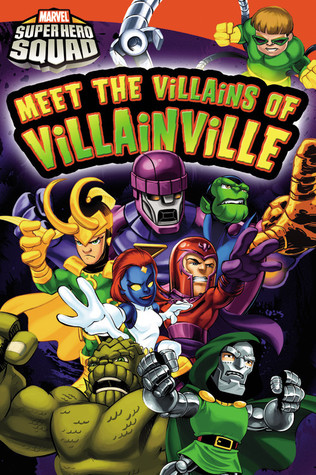
Super Hero Squad: Marvel doesn't think that girls like superheroes?

Penelope, my four year-old, loves superheroes. Sure, she loves them in the way that most four year-olds love anything - alternating obsession and indifference - but who am I to deny her the opportunity to read age-appropriate superhero comics? (And why would I want to, anyway?)

Problem, the first: it is really hard to find age-appropriate superhero comics. I don't mean that in terms of violence, even, so much as I do accessibility. Even the Bruce Timm-styled DC Adventure stories, while generally tame and invitingly cartoony, feature storytelling that's as complex and dialogue bubbles that are as dense as most adult comics. That leaves us with relatively few options, in terms of superhero stories that are pitched at a pre-schooler's level - only DC's Tiny Titans and Marvel's Super Hero Squad, really.

I bought Penelope a Tiny Titans book a few months ago. She liked it, but aside from Batgirl she doesn't really know the characters. I can remember being personally impressed with the wide range of faces that were included - not much in terms of volume, mind you, but it's something - but she'd be much more impressed with stories that included Spider-man, Captain America, and/or Iron Man. So, as you can imagine, I was pretty thrilled when I found a used Super Hero Squad book. And then, a day later, I found three more.


Problem, the second: here's a list of all the characters who appear in those four Super Hero Squad books:
Heroes (16): 
General Ross, Iron Man, Captain America, Mr. Fantastic, Spider-man, Hawkeye, Thor, Falcon, Iceman, Wolverine, Hulk, Silver Surfer, Odin, Human Torch, Thing, Cyclops (the faces of Sunspot and the movie version of Nick Fury appear on a view-screen, but I don't really think that "counts")
Villains (9): 
Loki, Magneto, Abomination, Doctor Octopus, Mole Man, Mystique, Doctor Doom, Sentinels, Super Skrull

For the record, here are the characters that aren't white men:
Hero (1): 
Falcon
Villain (1):
Mystique

Now, I suppose we should at least exclude the Sentinel, who is clearly inhuman, and at least some of the other inhuman or monstrous characters. But regardless - of the remaining 20 or so characters, there's a single blue woman and a single black man. If we want to expand our range to look at the victims and various other background characters, each of those numbers double - Iron Man saves a white woman from a burning building, while a black man appears to be escaping the same building in the background. And that's it. Ugh.


One of the things that I address with my students when we talk about pop culture and representation is the feeling that's created when you can't see yourself - your gender, your race - in the stories that are being told to you. (And conversely, of course, the privilege that comes from being able to see yourself in everything.) This stuff? This is exactly the sort of stuff that I would talk about with them.

I want my daughter to read superhero stories. But I also want her to read stories that allow her to see herself in the characters. In these four Super Hero Squad stories, that would seem to restrict her to either a shape-changing villain or a damsel-in-distress. At a minimum, that's sad. And, of course, it could always be worse - if she weren't white, she wouldn't see any representations of herself at all.


Update: On a somewhat related note, here's an example of how Marvel genders superhero shirts for kids. I am not impressed.

Friday, March 01, 2013

Why Seth McFarlane wasn't funny and why the Onion was

Given that the turnaround for commentary on award shows is now, like, 12 hours, this is at least several days late. So, I apologize for my tardiness.


1. The Seth MacFarlane controversy

Seth MacFarlane was pretty awful, but I don't really have to tell you that. Instead, I can point you in the direction of a few links: you can find a list of sexist jokes here, a description of the sexism fatigue that sets in when one finds him/herself constantly fighting against defenses of sexism, and another perspective that didn't think the jokes were particularly bad but found MacFarlane's reduction of Halle Berry to merely a "beautiful woman" insulting. What emerges, even though many of the articles disagree over the specifics, is a general agreement about the "banality of sexism".

Because the problem isn't any one individual joke or comment that came from MacFarlane, which, in their isolation, might very well have seemed funny. The problem was 1) an unceasing barrage of mean-spirited jokes about women and 2) the relative absence of gendered jokes at the expense of men. And what that contributes to is a feeling that this kind of differential is simply normal. And if it seems like it's not a big deal, that's only because we're numb to what the jokes and comments actually mean. To wit, if we don't think it's problematic to describe Halle Berry only in terms of her beauty, rather than her talent, that's because we're entirely too accustomed to valuing women for their beauty, and only their beauty. It might be a compliment, but it's effectively a back-handed one.


2. The Onion controversy

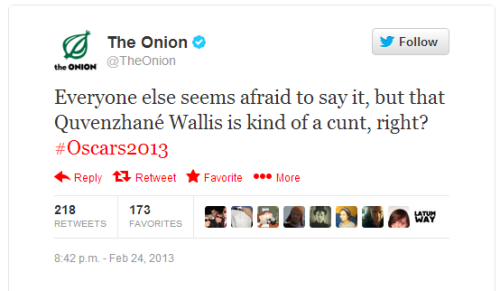
This got less attention. The Onion was live-tweeting the Oscars, and this was one of those tweets:


Quvenzhané Wallis, if you didn't follow the show or watch Beasts of the Southern Wild, is a 9 year-old, and the reaction to the joke was so very swift and very negative that the Onion quickly pulled the tweet and apologized.

The thing is... I actually think this joke is hilarious. For one, the Onion isn't Seth MacFarlane - who made his own joke about Wallis, a worse one, that implied she was nearly old enough for George Clooney to date - and they have substantially more cred when it comes to gender-based humor. For another, the joke is both good satire (this is exactly the kind of crap that tabloids actually write...) and hilariously absurd (...but it's also the basest, most extreme version of that same tabloid crap). The joke works because no one would say that this 9 year-old girl is a "cunt".

And the joke also works because it isn't actually about Wallis - it's actually about the vacuity and mean-spiritedness of entertainment journalism and, more generally, the sort of people who thoughtlessly slap these sorts of misogynist labels on all women. This is also why MacFarlane's jokes are bad - he finds humor in victimization and oppression (see: his Rhianna and Chris Brown joke) rather than poking fun at the oppressors. (Admittedly, this is where the Wallis joke is shakiest. It could be read as making fun of her, certainly. But the best jokes also have to walk that sort of delicate line.)

And, as such, it actually does a pretty effective job of peeling back that layer of banality that insulates discourses of sexism. This might very well be something that no one would say, but it sounds suspiciously similar to things that people say all the time.

Now, admittedly, this is a pretty meta-level justification. And if people find this distasteful and unacceptable, I get it. But that's also kinda the point. Good satire scores political points by way of establishing its similarity to something real that's different in degree, not type. So, if you can't buy into the sexism of this joke, you shouldn't buy into the sexism that underlies those other jokes. That is, you should be able to see that the problem isn't how the Onion called this 9 year-old a "cunt" - the problem is that we think it's cool to call anyone a "cunt". Or sing about their boobs. Or how they had to develop eating disorders in order to fit into their dresses.