Showing posts with label television. Show all posts

Saturday, February 15, 2014

AMC's The Walking Dead and the many ways in which it *ahem* bites

With the return of AMC's The Walking Dead, this week, here are my much-delayed but eagerly-awaited (or not!) reflections on why the show is terrible, and how it manages to screw up everything that the the comic does right. (Be warned! I will probably end up spoiling stuff.)

[A quick note: This is not to suggest that the comic is perfect, by any means. The prison arc drags and, more recently, characters have a habit of monologue-ing in such a way that I have to think Robert Kirkman is hoping to make some sort of serious social commentary that's well beyond his ability. But still, it's much better]

1) The Walking Dead are supposed to be the people, not the zombies


The show's biggest failing is that it thinks the zombies are the stars. It can't go an episode without a zombie sneak-attack, and it makes a zombie encounter part of every story. To pull some examples from this season:
  • The story about the flu, while ostensibly serving as some sort of banal contrast and reminder of the dangers of the everyday, devolved into just another surprise zombie rampage.
  • The visit to the grocery store was interrupted by bunches of zombies falling inexplicably from the ceiling. (I say 'inexplicably' not because it doesn't make sense that the roof is sagging, but because it appears they had been there for months, and somehow none of them had previously managed to fall through the roof)
  • Though it was understated, even Rick and Carol's half-decent foraging episode was interrupted by  zombies who carried away and ate the new people. (But even I'll admit that this was done with impressive restraint.)
  • In the latest episode, Carl is nearly bitten not just once but twice by zombies who either snuck up or sprang out from behind a door, both of which are lazy tropes that the show relies on with alarming regularity.
In the comic, the zombies have been largely reduced to background pieces that do little to move the plot forward. When they gather en masse, it's to serve some sort of symbolic purpose.
  • The zombies flood the prison as an after-effect of the battle with The Governor, not because he deploys them as a weapon. 
  • When a zombie herd pushes through the walls that surround Alexandria, it follows a gun-fight with outside bandits and parallels an internal struggle for the right to lead the town. When Rick is finally installed as leader, the town finally learns how to keep the zombies out.

It's not that the zombies disappear or are rendered harmless, but nor are they aggressors or malevolent. Rather, the zombies of the comic appear as a consequence of human folly - the wrath of god, a force of nature, a critique of social relations given undead form, or however you choose to explain it. And so there's a subtle moral element to it, too, at least in the past few years. Not that any particularly person deserves to be attacked by a zombie, mind you, but that we, more generally, have brought this upon our selves - and we're running out of chances.

2) Pacing

A friend of mine defended the story arc in the first half of this season by way of claiming that it was about the difficulty of re-establishing society. Which, if it were true, would've been great. Instead, having only just established the prison community in the previous year's season finale, this year's season premiere immediately introduced a mystery illness to destroy it. Number of full episodes spent showing that it's not all about the zombie attacks: 0
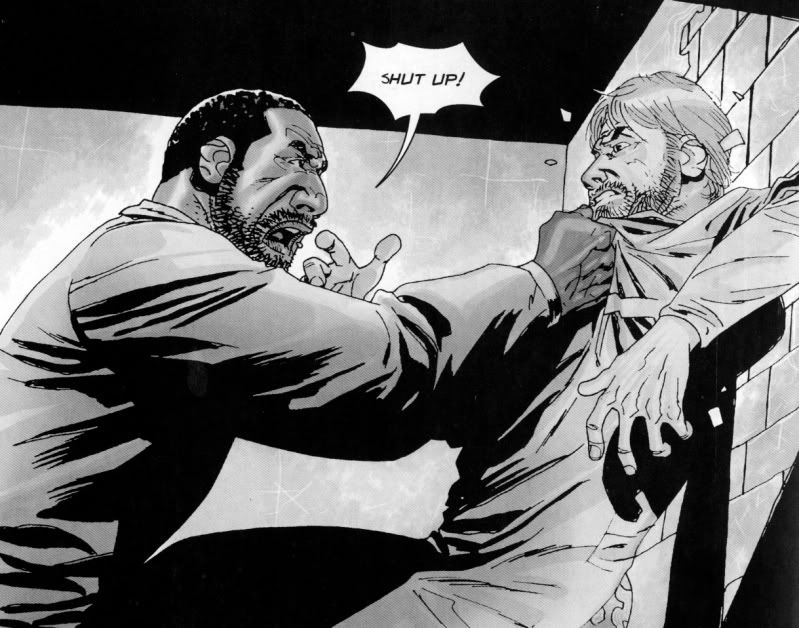

By contrast, the comic book spent dozens of issues in the prison and plenty of time showing that inter-personal conflict and power struggles were far more deadly than anything outside the walls. What my friend claimed/hoped the show was doing? That's what the comic book actually did. If you're going to make a show about humanity after the apocalypse, it probably behooves you to slow down and establish that they can still interact with other human beings.

3) Choreography that would make a pro wrestler blush

Again, the lazy tropes. There's a difference between the effective use of horror conventions and the poor use of them. While I expect the disorienting close-up or extreme that shields our view from a surprise, I expect what follows to be an actual surprise. When Hershel stepped slowly past a body in a dark prison corridor, I knew it would bite him. When, in the second season, Lori went after Rick in a car, I was reasonably sure that she would crash. When she held up a map and took her eyes off the road, I knew there would be a zombie in the way when she looked up. And that she would swerve. And that she would crash.

And when, earlier this season, Rick was outside the prison and got pinned against the fence, the camera angle suggested that someone was going to sneak up, unseen, from behind to save him. So, Daryl did just that:


It's one thing to anticipate a surprise, but to know exactly what that surprise will be? That's not a surprise at all. It reduces the anticipation to an expectation, and robs the scene of tension or excitement entirely.

4) The physics of sound

When they're off-screen, the zombies are remarkably quiet. Like, sooo quiet. But when they're on screen, they're incredibly noisy - gnashing and moaning and gurgling and growling.

But, you're saying, it's just that they're quiet when there are no humans around - obviously, they get noisy when there's meat in their presence.

Except, that's not what I'm saying at all. I literally mean that it's a matter of whether the camera can see them or not.
  • When, in the season premiere, the group arrives at a grocery store, the scene is totally silent. But, as the camera pans up, we see and hear dozens of zombies on the roof. (Which puts that whole 'the zombies are normally quiet' theory to bed.) Now, I'm not at all certain whether the humans would've heard the zombies, but it's pretty silly that the zombies fail to hear the humans approach - especially since their hearing is acute enough to hear a crash from within the building.
  • When Meghan is attacked in the Governor's RV camp, it is doubly ridiculous. Not only is it shot from directly in front, which immediately gives away the eventual zombie attack, but the zombie that she finds is standing totally stationary behind a bed sheet, of all things. A bed sheet that could, ostensibly, block both the sound of the zombie from ours and Meghan's ears, as well as the sound of the community from the zombie, who was turned in the wrong direction and thus oblivious to their presence. Dumb.
  • And the most egregious example, from the end of the second season, is when Dale is standing in an empty field - which we know to be empty because the establishing shot was from a distance. Yet, somehow, a zombie swiftly and totally silently sneaks up from behind him. Which is even more impressive because the field is, itself, totally silent. Until, of course, Dale turns around and the zombie appears on camera, its mouth all frothy and gurgling. Because, of course.

5) Rick

In AMC's version, everyone hates Rick. He's a reluctant leader who's largely incapable of making decisions, wracked by self-doubt and guilt. This might be a fine archetype to employ in literary fiction, but in the hands of lesser writers, Rick is simply annoying.


The problem is, the TV version of Rick is only a small fraction of a full character. Like AMC's Rick, the comic book version of Rick also has a period of self-doubt where he's paralyzed by guilt. But that's not how he begins, and that's not where he's been for a long time.

In the first few years of stories, Rick is instead characterized by a survive-at-all-costs ethos, an angry-at-the-world recklessness, and is intensely protective of his family. Just like TV's Shane. (The comic's Shane died after only a few issues - killed by Carl, rather than Rick.) And, in the comic, he finds some solace in rejecting his responsibility to others and disappearing for days at a time, setting out alone on his motorcycle like some sort of post-apocalyptic cowboy. Like TV's Daryl. (The comic has no Daryl.)

6) Didn't we see all this before? This is what passes for character development?

When the previous season ended, The Governor wanted the prison and was willing to destroy it if he couldn't have it, bringing with him a small army to demand its surrender and knocking its gates down. When The Governor returned at the midpoint of his season, he wanted the prison and was willing to destroy it if he couldn't have it, bringing with him a small army to demand its surrender and knocking its gates down.

Ugh.


In between, we were given two episodes that demonstrated how a shattered Governor rebuilt himself in order to become the exact same person he had been before, with a more or less identical purpose - he replaced his old community with a new one, regained his leadership role, even managed to find a new daughter. And this all served what point, exactly?

7) How gender influences your chances of surviving a zombie apocalypse

I haven't fully developed this point in my head, and it deserves a longer, fuller discussion. But regardless, it's something that needs to be covered. (That I've put it number last on my list isn't an indication of priority. Instead, it's an indication that it's the least rigorously formulated.)

One of the interesting tropes in The Walking Dead comic is the clash of male egos and its catastrophic consequences. Shane nearly kills Rick before the first story arc is complete; Rick and Tyreese nearly kill each other; Rick and The Governor destroy one another's homes; a group of cannibals become a particularly unsubtle metaphor for the direction that this is all heading in. The group's most brazen and direct actions also tend toward disaster: Shane pulls a gun on Rick and Carl shoots Shane in the neck; Rick's first confrontation with the Governor is memorable for Rick getting his hand chopped off; Tyreese's pre-emptive strike against Woodbury results in his capture and execution; Rick's first encounter with Negan ends with Glenn's murder.

Consciously or not, there is a clear and obvious indictment of hegemonic masculine aggression, ambition, and hubris. But this is also a violent story with characteristically violent consequences, so all of this might seem rather unconvincing and lazy - characters die all time, most of those characters are men, and it's easy to link any one death to any one man's reckless actions.

So, let's try this, instead: apart from the characters who were introduced in the current storyline of the comic, only one man who claimed any kind of leadership role is still alive: Rick.
  • Shane, who led the RV group before Rick arrived, is dead.
  • So is Tyreese, Rick's other early competition for leadership of the original group. 
  • And Hershel, who stepped up when Rick and Tyreese were trying to kill each other.
  • Glenn was also among the group that tried to replace Rick. Also dead.
  • Douglas, who preceded Rick as leader of Alexandria. 
  • Spencer, Douglas' son who plotted to replace Rick, is murdered by Negan. 
  • Gregory, who leads The Hilltop, is also killed by Negan.
  • And the bad guys, too, like The Governor and whoever led The Hunters. It's only a matter of time until Negan dies.

Now, it's not like women don't take risks or don't die. The comic book version of Carol kills herself. (Carol is the one major exception to the general rule that the comic does everything better. But even though it seems inevitable that she'll return to the show, the way they wrote her out was awful. And just reinforces the fact that Rick is a dick.) Lori and Judith are killed in the Governor's attack, which ultimately reduces them to a story function - the cost of Rick's pride.

[Quick aside, though. The female characters on the TV show? Some great steps have been taken to build them up into strong, independent people. But there's a reason that half of the early TWD memes relished in point out how annoying they were.]

But Andrea and Michonne have survived capture and physical abuse, and have grown into leadership roles rather than having taken them by force. Necessity plays a role, too: when Gregory gives his allegiance to Negan, a disgusted Maggie effectively takes command of The Hilltop.

And this is hardly an argument for some wildly different form of feminine leadership. Michonne is no less hot-headed and independent in the comic than she is on the TV show, and Andrea is remarkable for her level-headedness and killer instinct. Maggie probably most closely resembles a recognizable feminine trope, having become something of a mother bear to Carol's daughter.

Rather, it seems to be an argument for leaders who don't aspire to hold power but earn it and will take it when they must; fighters who don't seek fights but will fight when they're backed into a corner. As it happens, these sorts of characters are all women.


Women who, I should again add, have taken very different paths and achieved very different outcomes. It's not as if the book recommends one particular way of surviving the zombie apocalypse, even if it seems to suggest that, yes, that one other particular way leads unavoidably to death.

Friday, August 02, 2013

Jem and the Holograms: some songs that won't make your ears bleed!

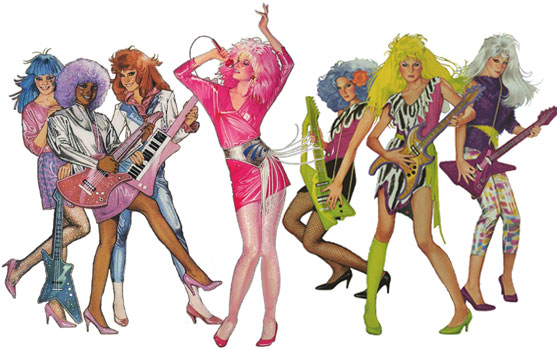
Because we all like fluffy blogs, at least once in a while, here are my five favorite songs from Jem and the Holograms. (You might remember that I did something like this for The Muppet Show, last year.) That's right, it's a "best of" list. And it's about Jem.


Why Jem? We have all three seasons on DVD and my daughter has been consistently obsessed with it. So, I've seen every episode at least once - and some 5 or more times - and heard every song. Also, as hilariously unnecessary as it may be, Victoria and I have actually argued about which Jem songs are the best/worst/creepiest. Because that's something worth (gently) arguing about, right? Right.

Why five? I dunno, it just feels like a good, and manageable, number. I've also arbitrarily decided that I'll include at least one video from each of the three groups in the series: The Holograms, The Misfits, and The Stingers. I'm not sure that any of The Misfits' songs actually deserve to be in a 'best of' list, but it feels somehow wrong to exclude them.

One last note on the actual songs that I chose before I actually get to posting them. If you watch these and think 'hey, that's not bad', don't start thinking that the other 150+ songs aren't bad. Because they mostly are. On the whole, the music is, at best, awfully cheesy and repetitive. The songs that I'm including here are notable precisely because they're exceptional in some way - they're unlike a typical song from the series. So, it's actually a very misleading list. Anyway...

*     *     *

The Misfits - "Lovesick" (3x02)


Like I said, The Misfits aren't given much to work with. Most of their songs are generic mid-tempo rockers with fairly monotone melodies and uninspired lyrics about being infantile bad girls. The only thing interesting about them is Pizzazz's vocal delivery, which features a pretty delightful snarl. But that gets old quickly when she employs it on pretty much every song.

Anyway, I'm a bit ambivalent about including "Lovesick". On the one hand, the vocals and the lyrics are a huge departure from the usual. It's also got some really slick production and an atypically fancy video. But that novelty comes at the expense of Pizzazz's character, who is never worse than when she's shown fawning over Riot. Ugh. I might've just as easily gone with "I Like Your Style", I guess.

Jem and the Holograms - "I've Got My Eye on You" (1x03 & 2x01)


Jem songs are often bathed in romantic clichés, but rarely are they actually hot. This is one of the rare exceptions, which means that it's worthy of inclusion here. (It's relative, of course. "Hot" on a kids' cartoon can only be so hot.)

This is, by the way, the second version of this song, from the second season of the show. It also appear early in the first season, where the video made the song a bit unsettling, if not creepy. In that version, Jem sings the song to a visibly discomforted Rio, who is developing a crush on her. Which would actually be okay, because Jem is the alter-ego of his girlfriend, Jerrica. Except that she hasn't told him that. (And she never does!) So, in the video Jem is hitting on a guy who is dating someone else... though that someone else also happens to be her. Weird and unnecessary.

The Stingers - "Take It or Leave It" (3x02 & 3x11)


Every group has some duds, but The Stingers have a higher proportion of good songs to bad than either of the other two groups. The Stingers were also around for only the final, half-length season and had something like 10 songs, so that might have something to do with it. They also had the only male vocalist, so that novelty could also explain why so many of the songs aren't terrible. Maybe.

Anyway, this is the second Stingers song we hear, but it effectively serves as their introduction - they're unrepentant assholes who treat everyone like garbage and they like it that way. This song is a bit of an exception to the rule that these songs are, themselves, exceptions: it's entirely indicative of The Stingers' sound and content, and it just happens to be the best of their 'we're better than everyone' songs.

Jem and the Holograms - "It Depends on the Mood I'm In"  (1x12 & 3x09)


For whatever reason, the songs about fashion are usually better than average - the next song on this list is also about fashion.

The Holograms' songs are usually overly serious - emo music for pre-punk, pop-listening tweens, basically. But when they decide to just have fun with a song, it usually turns out okay. Or, as with this song, better than okay. "It Depends on the Mood I'm In" also benefits from being somewhat meta, and being a bit playful with the whole hologram/dual-personality conceit that, when it's addressed, is usually discussed in a really tedious manner. And it includes the trademark "truly outrageous" line, which appears in a couple other songs, too. (And is a strange slogan for a group that is neither "true" in the sense that Jem is holographic, nor "outrageous" in the sense that they're really boring. Discuss.)

The Stingers "All in the Style" (3x09)


Like I said before, The Stingers are kind of bad ass. Well, bad ass for an 80s Saturday morning cartoon, anyway. They're telling you to "catch them [people] unaware" and "make them stop and stare".  And they want you to "set the world aglow" and "radiate heat". I might have said that "I've Got My Eye on You" was hot, but this song is saying that you are hot.

It doesn't matter that, within the plot of the episode, Riot is being disingenuous - he's complimenting a designer because he wants to convince her to work for him instead of Jem. This is a genuinely smart and even empowering song, if also a somewhat cynical one about how your power is connected to your ability to capture people's attention. Still, a Jem version of this song would be full of empty platitudes while this Stingers version, at least, addresses your agency.

Thursday, May 23, 2013

White male privilege in Star Trek: no single person's responsibility, but everyone's problem

I haven't seen Star Trek: Into Darkness - I plan to, eventually - but this article about Star Trek's failure to live up to its credo of diversity and tolerance (if not acceptance) makes some broader points that, I suspect, apply equally well to the new film. The money quote:
"The reality is that, at best, Star Trek is like a well-meaning but misguided friend who thinks that they are far more progressive than they actually are. Depending on the topic and franchise, Star Trek’s track record varies from 'mediocre but still better than most other shows of its era' to 'fucking hypocritical bullshit that makes me swear at the TV.'"

I wrote a short blog about this a few years ago, when I was commenting on both the remarkable racism - at least, in light of its purported progressive values - of The Next Generation and, yet, its oddly satisfying conclusion, where the producers argue that the progress narrative is deeply hypocritical and masks a root savagery that we'll never fully shake. (Deep Space Nine would pick this idea up and really run with it, positing that the more civilized the exterior appears, the more rotten it is at its core. Which, funny enough, seems to be exactly the argument that George R.R. Martin is putting forward with A Song of Ice and Fire/Game of Thrones.)

Actual shot from the most embarrassingly racist episode of TNG.


But the part of that article that I wanted to respond to, specifically, is where the author makes reference to the absence of gay characters and the explanations offered by current and former writers/producers Ronald D. Moore and J.J. Abrams. And we can add one from former show-runner Brannon Braga, too:

“The truth is it was not really a priority for any of us on the staff so it wasn’t really something that was strong on anybody’s radar.... Somebody has to decide that it’s important before you do it.” (Moore)

"I think it was, not so much a young man’s [issue], it was a syndicated family show, showing at six o’clock, you know, in Salt Lake City, so you had to deal with each separate affiliate rather than one network. And things like that. It was not a forward thinking decision. Knowing the players involved, knowing the decision makers, knowing it was that they felt reluctant about, you know, we’re not saying 'yes,' we’re not saying 'no,' we’re not just not going to touch that right now." (Braga)

"I just wouldn’t want the agenda to be-- whether it’s a heterosexual relationship or a homosexual relationship, to tell a story that was, that felt distracting from part of the purpose of the story is. ...this was not in the list of my priorities to try to figure out how to make this movie in the best possible way. But it will now be in the hopper. And it’s one of those things I’ll bring up with the writers next time we meet." (Abrams

So, each comment amounts to "we didn't really think about it", though with varying degrees of self-awareness and self-reflexivity. Braga seems to recognize, at least tacitly, that straight male privilege was preventing them from even considering it. Abrams, on the other hand, doesn't seem to realize how problematic it is to situate gay relationships as "distractions" when straight relationships wouldn't be similarly interrogated.

Anyway, this reminded me of the critiques of Girls and Game of Thrones, when each of those shows debuted. People complained (fairly) that Girls manages to almost completely whitewash one of the most racially-diverse cities in the world. People complained (fairly) that Game of Thrones reduces ethnic Others to almost comically barbaric stereotypes. These shows, the critics said, need to be more inclusive.


The defenders of these shows replied (again, fairly) that it is not their responsibility to be inclusive - they're telling a story, and telling it the best way they know how. And this is where I see the overlap with the Star Trek quotes above. Presumably, if someone were to push particularly hard - and I think you can actually see this if you read the full Abrams interview - they would fall into a sort of rhetoric of 'it's not my/our job to be everything to everyone', and making media for straight white dudes is a relatively easy sell. And, again, on an individual basis, they would be right.

The problem is, no one thinks it's their job to make a multicultural Girls, a racially-sensitive Game of Thrones, or a gay Star Trek character. Well, not "no one", but certainly very few people - and certainly not anyone with mainstream prominence. And while it may not be any single person's responsibility, it is our collective responsibility to ensure that real people see their lives reflected in real representations.

And that's the catch-22 - there's a collective obligation and need, here, but you can't force a J.J. Abrams or George R.R. Martin to be more inclusive, individually. (Well, maybe you can argue that Star Trek requires that the guy at the helm prove that it deserves its reputation. Maybe.) Yet, it's obvious that individual action - and accompanying monetary success - is the only thing that can lead to change among the wider entertainment industry. But while something needs to change, no one person is required to be the person who does it. So, no one does.

And that's why we just keep complaining.

Tuesday, May 21, 2013

We still need to talk about nudity on Game of Thrones

Like a lot of other Game of Thrones actors, Oona Chaplin, who plays Talisa, the Queen in the North, has appeared naked on the show and, subsequently, been asked her opinion on it. (For the record, she's happy with it, provided that it's "beautiful" and "honours the female form.") But one of her most recent comments has earned some interesting responses. Says Chaplin,

“One of the girls in the show who got her kit off the most in the first couple of seasons now doesn’t at all because she said, ‘I want to be known for my acting not for my breasts.’” 

Now, while there's a lot of nudity in the show, the large majority of nudity is provided by background or very minor characters. So, there aren't a whole lot of options, and most people assume that she's referring to Emelia Clarke, who plays Daenerys. You might remember that she was constantly nude in the first season, and that she made the news more recently for her performance in Breakfast at Tiffany's, where her nude scene was interrupted by a flurry of flash photography. For better or worse, she's become known for her naked body.


But this blog isn't about any of that. Well, not directly, anyway. Instead, it's about the unsympathetic fan response to Clarke's purported annoyance/discomfort:

"Didn't the actress read the part before she signed on? There is alot of this stuff in the books.. get a grip and learn what you're doing before you jump in with both feet"

"Exactly what I was thinking, the books are full of references which then would need to be translated into the show in order to maintain the level of authenticity many fans desire. I'm tired of this whole 'nudity is bad and detracts from seriousness' debate."

"Didn't halley [sp] berry win an Oscar for a role she appeared nude in?"

Ugh. Obviously, I'm reproducing these comments because I think they're off-the-mark. Here are a few reasons why:
  • Unfortunately, Clarke - and I'm assuming that the anonymous comments do belong to her - is right, she is known for her breasts. So much so that it's a huge distraction, as it was in her Breakfast at Tiffany's performance, where a significant number of people valued her performance precisely because she would be naked. And probably did a lot to ruin the show for everyone else, too. (Though, as I understand it, it wasn't a particularly good staging to begin with...)

  • Further, GoT is just generally infamous for its excessive female nudity.  This is why SNL was able to make a hilariously on-point parody like this one, which claims that the show owes its success in equal parts to George R.R. Martin, writer of the books, and a 13 year-old named Adam Friedberg, whose only job is to add more boobs:


    I should add that, when I watch the show and breasts make an appearance, I immediately think of Adam Friedberg. So, there's another knock against too much nudity - as entertained and immersed in the story as I might otherwise be, I immediately think of Andy Samberg's impression of a 13 year-old.

  • Some fans seem to think that fidelity to the books is an absolute defense. If Daenerys was often nude in the books, then Clarke should accept that. Never mind that men are also often naked in the books, and yet we've only seen a few asses and no penises. Or that there's no rule stating that any TV adaptation needs to be perfectly faithful. (See: The Walking Dead, which departs in significant ways from the source material. Or don't, because most of those differences are awful ones.)

  • But most problematic, I think, is the implication that an actor can't re-assess the situation, take account of new information, reflect on her experience, and... change her mind. Clearly, she was comfortable with the nudity in the beginning. Now, seeing the unpredictable kind of notoriety that it's earned her, she's decided that she doesn't much like it. That actually strikes me as pretty reasonable.

[Correction: I originally attributed the quote at the top to Natalia Tena, who plays a different character on the show. This is because The Mary Sue made the same mistake, and I didn't bother to double-check the source. My bad.]

Wednesday, May 01, 2013

CBC Kids doesn't want white people, and it's not racist or even a big deal


So, Kids' CBC is looking for a new co-host for their morning programming. Presently, the morning show is hosted by Patty, a 40ish white woman, and Mamma Yamma, a yam-shaped puppet. So, I guess that means that Sid Bobb, an Aboriginal man whose on-air role has noticeably declined in the last few months, is moving on to something else.

For the record, I've consistently watched Kids' CBC - sometimes more frequently than other times - with my daughter for more than 3 years, now. Aside from some bizarrely interesting musical guest choices - Billy Bragg singing with a puppet-crab, for instance - it's a remarkably tame show, no different from any other morning show aimed at the kindergarten demographic. So, this shouldn't be big news. But it turns out that it is. (Again, it shouldn't be, but it is.) Because this is what a hiring agency posted for the CBC:


The contentious line is the last one in this screen cap - "any race except Caucasian". (That this is the only contentious line is a hilarious irony that exposes the ridiculousness of the 'controversy', but I'll get to that later.) Twitter erupted with rage over the exclusion of white men, and both the CBC and the casting company they hired apologized. The casting agency also amended the ad so that it no longer mentions race, and you can read more about the agency and CBC's responses here. You can also check the coverage of this story at the Huffington Post, where Marni Soupcoff makes a number of observations that I both agree and disagree with, but all of them are quite thoughtful.

But as for that rage... the ads elicited a predictably conservative reaction, but I think that it's probably fair to look at just one. A friend of mine tweeted that it was an example of "sickly racism" and added the familiar cliché, "how about hiring the BEST host, rather than one with certain skin pigmentation?" He also made a connection between these hiring practices and the spotty record of Affirmative Action in universities, posting this link to a story in The Atlantic.

To that, I say "bullshit". (Well, in the actual interaction I called it a "non sequitur". But, y'know, it's bullshit.) The story in The Atlantic is about admitting students who lack the preparation and skill to compete at top-tier schools; this story is about a children's morning show host. The story in The Atlantic mentions that academic "mismatch"* might be responsible for black students dropping out of engineering programs at more than twice the rate of white students; but this job is literally not rocket science.


Some of the Kids' CBC cast: Sid, Patty, Captain Claw,
Mamma Yamma, and Salmon. Not rocket scientists.


There are two main points that I want to make, one in response to my friends complaints, and another more broadly in support of the CBC's hiring directives.

One, there is no "BEST host" out there. No one is finishing in the top-percentile of the Standardized Hosting Test and being overlooked because he's white. And to the extent that the CBC should be looking for the "BEST host", it's worth considering the actual needs and objectives of the program. Reasonably, I think, Soupcoff points out that "we also have to remember that what we're talking about here is casting an entertainer in a dramatic enterprise, not staffing a position in the bureaucracy."And indeed, a letter from the CBC told the hiring agency that they wanted actors who reflect "Canada and its regions as well as the country's multicultural and multiracial nature", since the show is very much about showcasing various regions and people in the country. In that case, the "BEST host" might very well be one with a particular race or gender that is otherwise under-represented.

And this leads directly into my second point. Regardless of the CBC's responsibility to aspiring hosts, they have a much larger responsibility to the kids that watch Kids' CBC. Canada's multicultural and multiracial nature? It's the audience for this show. Those same non-white kids? They can look forward to years of TV and film programming filled with the faces of white men, with the stereotypes of their own race and ethnicity, or with the exclusion of their race and ethnicity altogether. Representation is power, and for non-white kids watching a morning show that's populated only with white people? Well, it follows that lack of representation is disempowering.

I mentioned, at the top, that there was an irony to all this outrage. And it has to do with the fact that all the anger is directed at the exclusion of white people. The thing is, they're not the only demographic groups that were denied the opportunity to apply. Let me spell it out, in case you missed it. This was the very first requirement listed:
  • Male between the ages of 23-35yrs

So, who else can't apply? Anyone under 23. Anyone over 35. And women. No women can apply. An entire gender has been barred from applying. And where's the outrage? Where are the cries of sexism? Why aren't the people who successfully lobbied CBC to consider white men also asking them to consider women of colour?

Unsurprisingly, those hypocrites are nowhere to be found.


[*According to the article, "mismatch" is the term for situations where the student simply doesn't have the proper educational background for their program. The reasoning is that we don't want mismatches because we're doing those "mismatched" students a disservice - we should, instead, nudge them toward easier programs. What the "mismatch" rhetoric fails to address, of course, is that systemic racism has a lot to do with the lack of preparation - the disservice is done well before they ever set foot in a university classroom.]