Showing posts with label race. Show all posts

Tuesday, January 14, 2014

Dangerously early guesses and questions about The Triple Package

Amy Chua, the Tiger Mom author, is back with a new book, co-written by her husband. And it looks like it will be unintentionally racist and blissfully unaware of social theory.

The Triple Package comes out next month, but it's easy enough to get a sense of its argument. Some "cultural groups" are more successful than other cultural groups, and this has to do with three values - a superiority complex, insecurity, and impulse control - that those successful cultures share. The specific groups, they revealed in an interview with Yahoo, are Mormons, Cuban exiles, Nigerian Americans, Indian Americans, Chinese Americans, American Jews, Iranian Americans and Lebanese Americans.


Now, since it isn't out until February, I obviously haven't read it. And I don't know that I will ever read it. Because it sounds plain dumb. But, rather than claim to know what it's done wrong, I'll ask some questions that are prompted by what I have seen:
  1. Who came up with the eight "cultural groups", and how? The categories they've defined throw up some red flags. Some of her "cultural groups" are defined by religion, others by political status or country of origin, but categorical ambiguity isn't, itself, necessarily problematic - it's realistic, because that's how we self-identify. But I wonder whether the members of the groups would identify first as "Mormon" or "Lebanese", or about the particular contexts within which they'd do so. And with this kind of work, it is hilariously easy to create a homogenous group where none exists, to group people together based on your perception of their similarity, rather than on their own perception. Neither of the authors are trained sociologists, so it'd be interesting to see whether their methodology accounts for those sorts or risks.
  2. What role in their success do you attribute to American society? I don't see any indication that they're accounting for American society as a whole, much less the dominant ideologies that define success. Even if we concede, for argument's sake, that the American socio-economic system rewards these three values, the orientation feels wrong - why look at who is successful, rather than those systemic features that enable their success?
  3. That is, what about capitalism and racism? Or, put another way, you can't do this analysis without explicitly addressing the roles that capital and race (that is, whiteness) play. I don't see any mention of either of those things in the blurb on the site. For instance, your proximity to whiteness matters - there's a reason that the two white groups (alright, "Jewish Americans" are a bit more complicated than that, but I'm trying to be concise) aren't defined by their geography or nationality - it's because race matters, and the white groups aren't marked by visual difference from the American norm. Which is to say, I think it's difficult to argue that the same thing is happening to and within these groups.
  4. How is this disproving the existence of the model minority? The blurb on the site says that successful immigrant groups become less successful over time, and this disproves the model minority theory. But this looks like a misunderstanding of what a model minority is and does. The model minority is not a person or people so much as a function within in a society. It describes minority figures or groups whose success legitimates the system ("If a schlub like me can make it, anyone can...") and its unequal treatment of populations within that society ("...which means you just didn't try hard enough, you leech."). And it actually makes sense that a given group would lose their model minority status and another gain it - because that function doesn't belong on any one minority, and it'll shift. Chinese Americans have existed for 200 years; they've only been model minorities for the past few decades.
  5. When looking at immigrant communities, how did you avoid selection bias? I think there's probably a pretty simple explanation for why some of these groups are, on the whole, disproportionately successful. The blurb notes that Nigerian immigrants have a lot of PhDs, which strikes me as pretty common sense, given how immigration works. There's a selection bias at work: only the best are allowed to come to the country, so we'd expect them to do well. (And we'd expect their kids to regress to the mean.)


Ironically, I get the sense that this book, while claiming to disprove the model minority, is actually telling us what a model minority is, and who fits that definition, right now. Which would make it kind of useful, right?

Again, haven't read the book, and probably won't unless someone gives it to me and I'm struck by a mood. But, then, everything I've seen has me thinking that it probably isn't worth my time. Or yours.

Tuesday, January 07, 2014

If you're gonna name your team after real people, at least do it right

We live in a world with NFL teams like the Washingtons* and MLB teams like the Clevelands*, that celebrate a tradition of white settler racism. A world where most sports fans lie somewhere on a spectrum from oblivious to indignant, mascots are unrepentantly racist, and owners have dug in their heels in defense of horribly offensive "traditions".

[* That's right. I refuse to use their chosen names. More on that below.]

That being the case, it seems important to celebrate the teams that do it right. Teams like the Spokane Indians. From Rodney Harwood of the Indian Country Today Media Network:
"In 2006, the baseball team’s front office and the tribe collaborated to come up with a team logo not only saying Spokane Indians in English, but developed a team logo printed in the Salish language, which was depicted on the sleeve of its uniforms.

"The Spokane Indians baseball team will take that collaboration one step further, making the logo in the Salish language the main logo on the front of its home uniforms for the 2014 season."

A Salish-language logo? And it's also their primary logo? That's pretty damn cool. It also addresses the obvious concern that this is a team called "the Indians". This is a word that was applied to the Aboriginal people of North America by white settlers, who misidentified them as Asian - and then didn't bother to correct themselves. It's inherently racist.

Impressively, the team is aware of this and shares those concerns - they don't use mascots, they don't have chants, none of that cartoonish crap that the Washingtons or Clevelands use. Says team co-owner Andy Billig, “We have a very positive relationship with the local tribes. We would talk with them from time-to-time to check in and say, ‘How are we doing?’ Even if we weren’t using any imagery, the name of the team was still the Spokane Indians and we knew that could potentially be sensitive. We believe that we are still the only professional sports team to collaborate with local tribes in this way.” 

The difference, with this Spokane team, is all in the collaboration and the new/old language. In making the Salish name the one that goes on their logo, with the help of the Spokane Nation, the name is effectively reclaimed - "Indians" becomes, at best, an English translation of the actual name. And an officially sanctioned nickname for the specific people that they represent. And it will surely decline in use as people familiarize themselves with the pronunciation of the Salish name.

This, by the way, is what that logo looks like:


In the past, I've always come down squarely against every iteration of the people-as-team-mascot kind of sports team. But this one, one that Spokane elders themselves say shows them respect and bring them pride? This is one that I feel pretty good about.

Thursday, September 12, 2013

This is Canada, according to the folks that you/we elected

I want to write about two very recent developments in Canadian politics, two things that seem largely separate and unconcerned with one another but strike me as very much related. Intentionally or not, both say a whole lot about what and who counts as "Canadian" and why - even when that's not what they think they're saying at all.

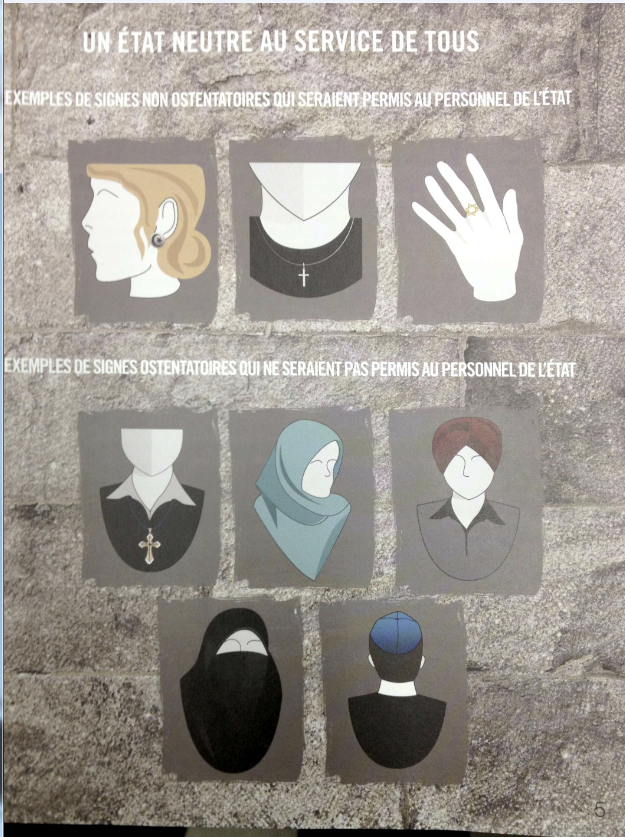
So, this is the first. It comes courtesy of Quebec's provincial government, which has drafted a "Charter of Values" that would ban public servants from wearing "overt and conspicuous" religious symbols. In the picture below, the bottom two rows show what constitutes "overt and conspicuous", while the top row shows, I dunno, examples that are presumably covert and inconspicuous. Or something. Some of the differences are obviously arbitrary, others are entirely too ambiguous, while the rest are just demonstrably racist.


Seriously, what's the difference between the first and second crucifix? One's small and one's bigger, sure, but what's the dividing line? At what point does a crucifix stop being small enough? Is there a particular length, mass, or volume? And, because there must be some standard that pertains to one or all three of these aspects, what is it and how did you determine that it achieved the necessary level of "conspicuousness"? And will the religious symbol police carry rulers and/or scales?

So, yes, this is obviously not actually about banning conspicuous symbols or defending Quebecois values so much as it is about putting the Other in their place and demonstrating who belongs and who does not. It really couldn't be any plainer.

And not just who belongs in Quebec. Because there's something very similar happening at a totally different level of government, in a totally different portfolio. Just check out some of these images from our new passports:


I think I spotted at least one person of colour, in an RCMP image. And Heather Mallick with the Toronto Star says that, across all the images, men outnumber women by a ratio of 16-to-1. These are terrible oversights. But they're also clear indications of hegemonic Canadian "values" - just as much as that poster is - and, in particular, of who and what counts as Canadian. That is, of who can comfortably call themselves Canadian. And it gets worse.

You might be wondering why I started with that Samuel de Champlain image. It's because the passport images are effectively placed in a chronology, with Champlain serving as the beginning of Canada. 'But it says page six, so surely there are other pages!', you say. 'And what about Aboriginal people?', you ask? Well, they do earn a token appearance on the previous page:


But that doesn't make them the origin of Canada in the narrative that the passport is advocating, oh no. This isn't presented as history, but as prehistory. In the logic of the feds, these aren't people or meaningful events, but symbols, artifacts best kept in a museum, representing some long-extinct community. There are no names or places or dates, here, and the symbols themselves are stripped of all context and specificity, reducing them to something generalized, depersonalized, and thusly unimportant. (Is that a particular inuksuk? Is it someone's approximation of one? Is it clip-art? Apparently, the answer doesn't matter.)

To add insult to the injury, of course, these are important symbols. They just aren't accorded any importance in the passport - at least, not enough importance to bother naming them or placing them within the narrative of the nation. And so appropriately, and depressingly, Aboriginal people are also absent from the rest of the passport images.

And so the Quebec that the "Charter of Values" from the Province of Quebec imagines? It excludes the same people that the Government of Canada does with the new passport. Hilariously - because Quebecois separatists and Conservative federalists imagine themselves ideologically opposed - they appear to be describing the exact same place.

And it's a place that requires a certain degree of hypocrisy and willful blindness. Because the Conservative Government of Canada actually opposes the "Charter of Values", which is motivated at least partly (and cynically) by the need to keep their lead among "New" Canadians. Because English Canadians get to respond with smug moral superiority, even as polls suggest that nearly half of us think the ban is a good idea. Because, ironically, Quebec's government fails to notice and condemn the conspicuous religious symbols contained in their own flag.

Wednesday, July 31, 2013

Andrew Garfield on Spider-man, me on Garfield's portrayal of Spider-man

This is what Andrew Garfield recently said about Spider-man and how he needs to be updated in order to remain relevant. Good points, all of them:
"...what I believe about Spider-Man is that he does stand for everybody: black, white, Chinese, Malaysian, gay, straight, lesbian, bisexual, transgender. He will put himself in harm’s way for anyone. He is colorblind. He’s blind to sexual orientation, and that is what he has always represented to me. He represents the everyman, but he represents the underdog and those marginalized who come up against great prejudice which I, as a middle-class straight, white man, don’t really understand so much. And when Stan Lee first wrote and created this character, the outcast was the computer nerd, was the science nerd, was the guy that couldn’t get the girl. Those guys now run the world. So how much of an outcast is that version of Peter Parker anymore? That’s my question."
 
If you've read my blog at any length, you'll know that I'm in complete agreement with a lot of this. The superhero-as-outsider metaphor has always been a bit of a stretch, given that most of the heroes are themselves white men, and that the outsider who identifies with Spider-man or the X-Men is often still white, male, middle-class. But it's become additionally problematic recently, what with the mainstreaming of super-hero culture and the generally increasing economic and political clout of geeks.


In short, Spider-man's ability to represent the underdog or the marginalized, while always a bit suspect, has become pretty much an impossibility.

The irony in these comments, of course, is that Garfield's Spider-man is probably cooler and less marginalized than any other version we've seen in the comics or movies. This is a Spider-man who skateboards, who is snarky rather than awkward, and who just oozes hipster cool. If he's an outsider, it seems like he's an outsider by choice. So even if Garfield's words ring true, his performance seems to be moving in the total opposite direction.

Tuesday, July 30, 2013

A quick blog about Trayvon Martin and racist non-sequiturs

So, I get a lot of emails from PR folks. Like, a whole lot. I was tempted, if I was stuck with nothing to do this summer, to actually attempt to respond to all of them, as a sort of absurdist writing project. Why absurdist? Because, for whatever reason, the PR folks who get my name are employed disproportionately by writers and politicians on the right-wing. This would not have been a sincere project at good journalism.

But why am I telling you this? Because this is arrived in my inbox a couple days ago, courtesy of the folks who rep Carol M. Swain, a Professor of politics and law at Vanderbilt:
"The people who are complaining about the Trayvon Martin verdict should turn their attention to the unacceptable levels of black-on-black violence that cripples urban communities. We should not be second guessing the jury. The jury examined the evidence and decided not to convict, despite the presence of a judge that seemed biased towards the prosecution. Folks, its time to move on to the real problems facing black communities. It's what we [black people] do to ourselves. It is imperative for the police to police in situations where disgruntled people are threatening violence over the not guilty verdict."

Wow. This is just... gross. Now, I'm not just using this blog to pick on Professor Swain. (Though I may want to use it to challenge the fact that the PR firm is representing her as a "race relations expert." Because no.) Because this is not the only time I've seen the black-on-black violence card played - I've seen it on Facebook, I've seen it in letters to the editor. But this blurb does make for an easy target, so there you have it. Carol Swain, you're guilty of deploying racist rhetoric, sure, but you're also guilty of being a convenient target, delivered straight to my inbox by the people who you're presumably paying.

I said this would be quick, so I'll try to keep it that way. This is why Carol Swain's little paragraph is, in a nutshell, emblematic of everything that's wrong with the response to the verdict in the Zimmerman case:

  • We should second guess juries. Of course we should. We should second-guess every decision that's made at every level of government, even those made by people who are effectively conscripted. It's how a responsible citizenry accords itself. It's why we're empowered as citizens in the first place. Because mistakes are made by everyone, at every level of government, all the time.
  • There's the implication that this case was a distraction - black people "should turn their attention", as if Trayvon Martin and raising awareness about racism wasn't worthy of it - from something more important. It's an insulting gesture, and it's in poor taste.
  • The "real problems facing black communities" bit is a complete non-sequitur. The Zimmerman case had nothing to do with black-on-black violence. At best, this illogical jump is opportunistic sleight-of-hand; at worst, it's purposely deceitful. She might as well have said that the real problem isn't men hurting men, but men hurting women. It would've made just as much sense.
  • Lastly, while Carol Swain is a black woman and this might strike some as unintuitive, I'd like to suggest that the argument she's making in that paragraph is also racist:
    • The first obvious implications is that black-on-black violence has nothing to do with white-on-black racism. Without going on at length, it does - the criminalblackman is a white supremacist myth that has, to some extent, created what it had first imagined. You can't solve that problem without first addressing the root cause, which is the internalization of hundreds of years of racial hate and white-on-black violence of all kinds.
    • The second second implication is less obvious, but still fairly clear. Swain's logic suggests that so long as black Americans don't value their own lives - after all, they can't be bothered with addressing the "real problems", right? - we shouldn't be surprised (or be outraged) when white Americans don't value them either. In essence, non-black folks get a free pass because she thinks the black community is worse. It's an idiotic line of thought. It's also surprisingly prevalent.

Wednesday, July 10, 2013

Star Trek, old and new

I saw Into Darkness a few weeks ago and just never got around to writing about it. Just before, I re-watched Wrath of Khan. Just after, I watched First Contact. So, having finally found the time to write something, I want to write about it it relation to the second iteration of each of the other two Star Trek movie franchises.

I liked Into Darkness, and I liked it for largely the same reason that I liked Abrams' first Star Trek: it was a really good Star Wars movie. Lots of stuff blew up, it was really exciting, and Cumberbatch's voice boomed with deep, sexy authority. I left wanting to jump from flying car to flying car like some genetically-modified superman. And that's just about all the response that it inspired.

This is actually from Star Trek: Insurrection, but I thought it looked hilarious.

Now, you might be thinking that my Wars/Trek distinction is splitting-hairs. And, sure, there's a lot of overlap between the franchises, especially the pre-1987 versions of each that seem to be the most resonant versions. Both imagine outer space as a basically lawless Wild West frontier, and imagine that cowboys and Zen masters are probably the archetypes best-suited to wrangle it.

But there's still a difference, and I'll go to Star Trek itself to help put a name to it. When, in The Next Generation, Jean Luc Picard locates an AWOL Ambassador Spock behind enemy lines, he refers to his actions (and, implicitly, that of the original Star Trek crew) as "cowboy diplomacy [that] will not easily be tolerated anymore". In Star Wars, cowboy stuff is the subject of the series - though, admittedly, it does cowboy stuff really well. But in the original Star Trek (TOS), "cowboy" is just an adjective, dressing for the deeper political and philosophical questions that it's trying to raise. It often asked the wrong questions or raised them in cheesy ways, sure, but the cowboy stuff was largely a vehicle to sell that higher purpose.

Anyway, and TL;DR: Star Trek Into Darkness is not really a Star Trek movie.

And not only is it not a Star Trek movie, but, contrary to the buzz on the internets, it's not even the best Khan movie. And among the Into Darkness, Wrath of Khan, and First Contact trifecta of Star Trek sequels, it's not even the second-best of the bunch.

In no particular order, then, here are the things about Into Darkness that give me pause. I'll elaborate more afterward.
  1. Like Wrath of Khan, it tries to build its emotional center on the Kirk-Spock friendship. It doesn't work.
  2. There's paying homage, and then there's just straight-up repetition...
  3. ...and when it does something that a previous Trek also did, it does it worse.
  4. When it acknowledges the post-TOS franchises, it misunderstands and mangles them.
  5. When it tries to show us growth and change, it fails.
  6. Khan is white.  Khan should not be white.

*     *     *

1. "You are my friend"

Kirk and Spock weren't friends in the first film. They don't seem to particularly like one another in this one, either. And where the friendship is forced to work... well, it's forced and doesn't work.

Take the scene where Spock looks shocked that Kirk has requested that the former be re-assigned as first officer under the latter. He should be. The movie has given us absolutely no reason to think Kirk should trust Spock, much less like him. The motivating force for their friendship seems to be destiny - they should be good friends because they were best friends in the original series, and Kirk knows this. That's weak. The movie wants that emotional pay-off when Kirk dies, but it hasn't done the work and doesn't earn the right.

2. Homage/repetition

I've been involved in a lot of arguments about the usefulness of homage and repetition in serial storytelling. I don't think I'm alone in suggesting that there's something lazy about reboots, though that doesn't necessarily mean that they're boring. The same rule applies to remakes, though I think these edge closer to being boring by default and need to work hard to prove they're not a waste of time. Because I think that either - the reboot or the remake - can be perfectly enjoyable things. They can be fun, even if they don't cover any new ground and, so, aren't anything more than that. But fun could be enough.


But while Star Trek seemed to pay homage, to wink at the old stuff, while establishing some new story, this film simply repeats a lot of their plot points. The most egregious moment is probably the reversed death scene, where Kirk fixes the warp engine and dies of radiation poisoning while Spock watches, and Spock gets to yell the "KHAAAAAAAN!" line. It a do-over, really, but with the roles reversed, and it doesn't add to or improve the original scene.


3. The same, but worse

In fact, I'd argue that the new radiation death scene is the weaker version. There are a couple of reasons I'm claiming this, so I'll do a simple bullet-list:
  •  In Khan, the death scene follows Khan's defeat. It is the sole occupant of our attention, and its placement in the story is a textbook demonstration of how you tell the story of a pyrrhic victory - the dizzying high, the devastating low. But Kirk's "death" in Into Darkness lacks the emotional weight because we know he isn't actually dead. It also has to be timed to happen before Khan's defeat, so we can't even linger on the moment.
  • In Khan, Spock calmly enters a clean, white, and eerily 2001-esque engine core room and seals himself behind a glass door while the engineering team watches in horror. It's a slow, banal exercise that grows slower and visibly painful as he starts to die. And it's almost totally silent. By comparison, Into Darkness's version shows that less is, indeed, more. The engine room is hilariously monstrous and inaccessible, and Kirk's attempts to climb the tubes/pipes to reach the engine is the real source of drama, here. Kirk's subsequent efforts to re-align the engine by hurling himself against it thusly becomes an apt metaphor for what his movie is trying to do with the source material - hit it really hard and hope everything falls into place.

4. Misreading and mangling

I'll keep this one short. I though it was really cool when the Admiral made a reference to Section 31, the cloak-and-dagger department we were introduced to in Deep Space Nine. Existing outside the official command structure of Starfleet, 31 was so secret that only top-level admirals seemed to know that it was a real thing - and even Admiral Ross would only confirm this when it was a) absolutely clear that Captain Sisko knew 31 was real, b) he had no choice.

Anyway, the novelty of the reference is lost almost immediately, when you realize that Admiral Marcus a) shouldn't know why 31 was using Khan, b) shouldn't be involved in the command structure of 31, c) 31, itself, shouldn't have a command structure, and d) he sure as hell wouldn't be talking about any of this with Kirk.

So, basically, they wanted to drop the name that would earn them cred with the hardcore fans, but without actually making any effort to represent the organization accurately. Super. And par for the course, really.

5. When character growth isn't actually character growth

I'm losing patience as I write, so I'll try to be even shorter. In the supposed climax, where Spock should be demonstrating what he's learned in order to out-fox Khan, the screenwriters take the easy way out instead. He just asks Old Spock what he should do. And then, presumably, does it. Weak.

6. White Khan

I'm not the first to say this, but I'll say it anyway. Khan isn't white, he shouldn't be white, and this constitutes an epic failure on the part of the people who wrote, cast, and produced the film.  (It's telling that no one seemed to think it mattered until the casting decision started to get criticized. Star Trek, it seems, engenders post-racial delusions in the mind of people who don't experience racism.)


Ricardo Montalban played the original Khan. Montalban, it should be said, was a white Mexican - though he passes convincingly as a person of color, so much so that John Cho (Sulu) referred to him as such - and his Khan was styled so as to appear at least somewhat Aboriginal. But we're also told that he was a benevolent dictator who conquered Asia and the Middle East, so it may just be that the producers thought he was close enough to South Asian to pass. (That is, they assumed that 'not white' was good enough.)

Also, his name is Khan Singh. Let's not pretend otherwise: the dude was obviously supposed to be Indian. And for this film, they cast a white, blue-eyed, English guy. And never bothered to explain why. Um, no.


*     *     *

I just realized that I promised a discussion of First Contact - because I claimed it was a better Star Trek film - and that never happened. Next time...

Thursday, May 23, 2013

White male privilege in Star Trek: no single person's responsibility, but everyone's problem

I haven't seen Star Trek: Into Darkness - I plan to, eventually - but this article about Star Trek's failure to live up to its credo of diversity and tolerance (if not acceptance) makes some broader points that, I suspect, apply equally well to the new film. The money quote:
"The reality is that, at best, Star Trek is like a well-meaning but misguided friend who thinks that they are far more progressive than they actually are. Depending on the topic and franchise, Star Trek’s track record varies from 'mediocre but still better than most other shows of its era' to 'fucking hypocritical bullshit that makes me swear at the TV.'"

I wrote a short blog about this a few years ago, when I was commenting on both the remarkable racism - at least, in light of its purported progressive values - of The Next Generation and, yet, its oddly satisfying conclusion, where the producers argue that the progress narrative is deeply hypocritical and masks a root savagery that we'll never fully shake. (Deep Space Nine would pick this idea up and really run with it, positing that the more civilized the exterior appears, the more rotten it is at its core. Which, funny enough, seems to be exactly the argument that George R.R. Martin is putting forward with A Song of Ice and Fire/Game of Thrones.)

Actual shot from the most embarrassingly racist episode of TNG.


But the part of that article that I wanted to respond to, specifically, is where the author makes reference to the absence of gay characters and the explanations offered by current and former writers/producers Ronald D. Moore and J.J. Abrams. And we can add one from former show-runner Brannon Braga, too:

“The truth is it was not really a priority for any of us on the staff so it wasn’t really something that was strong on anybody’s radar.... Somebody has to decide that it’s important before you do it.” (Moore)

"I think it was, not so much a young man’s [issue], it was a syndicated family show, showing at six o’clock, you know, in Salt Lake City, so you had to deal with each separate affiliate rather than one network. And things like that. It was not a forward thinking decision. Knowing the players involved, knowing the decision makers, knowing it was that they felt reluctant about, you know, we’re not saying 'yes,' we’re not saying 'no,' we’re not just not going to touch that right now." (Braga)

"I just wouldn’t want the agenda to be-- whether it’s a heterosexual relationship or a homosexual relationship, to tell a story that was, that felt distracting from part of the purpose of the story is. ...this was not in the list of my priorities to try to figure out how to make this movie in the best possible way. But it will now be in the hopper. And it’s one of those things I’ll bring up with the writers next time we meet." (Abrams

So, each comment amounts to "we didn't really think about it", though with varying degrees of self-awareness and self-reflexivity. Braga seems to recognize, at least tacitly, that straight male privilege was preventing them from even considering it. Abrams, on the other hand, doesn't seem to realize how problematic it is to situate gay relationships as "distractions" when straight relationships wouldn't be similarly interrogated.

Anyway, this reminded me of the critiques of Girls and Game of Thrones, when each of those shows debuted. People complained (fairly) that Girls manages to almost completely whitewash one of the most racially-diverse cities in the world. People complained (fairly) that Game of Thrones reduces ethnic Others to almost comically barbaric stereotypes. These shows, the critics said, need to be more inclusive.


The defenders of these shows replied (again, fairly) that it is not their responsibility to be inclusive - they're telling a story, and telling it the best way they know how. And this is where I see the overlap with the Star Trek quotes above. Presumably, if someone were to push particularly hard - and I think you can actually see this if you read the full Abrams interview - they would fall into a sort of rhetoric of 'it's not my/our job to be everything to everyone', and making media for straight white dudes is a relatively easy sell. And, again, on an individual basis, they would be right.

The problem is, no one thinks it's their job to make a multicultural Girls, a racially-sensitive Game of Thrones, or a gay Star Trek character. Well, not "no one", but certainly very few people - and certainly not anyone with mainstream prominence. And while it may not be any single person's responsibility, it is our collective responsibility to ensure that real people see their lives reflected in real representations.

And that's the catch-22 - there's a collective obligation and need, here, but you can't force a J.J. Abrams or George R.R. Martin to be more inclusive, individually. (Well, maybe you can argue that Star Trek requires that the guy at the helm prove that it deserves its reputation. Maybe.) Yet, it's obvious that individual action - and accompanying monetary success - is the only thing that can lead to change among the wider entertainment industry. But while something needs to change, no one person is required to be the person who does it. So, no one does.

And that's why we just keep complaining.

Thursday, May 16, 2013

The X-Men don't represent what you think they represent


I'm very late to the game with this one, but I wanted to get some thoughts down on paper. (Or on keyboard. On the screen. Online? Whichever.)


The X-Men, we've been told many times, are less a team of superhero than they are a metaphor. Their creator, Stan Lee, wanted a group of heroes that would engender fear for the simple fact that they are different. "People fear things that are different," writes Lee, and it's hard to think that Lee, a Jewish-American, wasn't thinking of Jews and Roma during the Holocaust.

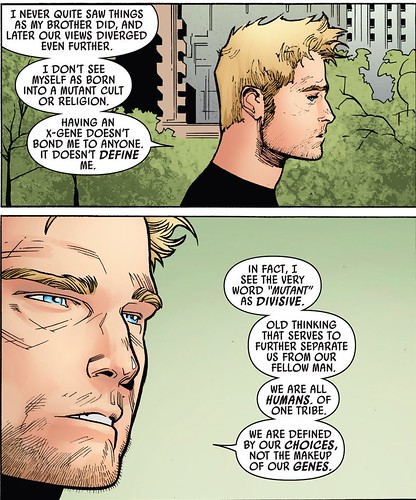
So, I was a bit disturbed when I saw this scene in an issue of Uncanny Avengers. The character speaking in the panels below is Havok, one of the X-Men. He's never been a particularly vocal advocate for mutant rights - he was briefly involved with a mutant terrorist group, but that was revealed to be an undercover job - but that's probably beside the point. Here's the leader of the Avengers' Unity team - a joint X-Men/Avengers effort to improve the standing of the mutant community - effectively telling everyone that he advocates a post-mutant (or, I guess, mutation-blind) society. And it left me cold:


In a subsequent panel, a reporter asks Havok what they should call him if not "mutant". He replies "Alex."

Now, the problem is not that Havok's speech is unrealistic or unconvincing. Havok has never shown himself to be the most dedicated X-Man - he's quit a couple of times, and for the first couple decades of the comic he preferred to be completely uninvolved in mutant politics or superheroics - and it might be compelling to situate him as a conservative voice for a post-mutant America. The rhetoric is certainly familiar: he doesn't want people to see his powers, just as the post-race bunch pretend that they don't see race; he sees himself as the product of his choices, ignoring the systemic realities that restrict those choices, just as many conservatives do.

It might not be an ideology that I value, but it could make for a compelling read. How would mutants with a more progressive take on human-mutant politics react to the choice of Havok for such a prominent role? Would they perceive some agenda on the part of Captain America, who selected him? And what kind of mutant politics erases the "mutant" from its own politics? I imagine that Havok would face a lot of the same criticisms that were lobbed at Condoleeza Rice or Colin Powell when the post-race Bush Administration came to power.

Alas, Marvel and writer Rick Remender weren't planning on taking it in that direction. For them, Havok's rhetoric was not political or even controversial. Funny, the sorts of nonsense you can sell yourself when you're able to write about - and enjoy - oppression from a position of privilege.

Mind you, this isn't new. Marvel has always used the X-Men to encourage people of privilege to experience - and derive some enjoyment from - oppression at a distance, vicariously. But I've never seen them do this, at least not so explicitly. Marvel is using the X-Men to violently undermine the relevance and reality of identity politics, to reduce social categories, from which people derive their sense of self and worth, to dirty words and systems of social inequality to "choices".

That kind of thing is going to make people angry, especially the fans who have been told that the X-Men are a minority like they are. As Ladies Making Comics so aptly put it on Twitter, "Telling people whose rights have been trampled for decades 'But we're all people! Let's get along!': guaranteed to piss them off." Yep, them and everyone else who gets it.

But, wait! said Marvel and Remender. That's not happening at all, because the X-Men aren't actually a metaphor. They're just a fictional category of superheroes, and YOU are reading too much into it. Cue Remender's response to Ladies Making Comics: "Mutants come from all races and sexual orientation. It's not an apt analogy you're making." And fellow X-Men writer Jason Aaron: "It's not the story of what it means to be black or gay in today's society."

In a sense, Aaron is right - the X-Men don't tell us what it's like to black or gay, because the people writing the X-Men are almost always straight white guys who can only guess. But that doesn't mean that they don't pretend that they can. To claim otherwise, as Remender and Aaron (and I can only guess who else) do, is disingenuous, if not dishonest. (Indeed, Racialicious has a huge piece on this story, which includes other writers - and Remender himself - contradicting these comments from Remender and Aaron. You should probably read it.)

But don't take my word for it:
  • "What's fascinating about these two characters [Magneto and Professor X] is that they're really the Malcolm X and Martin Luther King of comic mythology." -Bryan Singer, director of X-Men, X2, and X-Men: Days of Future Past
  • “I know, speaking to Marvel Comics, that it’s not just gay people who identify with mutants – it’s other minorities, too, religious minorities, racial minorities” -Ian McKellan, Magneto in the X-Men films
  • "Every time I would hear one of these ideas, I would always ask myself, 'What's the point of being so specific? A gay mutant? An African American mutant? An HIV-positive mutant? Oxymorons, all of them.' To my mind, mutants are all those thing simultaneously. They're every oppressed minority and disenfranchised subculture, all rolled up into one metaphor." -Joe Casey, former Uncanny X-Men writer

When people are gushing about the property and it's inclusivity, they're quick on the draw to brag about how the comic was always meant to accommodate all these identifications and readings. It speaks to the real world, it allegorizes real people and situations.

But when people start to critique it? When they begin to disagree with the message that Marvel is selling, that it's effectively putting into the mouths of disempowered peoples? Then, the creators deny that it was ever supposed to reflect reality, that it was ever intended to be more than escapist fantasy.

And that's probably the most infuriating part of this whole thing. It's not that they simply deny responsibility for or awareness of the metaphorical reading that everyone is familiar with, it's that they forsake it in one breath but accept any and all kudos in the next. Marvel wants to have it both ways, and they shouldn't get away with it. But they do.

Wednesday, May 01, 2013

CBC Kids doesn't want white people, and it's not racist or even a big deal


So, Kids' CBC is looking for a new co-host for their morning programming. Presently, the morning show is hosted by Patty, a 40ish white woman, and Mamma Yamma, a yam-shaped puppet. So, I guess that means that Sid Bobb, an Aboriginal man whose on-air role has noticeably declined in the last few months, is moving on to something else.

For the record, I've consistently watched Kids' CBC - sometimes more frequently than other times - with my daughter for more than 3 years, now. Aside from some bizarrely interesting musical guest choices - Billy Bragg singing with a puppet-crab, for instance - it's a remarkably tame show, no different from any other morning show aimed at the kindergarten demographic. So, this shouldn't be big news. But it turns out that it is. (Again, it shouldn't be, but it is.) Because this is what a hiring agency posted for the CBC:


The contentious line is the last one in this screen cap - "any race except Caucasian". (That this is the only contentious line is a hilarious irony that exposes the ridiculousness of the 'controversy', but I'll get to that later.) Twitter erupted with rage over the exclusion of white men, and both the CBC and the casting company they hired apologized. The casting agency also amended the ad so that it no longer mentions race, and you can read more about the agency and CBC's responses here. You can also check the coverage of this story at the Huffington Post, where Marni Soupcoff makes a number of observations that I both agree and disagree with, but all of them are quite thoughtful.

But as for that rage... the ads elicited a predictably conservative reaction, but I think that it's probably fair to look at just one. A friend of mine tweeted that it was an example of "sickly racism" and added the familiar cliché, "how about hiring the BEST host, rather than one with certain skin pigmentation?" He also made a connection between these hiring practices and the spotty record of Affirmative Action in universities, posting this link to a story in The Atlantic.

To that, I say "bullshit". (Well, in the actual interaction I called it a "non sequitur". But, y'know, it's bullshit.) The story in The Atlantic is about admitting students who lack the preparation and skill to compete at top-tier schools; this story is about a children's morning show host. The story in The Atlantic mentions that academic "mismatch"* might be responsible for black students dropping out of engineering programs at more than twice the rate of white students; but this job is literally not rocket science.


Some of the Kids' CBC cast: Sid, Patty, Captain Claw,
Mamma Yamma, and Salmon. Not rocket scientists.


There are two main points that I want to make, one in response to my friends complaints, and another more broadly in support of the CBC's hiring directives.

One, there is no "BEST host" out there. No one is finishing in the top-percentile of the Standardized Hosting Test and being overlooked because he's white. And to the extent that the CBC should be looking for the "BEST host", it's worth considering the actual needs and objectives of the program. Reasonably, I think, Soupcoff points out that "we also have to remember that what we're talking about here is casting an entertainer in a dramatic enterprise, not staffing a position in the bureaucracy."And indeed, a letter from the CBC told the hiring agency that they wanted actors who reflect "Canada and its regions as well as the country's multicultural and multiracial nature", since the show is very much about showcasing various regions and people in the country. In that case, the "BEST host" might very well be one with a particular race or gender that is otherwise under-represented.

And this leads directly into my second point. Regardless of the CBC's responsibility to aspiring hosts, they have a much larger responsibility to the kids that watch Kids' CBC. Canada's multicultural and multiracial nature? It's the audience for this show. Those same non-white kids? They can look forward to years of TV and film programming filled with the faces of white men, with the stereotypes of their own race and ethnicity, or with the exclusion of their race and ethnicity altogether. Representation is power, and for non-white kids watching a morning show that's populated only with white people? Well, it follows that lack of representation is disempowering.

I mentioned, at the top, that there was an irony to all this outrage. And it has to do with the fact that all the anger is directed at the exclusion of white people. The thing is, they're not the only demographic groups that were denied the opportunity to apply. Let me spell it out, in case you missed it. This was the very first requirement listed:
  • Male between the ages of 23-35yrs

So, who else can't apply? Anyone under 23. Anyone over 35. And women. No women can apply. An entire gender has been barred from applying. And where's the outrage? Where are the cries of sexism? Why aren't the people who successfully lobbied CBC to consider white men also asking them to consider women of colour?

Unsurprisingly, those hypocrites are nowhere to be found.


[*According to the article, "mismatch" is the term for situations where the student simply doesn't have the proper educational background for their program. The reasoning is that we don't want mismatches because we're doing those "mismatched" students a disservice - we should, instead, nudge them toward easier programs. What the "mismatch" rhetoric fails to address, of course, is that systemic racism has a lot to do with the lack of preparation - the disservice is done well before they ever set foot in a university classroom.]