Showing posts with label Brett Lawrie. Show all posts

Thursday, January 03, 2013

The sad case of Ryan Freel, and what players like Brett Lawrie should learn from it

When I wrote about the Toronto Blue Jays' Brett Lawrie last summer - suggesting that, in cases like his, 'playing hard' could easily be a bad thing - I compared him to Eric Byrnes, a late-peaking player who burned bright for a few years (the 67th most valuable hitter from 2004-2007) before suddenly fizzling. But I might have just as easily compared Lawrie to Ryan Freel.


The 36 year-old Freel, who hadn't played Major League Baseball since 2009, died last week, after shooting himself in the head. According to his family, baseball-related concussions - he suffered somewhere between 10 and 20 of them - were almost certainly to blame. According to his ex-wife,
“I don’t know how many times he would talk about sliding into second or third base and blacking out or seeing stars. I cringed that that’s who he was – all-out, full throttle. It was very hard to watch.”


I've actually known about Ryan Freel since he debuted, given that he came up with the Blue Jays in 2001. It's a somewhat vague memory, at this point, but I remember really liking him - he was small and overly serious. He was also quite good, and Freel's career and performance (the 62nd most valuable hitter from 2004-2006) was shockingly similar to that of Byrnes. And, like Byrnes, a lot of that value came from doing the little things that aren't easily appreciated - running the bases well, stealing bases, playing strong defense.

Freel was not highly-valued or considered to be incredibly talented (unlike Lawrie, in this regard) but was considered hard-nosed and gutsy, sacrificing his body at every turn and chasing after every ball within a couple hundred feet of him. And, like Byrnes, in his early 30s he quickly went from being a tremendously useful, and above-average, everyday player to a poor-hitting scrub. Again, like Byrnes, the injuries eventually became too much to play through, too much of an impediment and detriment.

Freel and Byrne were only useful so long as they could run hard and crash hard - be it into walls, into the stands, into opposing players, or even, occasionally, their own teammates. (A collision with a teammate is often cited as the concussion that finally ended Freel's career.) And when they could no longer do those things, their below-average skills couldn't keep them employed.

Lawrie is a better athlete, and probably a better player, than either Freel or Byrne. But one would hope that players like these can take something away from Freel's story.

Thursday, July 19, 2012

When 'giving it your all' is giving too much

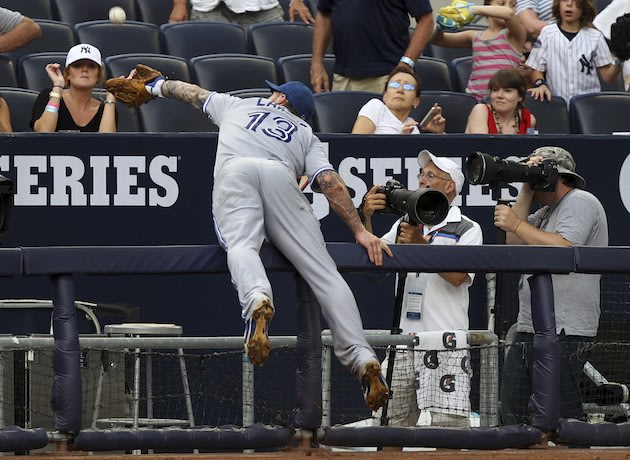
In an all too predictable scene from last night's Blue Jays game, Brett Lawrie leaped over a guard-rail, Superman-like, to catch a fly ball in Yankee stadium, banging his leg on a smaller railing as he came crashing back to the Earth. (Not that it really matters, but he didn't make the catch.) It doesn't look particularly ugly at first. And then it does with the benefit of a slowed replay and a better angle:


To quote the YES network commentators, Lawrie is one of those guys who "gives it their all". And according to Kevin Kaduk with Yahoo Sports, Lawrie "came away with...the respect of those who happened to be watching". But from all the comments I've read, Dirk Hayhurst comes closest to hitting the nail on the head...:


Let's make sure that this is perfectly clear: it isn't a coincidence that Lawrie is both a guy who 'gives it his all' and that he hurt himself, nor should we bemoan how unfortunate it is that such an accident and injury would befall someone who plays so recklessly. (Much less pay him respect for doing so.) It is, in fact, entirely foreseeable, and the injury is the direct result of his overly-intense style of play. And it shouldn't be encouraged.

Because it was also entirely avoidable. What's lacking from the discourse surrounding the injury is any discussion of, frankly, Lawrie's stupidity. Jumping into a concrete camera bay - a concrete camera pit, no less, because it looks like it's recessed from field-level by about 2 feet - is an undeniably stupid thing to do. And we shouldn't lament his accident, praise his vigour, or give him our "respect" when he does things that are unnecessarily dangerous. Instead, we need to hold him accountable, because in hurting himself he also hurts his teammates.

I'll admit that this looks cool, but, seriously,
it's also just completely unnecessary. Photo by the AP.

It's customary, when players are accused of the opposite problem - of playing too lackadaisically, of not running-out a ground ball, not playing hard when the game isn't close - to bench them. (Sometimes, this strategy is misused - like when a player fails to run on a play that's an automatic-out 99% of the time in an 8-0 game. But, sometimes, it makes a lot of sense.) And Lawrie, as a result of his own carelessness, is very likely to miss a game or two. That's maybe something, a de facto suspension, if you will.

But I'm not sure that's good enough. Players get benched for hurting the team because they don't try hard enough - why not bench Lawrie because he hurt the team by trying too hard? (No, seriously.) For his own good, even. Because if someone isn't able to convince him that, occasionally, it's just fine to ease up, he's not going to be long for this sport. And that's bad news for anyone and everyone who's associated with or simply likes the Toronto Blue Jays

Friday, May 18, 2012

The logic of baseball suspension length, or lack thereof

First, a disclaimer: This blog is not going to turn into the Brett Lawrie Blog, Sometimes Covering Other Topics. (Even though, right now, it might seem that is!)

Second, an additional disclaimer: I have been harshly critical of Lawrie in the two posts that I've devoted almost entirely to him. I'm not certain that I would like him much in conversation, but I actually do really enjoy watching him play. He's exciting to watch, in part because he's already a good player and in part because he's always putting in maximum effort. The enthusiasm he displays in every moment is, I think, unparalleled in baseball, and you can feel it rubbing off on the rest of the team. And the series of handshakes that he's designed with each of his teammates are ridiculous, but in a good way.

But, the guy who seems to pull off something like every second game...


...is the same guy who did this a couple days ago.


Understandably, he was suspended. Because as much as we all want, to put it euphemistically, to lose our shit when a call doesn't go our way - and, in fact, it was two consecutive blown calls that led to Lawrie's "Hulk Smash!" explosion - it was a terrible idea. (I know that the Pitch F/X data that's been circulating suggests that the pitch barely missed an inch high, but their range makes no sense. I can't imagine any umpire calling a pitch that's more than 3 and a half feet high a strike, much less against a 6 foot tall hitter who's a half foot shorter in his stance.)

The culture of the game is to blame, too, of course. Players and umpires are all but encouraged to get in each other's faces and scream. The system by which umpires are evaluated and made accountable for their mistakes are entirely opaque. And it should be very easy to develop a program that can call balls and strikes with better accuracy. Baseball has made no effort to address any of those things.

So, what I wanted to look at is where the punishment - four games - fits in relation to other suspensions, across various sports. In part, I want to see whether there's a consistent logic applied within baseball and across various sports; in part, and assuming that there is some consistency, I want to see if Lawrie's punishment fits it. Following from this starting point, then, I pulled together this list.

  • 1 game (<1% of season) - Bobby Bonilla, 2001 (slapping another player)
  • 2 games (1%) - Milton Bradley, 2009 (bumping an umpire)
  • 2 games (1%) - Marlon Anderson, 2007 (throwing helmet toward home plate)
  • 2 games (1%) - Lance Berkamn, 2007 (throwing equipment on field)
  • 2 games (1%) - Roberto Alomar, 2005 (throwing glove in direction of umpire)
  • 3 games (2%) - Jonathan Papelbon, 2011 (bumping an umpire)
  • 3 games (2%) - Burke Badenhop, 2009 (hitting Orlando Hudson with a pitch, after a warning)
  • 3 games (2%) - Albert Belle, 1993 (charging the mound after being hit by pitch)
  • 4 games (2.5%) - Brett Lawrie, 2012
  • 4 games (2.5%) - Moises Alou, 1995 (participating in bench-clearing brawl)
  • 5 games (3%) - Cole Hamels, 2012 (hitting Bryce Harper with a pitch)
  • 5 games (3%) - Yadier Molina, 2011 (bumping an umpire, with incidental spit)
  • 5 games (3%) - Josh Beckett, 2009 (intentionally throwing near Bobby Abreu's head)
  • 5 games (3% ) - Roberto Alomar, 1996 (intentionally spitting on umpire) 
  • 50 games (35%) - Delmon Young [International League], 2006 (throwing bat at umpire)
  • Banned for life - Jose Offerman [Dominican Winter League], 2010 (punching umpire in face)

The first thing that's made clear, here, is that baseball treats violence (and the threat of violence) against players and umpires differently. Charging the mound with your fist cocked is given the same punishment as bumping the beak of your hat against the umpires forehead. The distinction makes sense, though; you need to allow for the possibility that things will get heated between opponents, but you can't allow players to think they can intimidate the officials. (I've also heard the legal argument - of "assumed risk" - that says baseball players concede implicitly that the job is potentially violent and injurious, while umpires do not.)

Jose Offerman charging the mound in a AAA game. He hit the catcher
in the head and give him a career-ending concussion. Is that "assumed risk"?
No photo credit available.

Second, baseball has been all over the place with the lengths of its suspensions. There are three different suspension lengths for three different umpire-bumping incidents, and Yadier Molina's bump-and-spit combo (where I'm probably being generous with "incidental" spit) got the exact same length as Alomar's unmistakably intentional spit 15 years ago. There should probably be some sort of standard here, but there clearly isn't. About the only thing that they can agree on is that pitchers should get about five games if they admit, or are proven, to have hit a batter intentionally. But this has less to do with how the infraction compares to other forms of violence than it does to the fact that starting pitchers only play once every five days.

And here are the comparisons to some recent rulings in other sports leagues.

  • 20 games (24% of the season) - rulebook suspension for intentionally tripping a referee [NHL]
  • 25 games (30% of the season*) - Raffi Torres [NHL], 2012 (blindside check to Marian Hossa w/head contact)
  • 15 games (39% of the season) - Dani Benitez [La Liga], 2012 (throwing water bottle at referee)
* the NHL's playoffs, like the NBA's, are so long and include so many teams that it's probably not fair to assign a percentage

The soccer suspension is completely out of whack with anything else that I've ever seen. It's actually maybe the nearest to the Lawrie incident, insofar as both throws seemed to be expressive of frustration and not an intent to injure. On the other hand, Benitez was trying to hit a referee, while Lawrie threw his helmet with such force that the possibility of accidental injury was greater (though still small). But that length is just nutty. And I've included the Raffi Torres incident in order to illustrate, again, the difference in punishments when we're talking players vs. officials. And while the NHL isn't anywhere near La Liga, when it comes to punishing players who lash out at referees, I think it's fair to say that they both take is a lot more serious than baseball does.

I don't have any solid conclusion to end with. Even though baseball's punishments appear to have no strict system of application, they're all so short (mostly between two and five games) that it's difficult to argue that Lawrie's suspension is surprising or inconsistent with past practice. The real question, though, might be whether baseball's practice is a good one, because Lawrie's actions would certainly earn him a longer suspension in either the NHL or La Liga. But that's something that all of baseball would need to start thinking about.

Wednesday, May 02, 2012

Victoria's Secret and Brett Lawrie: the jokes write themselves

Brett Lawrie flirts with a model while enthusiastically gripping a bedazzled phallic object.
Yep, this is news. Photo by Carlos Osorio

I'm not going to discuss the story that this picture comes from. The Toronto Star does a decent job of that, as do the bloggers that they link to in that article. No, I just wanted to post this picture of Brett Lawrie and one of the Victoria's Secret Angels, because it's both hilarious and shameless. How Lawrie continues to allow himself to be photographed like this, especially after all of the other embarrassing pictures that have been leaked to the internets - pictures that initially had Jays fans questioning his judgement and, uh, "make-up", to put it euphemistically - boggles the mind.

And, honestly? I realize it's Victoria's Secret and all, but did they really need a lingerie model? Could they have made it any clearer that this line isn't for the average female baseball fan? And that the clothes aren't even made for the women who wear the clothes, but rather for the men who'll see them wear it? (As opposed to, say, men's merchandise, which isn't restricted to underwear and pyjamas, and is designed to fit and flatter all sorts of body types?)

At the very least, they could pair the ballplayer Brett with a female ballplayer - match an athlete with athlete. "Well, who could that possibly be?" you say? Well, at least one name springs to mind immediately. And Brett Lawrie has even taken pictures with her before!

That's Brett's sister, Danielle, btw. Can't find a photo credit.

Thursday, April 19, 2012

Brett Lawrie and 'playing the game the right way'

When the Oakland A's Eric Byrnes finally managed to stick with the big league team in 2003, it was with some serious concerns about his durability. Sure enough, Byrnes did a lot of The Right Things: when Fangraphs last deemed him worth writing about - in 2010 - they noted that he was both beloved and mocked for his "grit", and even his Wikipedia page notes that he was known primarily for his "hustle". Which is to say that he demonstrably tried really hard.

Byrnes, making a play on a routine fly ball. Because that's just how he rolls.

Of course, pushing yourself and hustling non-stop can certainly be a bad thing. (On a personal note: I play really hard, and I only play rec-league softball. Last year, I pulled my rib cage; the year before, I broke a bone in my foot.) Those concerns - made prophetically by scouts and analysts during his breakout in '03, when he was still hitting .350 and leaping for every ball in the outfield - had mostly to do with the fact that he tried too hard, played too recklessly, and couldn't last an entire season. And they were right: Byrnes hit .334 and was 50% better than league average on offense - according to Tom Tango's wOBA - in the first half of the year, which is superstar-calibre hitting; he hit .146 and was 50% below average the rest of the way, which probably isn't even deserving of a spot on the bench. (Though the split isn't as extreme over the length of his career, it remains: his best months were May and June, where he was about consistently about 10% above-average, and his worst were August and September, where he was about 25% below.) As for his durability, he would only once play more than 143 games, and in the eight years between his breakout and retirement - he retired at 34, which is very young for a once-star player with speed and fielding skills - he only averaged 120 games a year, or about 75% of a full-season.

But Brett Lawrie's name appears in the title of this post, doesn't it? And here I am, wasting hundreds of words on Eric Byrnes.

Now, granted, I haven't watched every Blue Jays broadcast so far this year. But when I have, one of Pat and Buck will inevitably make reference to how hard Lawrie plays - often invoking the cliché of "he plays the game the right way". And if you're really lucky, they'll say it repeatedly!

I would ask "what the fuck does that even mean?", but that would be disingenuous - because I do know what it means, and you know that I know what it means, if only because I just went through that whole Eric Byrnes story. (Also, you probably know what it means!) What it means, even if they're incapable of clearly articulating this, is that he runs hard on every ground-ball, he dives for everything remotely near him, and he slides hard into every base. Just like Eric Byrnes.


Lawrie, following an intentional-walk. Seriously, you should see this guy run out a ground-ball.

I actually have a surprisingly clear memory of Lawrie's first Major League triple. He hit it at home (against the Angels - I had to look that up) and it could have easily been a stand-up, because he's that fast. But, because he was probably too pumped up to notice that there was no play, he dove into the base, head-first and hard. Which seems pretty innocuous, but - and maybe you shouldn't take my word for this, because Lawrie has about 10x the pectoral muscle-mass that I have - holy shit, does sliding on your chest across dirt ever bang up your body. It was completely unnecessary. And it certainly wasn't the only time he's done it without having to.

And while all this might sound laudable, it really isn't. It doesn't actually make sense for an MLB player to run their hardest on every grounder, because 99% of the routine ones will be fielded, thrown, and caught cleanly. Likewise, it may make sense to ease up on fielding a difficult ball in a low-leverage situation, or choose to slide feet-first rather than the considerably more dangerous (but more controllable and possibly faster) head-first. Injury is probably the most important factor, here, (lemme say it again: Eric Byrnes) but common sense should come into play, too - don't use all your bullets unless/until you need to. Because, make no mistake, your body only has so many dives, slides, and full-speed sprints locked inside of it.*

But back to "playing the game the right way", and the full implications of what it means to say that. David Savran once wrote that masculinity is an accomplishment, but a particularly masochistic one - a constant struggle to measure up to an impossibly high standard, one where your failures and their accompanying pain are themselves the mark of normative manhood. It's not about "mastery" but "the act of being subjected, abused, even tortured". (I think there's space, here, for a totally different but entirely interesting discussion about why we like to celebrate the plucky guys who live on the fringe and hate/resent the guys who make it look too easy.)

So, part of what it means to "play the right way" is, in fact, to subject your body to unreasonable amounts of stress and risk injury - and to prove your worth and suitability through the accumulation of injuries. And while his career ended early, this style of play ultimately proved to be a pretty good investment for Eric Byrnes. How's that? Well, he parlayed his best season and reputation for grittiness into a $30 million contract, a contract that he would never come even close to making good on. But, obviously, what's good for your masculine credibility is bad for your body. (And bad for the team.) It would just be nice for the people within baseball, cheering on the masochism, to acknowledge that more often.


* I realize that this might sound contradictory or hypocritical, because in my first live-blog I criticized Pat Tabler for suggesting that guys "concentrate more" when the game is on the line. But this isn't a concentration thing - if anything, it's the opposite, because I'm saying that players like Lawrie lose their concentration and seem to let their adrenaline dictate their pace of play.