Showing posts with label the Olympics. Show all posts

Thursday, August 09, 2012

Olympic soccer: rules and dives

Two quick responses to Olympic women's soccer:


1) Without getting into too much detail - because if you care, you already know; and if you don't, you can just read about it here - a semi-final game in Olympic soccer might have been decided by a referee's decision to invoke an arcane and rarely used rule that says a goalkeeper can't hold on to the ball for more than 6 seconds. (How rare and arcane? Apparently, no sports writer can find mention of it in an international or major domestic league game - men's or women's - since 2002. That's ten years, and probably tens of thousands of games.) What makes this rule especially damaging is that the opposing team is awarded a free-kick directly in front of the goal.

For baseball fans, this would be like enforcing the "12-second" rule for pitchers. What "12-second" rule, you ask? The one that's never actually used, yet remains in the rulebook:

8.04 When the bases are unoccupied, the pitcher shall deliver the ball to the batter within 12 seconds after he receives the ball. Each time the pitcher delays the game by violating this rule, the umpire shall call “Ball.” The 12-second timing starts when the pitcher is in possession of the ball and the batter is in the box, alert to the pitcher. The timing stops when the pitcher releases the ball.

Hilariously, the average pitcher in Major League Baseball is nowhere near the ostensible "limit" of 12 seconds per possession - it's actually more like 20. And yet, an umpire could suddenly decide to call this rule, and the pitcher would have no substantive reason to object, except on the grounds that no one calls it. Which is simply a disaster waiting to happen. If officials don't use it, the rulebook should lose it.

*     *     *

2) I often find men's soccer painful to watch. It's the diving. I just can't stand to watch people pretend to be fouled and then pretend to be hurt. And I like watching women's soccer because it there's almost none of that. And not only is there virtually no diving, but it seems like these women will collide and run over each other and get right back up - to put it simply, they 'suck it up'.

At first, this seems really unintuitive. We expect women's sports to have (patronizing) rules in place to protect them - women's hockey, for instance, doesn't allow body checking at any level - and we expect, in North America, at least, that men will behave in typically masculine ways and eschew diving or any other behavior that might make them seem weak.

That last bit might be the important part, though. When I was watching Canada play Great Britain, the commentators suggested that the stylistic difference between the women's and men's games was cultural - the women's game, and it's first powerhouse-teams - emerged in the USA and East Asia, where diving in any sport has never been valued, and those values were emulated by other countries. Now, I don't know that this is an adequate explanation. Most of the women's teams are coached and trained by European men, after all. But it's certainly interesting. (And certainly problematic, since it's that masculine ethic of playing through the pain and self-destructive behavior that I've criticized again and again. And which, clearly, I value in spite of that.)

Saturday, July 28, 2012

Mocking the London Olympics' Opening Ceremonies

The Opening Ceremonies for the 2012 Olympics made all sorts of references to the children's literature that's been produced by British authors: Mary Poppins, Peter Pan, and Harry Potter were all rather prominent. But the book - or series of books, rather - that seemed to dominate the show was never actually referred to by name.

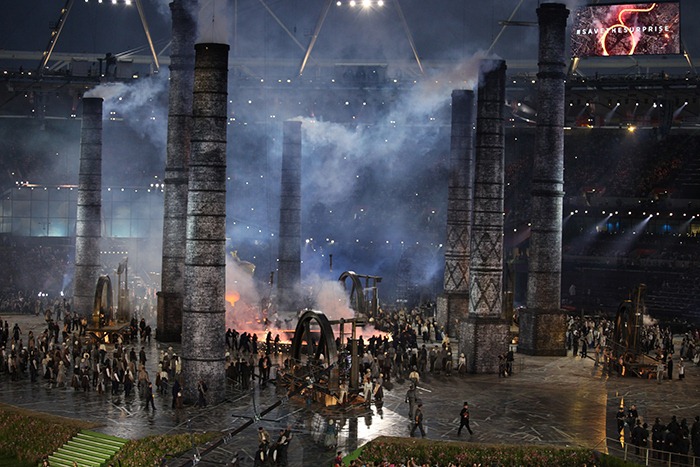
Take the landscape that opens the show, which looks something like this. The center of the stadium is filled with green, rolling fields, featuring a giant hill in the background. Idyllic, pastoral. It's Shire-like, even:


But then, after a bit of a show and speech, (by Kenneth Branagh!) the green burns away, smoking towers rise from the ground, and weary, dirty laborers replace the cheerful farmers-in-repose. It's supposed to dramatize the "progress" of the industrial revolution...


...instead, it looks ominous, even somewhat apocalyptic. I'm thinking less of industry and more of the orcs plundering Isengard. And though you can't really see it in this image, (you'll see it in the one immediately below) they're forging a ring in the center of the pillars.


Do I need to say it? We're looking at the heart of Mount Doom. (You've probably caught on by now, too - the English classic that goes unnamed, probably not even consciously invoked, but nonetheless haunts the ceremony is The Lord of the Rings. Apt, too, when you think about how needlessly expensive and exploitative these kinds of events tend to be!)

But we're not done yet! Because the Olympic flame is eventually raised, and it looks a little something like this.


"The Eye was rimmed with fire, but was itself glazed, yellow as a cat's, watchful and intent, and the black slit of its pupil opened on a pit, a window into nothing."

Oh, yes. I went there.

Seriously, though, there was something vaguely terrifying about the entire process. How anyone could read the transformation of that adorable countryside into so much machinery-scarred Earth and smoke as anything other than a horror story... yeah, that's just confusing.

Thursday, June 28, 2012

Castor Semenya still has something to prove

Whenever I teach the flimsiness of biological sex definitions to undergraduate students, I approach it via international sport and the repeated failures of "sex-testing". (Well, actually, I start by asking the students explain how we "know" someone is a man or a woman, and then to subsequently explain how they "know" that I am a man.) I won't bore you with a history lesson - you can find some of that here, or a more detailed and interesting account in books written by people like Anne Fausto-Sterling. Suffice it to say, sex-testing has been such a disaster for international sport - from a human rights standpoint, from a PR standpoint, from a scientific standpoint, from a basic fairness standpoint - that the last Olympic venue to sex-test all of its athletes was Atlanta in 1996.

Why? The problem, if you're new to the study of sex and gender, is that there's no universal standard for what makes a woman a woman. According to New Scientist, the Olympics actually uses several experts from several fields, each with their own measures and definitions: "an endocrinologist, a gynaecologist, an internal medicine expert, an expert on gender and a psychologist". Obviously, then, it's not surprising that the system eventually broken down for lack of a single, satisfactory definition.

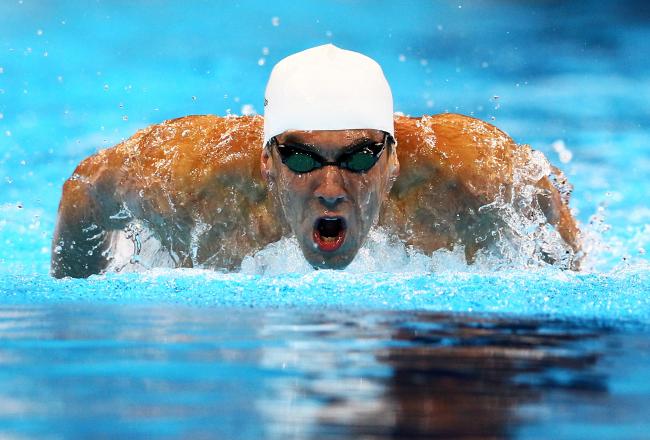
(International sport doesn't actually care if someone who's competing as a man is a woman, or if a man is a mutant, for that matter. Michael Phelps is an evolutionary wunderkind who would probably fail his sex test if he were a woman, if only because his body deviates so significantly from human norms that those deviations are bound to overlap with stuff we usually associate with sex characteristics. But he's not a woman, so no one cares how his natural ability to not create lactic acid impacts his sex.)

Is he a man? (Or is he a muppet? A muppet of a man?) Photo by Al Bello/Getty.

Now, that's not to say that sex-testing doesn't still happen - it does, and a few Olympic athletes have quietly failed their tests since 1996. But there's no more pretending that a single test (or even a series of tests) can adequately address the variety of sexes offered by human beings.

But that system, and its problems, only really came to light - and blew up - when Caster Semenya became a lightning rod for the discussion in 2009. You might remember her as the World Champion long-distance runner who, it was suspected, might "actually" be a man. Officially, the International Association of Athletics Federation (IAAF) was concerned that she might have a "rare medical condition" that gave her an unfair advantage. Nice euphemism.

(Returning to Phelps, again - strangely, no one has ever suggested that his "rare medical condition" is unfair, have they? And furthermore, don't you kinda have to have a "rare condition" of some physical sort or another in order to become an elite athlete in the first place? It's not like Usain Bolt is that fast only because he trains harder than everyone else, y'know?)

Athletics South Africa (ASA) would later admit that they had administered a sex-test without Semenya's knowledge. (And subsequently suppressed the results!) And the IAAF eventually agreed that Semenya's World Championship would stand, but said nothing about whether she would still qualify as a woman for future events. (At least, not until the next World Championship was nearly upon them.) Or, for that matter, what defined "woman" for their purposes.

Caster Semenya in 2010. Photo by Erik van Leeuwen.

Getting back to my gender class, though - recently, and in response to the whole Semenya thing, I've been telling my students that most sports orgs have acknowledged the problems inherent in sex-testing and dropped the tests altogether. And that's kind of true. (There have been allusions to "secret" investigations. Obviously, I can't say much about something that may or may not exist, and that no one is talking about regardless.) But what's happened, and it seems that no one really knew until a few weeks ago, is that sex-testing has reappeared in a new and unexpectedly backward way.

Given that they can't effectively police the borderlands between male and female, this year's Olympics will police one specific element of their bodies: their testosterone levels. From the Toronto Star:

recent rule changes by the International Association of Athletics Federations (IAAF), the governing body of track and field, state that for a woman to compete, her testosterone must not exceed the male threshold. If it does, she must have surgery or receive hormone therapy prescribed by an expert IAAF medical panel and submit to regular monitoring.

What. The. Fuck. Hormone therapy? "The male threshold"? Who decides what that "threshold" is, anyway? And if we can't define male, how do we even begin to go about defining its threshold level? I'm not sure if this is lunacy or idiocy.

“What’s been going on here, for over 50 years now, has been an attempt to modify and refine the rules so as to be fair but also to be scientifically accurate and appropriate,” says [IAAF endocrinologist Dr. Myron] Genel. “We’ll get it right.”

And as long as they think there's a "right" test out there, somewhere, we can be certain that they'll continue to get it wrong.

One last quote from the Toronto Star article, this one from Bruce Kidd, a Canadian sports policy adviser who links the needs to define "real woman" with some very old politics and opinions:

“It’s still the old patriarchal fear, or doubt, that women can do outstanding athletic performances. If they do, they can’t be real women. It’s that clear, it’s that prejudicial,”