Showing posts with label follow-up. Show all posts

Thursday, February 28, 2013

The Saginaw Chippewa and People-as-Mascots: there's a Santayana joke in here, somewhere

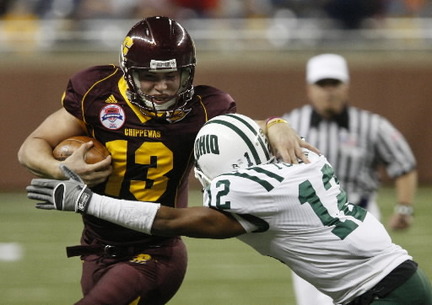
A while back, this interview showed up on my Twitter feed, about the stance of the Saginaw Chippewa tribe with respect to sports teams that use Aboriginal names and likenesses as logos and mascots. In short, they're supportive of these symbols provided that they aren't used mockingly and serve to educate, and teams like the Western Warriors (a high school basketball team) and Central Michigan Chippewas (a College team) have their full support.

Just in case you're a TL;DR kind of reader: folks on Twitter claimed that the above interview might lead some to re-think their position on such mascots. But it shouldn't. And that's what this particular blog is about.

I have some strong feelings on this topic - which I've shared before - but I'm not entirely opposed to the sentiment that's expressed in the article. Education is certainly a good thing, and if a mascot can actually increase historical awareness, that would be pretty awesome.

The problem is, I don't think it can, or at least it hardly ever does. And for an argument that's premised on historical awareness, there's at lease this one little bit of unfortunate irony, offered by Frank Cloutier, public relations director for the Saginaw Chippewa:
Our position is that if it's not derogatory and it's being used appropriately, with an opportunity to share or cross-share our culture, then it's fine. There's nothing derogatory about "Warriors" or "Braves." There's nothing derogatory about "Indian." But terms like "Redskin" or "Half-Breed," those are derogatory terms to us. 

Now, I could take the easy path, here, and argue that "Brave" and "Indian" certainly can be derogatory but I won't. That's less an irony than it is a disagreement. Instead, I'm going to take a closer look at the "Redskin" team that he's referring to. (It's oblique, in this instance, but he later says that it would be "most appropriate" if the Washington Redskins changed their name.)
 
The irony, instead, that the football team's logo and mascot might exist, and have persisted, precisely because an earlier Aboriginal leader advocated for it. From a 2002 Washington Post article that's since gone offline:
“I said, ‘I’d like to see an Indian on your helmets,’ “ which then sported a big “R” as the team logo, remembers [former chairman of the Blackfoot tribe and president of the National Congress of American Indians Walter] Wetzel, now 86 and retired in Montana. Within weeks, the Redskins had a new logo, a composite Indian taken from the features in Wetzel’s pictures. “It made us all so proud to have an Indian on a big-time team. . . . It’s only a small group of radicals who oppose those names. Indians are proud of Indians.”

For all that emphasis on history and education, Cloutier has ignored the very history of racist logos - and how that Redskins name and logo that he finds distasteful is, itself, a product of compromise and collaboration between white owners and a Native-American leader. Clearly, what's worth celebrating, and the value or meaning of educating, is highly relative. What strikes Cloutier as offensive is perfectly acceptable to Wetzel. And, presumably, Wetzel had his own line-in-the-sand, marking the division between the Redskins and the space where unacceptable mascots and logos lay.


For what it's worth, I'm in agreement with Cloutier with respect to the Redskins - the mascot should go, the logo should go, the name should go. But I'm not on-board with his argument that the names and logos are okay provided they're well-intentioned and have some educational component. Intentions don't speak all that well to the large contingent of fans who don't respect the culture, and education doesn't mesh particularly well with the ethos of organized sports. (If sport and critical thought tended to accompany one another, we wouldn't have to have conversations like 'is this racist?' all the time.)

And if history has taught us anything, it's that, eventually, another Frank Cloutier will come along and suggest that the Western Warriors and Central Michigan Chippewas are just bad as the Washington Redskins.

Wednesday, November 21, 2012

Baseball follow-up: and sometimes, it's all love

I blogged yesterday about the ambivalence that I feel for pro sports. But today, I read a story that reminds me that, sometimes, I don't have to feel ambivalent. Sometimes, it's all good.

This is Ichiro, inarguably one of the world's most famous ballplayers:


For the first ten years of his career, he was also one of the world's best ballplayers - he collected the 4th-most Wins Above Replacement from 2001-10, during which he also broke the record for hits in a single-season.

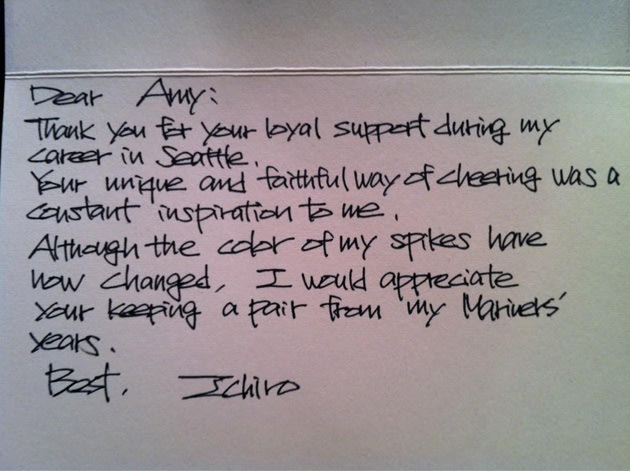
Just as importantly, he's earned a reputation for being a really nice guy. How nice? This is the letter that he wrote to a fan in Seattle, how kept a running tally of how many hits Ichiro recorded every season on her Ichimeter: (apologies to Yahoo for so shamelessly stealing their image and story)


And, sure enough, Ichiro included a pair of shoes and a bat, all autographed. Pretty awesome stuff.

Tuesday, October 23, 2012

University: It's not (just) about the ROI

A few weeks ago, I wrote a blog that responded to the whole Margaret Wente plagiarism controversy that was scandalizing the folks who cared about that sort of thing. (Which is to say, not many of us. But those who cared? We cared a whole lot.) And now? Margaret Wente is back to pissing people off - and, largely, the same group of people!

Accused plagiarist Margaret Wente.
Am I including this picture because I want to increase the likelihood
that her Google results will find this blog? Why, yes. Yes I am.


Now, I don't want to dignify Wente's claptrap with a prolonged summary of its argument. Everyone who follows these debates is already familiar with it, and this particular iteration doesn't deserve special treatment. But she (mis)identifies two problems with the Canadian university system, and I want to critique these in particular:
  1. You can't make universities both broadly accessible and ensure high quality.
  2. You need some sort of transparency about the Return On Investment, if not a guarantee that the ROI will justify the time and money.

The first premise is just plain wrong. It assumes that, because Canada provides better access to a university education than most other states, a university education is therefor accessible to and attainable by all Canadians. That's fundamentally untrue - millions of people have been shut out before they even get a chance to consider university, and millions more who want to go will realize that they simply can't afford the time commitment or the debt.

Now, it is true that we want to encourage continued participation. We (that is, instructors) don't want to crush our students, (not without good reason, anyway!) and we want to give them the chance to succeed. But we can't force them to succeed - they have to do that on their own. And I resent the implication that wanting to be accessible and inclusive requires that we diminish the quality of our teaching or evaluation. In fact, it's in those moments where someone (me, sometimes) is at their most inaccessible and exclusionary that the teaching devolves into an alienating experience where no one but the people who already hold The Knowledge seem to learn anything.

As for the second, well, ROI is simply a terrible metric to use when you're evaluating the quality of an education. I mean, is it the fault of the school or industry that, for instance, a BA in Political Science or Philosophy is going to fail to meet the parameters of the HR keyword search when you apply to work at Rogers? Is it the fault of the school or industry that one school's name carries more cultural caché than another? It doesn't matter how good your education is if you don't get the chance to demonstrate what you've learned, and increasing the transparency about ROI will do absolutely nothing to address a systemic bias against liberal arts degrees and small schools.

In fact, the liberal arts, specifically, shouldn't be privileging ROI at all. (I'm not going to lie, though. It matters that you can find work after university. But your salary shouldn't be the meter stick against which your education is measured. Or, honestly, against which you measure yourself.) I'm not sure whether it was intended as such, but three days after Wente's column was published, this fantastic rebuttal appeared at Inside Higher Ed. The gist of it is this: the liberal arts make us better citizens and better people. They matter because they contribute to a healthier, more self-aware, and socially-engaged society. And ROI doesn't capture all of that. (Nor do those algorithms that compile applicant lists of "qualified" applicants for massive corporations. And by "all of that," I mean "any of that.")

*     *     *

I'm willing to make two concessions, neither of which is central to Wente's theses.

One, while the university system may recognize high achievement - by conferring Honours or attaching some kind of distinction to the degree - it doesn't do so in a way that is easily comprehended outside that same system. So, when two people with the same type of degree apply for the same work in industry, the people doing the hiring either don't or can't distinguish between their relative levels of achievement. Essentially, and assuming everything else is equal, graduating on academic probation is just as valuable as graduating magna cum laude. (At York University, the two levels of distinction are magna cum laude and summa cum laude. Which one is better? If you can't tell, how the hell is a prospective employer supposed to know?)

Sure, you need to do more than merely participate, but you certainly aren't rewarded in any meaningful way for being the highest achiever. (Well, you can go to graduate school, I guess!) And this doesn't necessarily mean that I agree with Wente - the universities, after all, do confer the distinctions that indicate someone was at the top of their class. The problem, rather, is that industry doesn't seem to care.

Two, Wente is spot-on with her complaint that every university "churn[s] out more surplus PhDs" and that "more of the work load [is] borne by itinerant teaching serfs who can’t find full-time jobs." In fact, I'm especially fond of the expression "itinerant teaching serfs." This is a huge problem. But it's also one that won't be solved by the solutions that she vaguely gestures toward. In fact, it would probably exacerbate them - those same itinerant teaching serfs would no longer be teaching serfs.

Thursday, September 20, 2012

A knock on the defense offered for Yunel Escobar

A brief update on the ongoing Yunel Escobar and the "tu ere maricon" controversy, which I first blogged about here and here.

The common defense that's being used, in the hours and days following the press conference, is that the possible negative connotation of the word is being overblown. Latin American players and reporters have been quick to say that there's a translation problem - both linguistically and culturally speaking - and that it really wasn't a big deal. "Maricon" means a lot of things, they say, and lots of people use it everyday and in casual conversation with friends and family. So, no problem, right?

Well, I don't really buy it. In fact, the culture-gap/culture-clash defense strikes me as pretty weak. Worse, it strikes me as, at best, a bit clueless and, at worst, indicative of a much larger problem with homophobia and a misunderstanding of how it operates and perpetuates. (And I'm not even gonna go anywhere near the "boys will be boys" type of defense that's been offered by Dirk Hayhurst and others. Honestly, if I need to explain why that one is unbelievably fucking problematic, you're probably not going to understand anything that follows, anyway.)

Players and coaches like Omar Vizquel and Ozzie Guillen quickly defended Escobar by saying that Latin Americans use the word in casual conversation with their friends all the time, to show them affection, to tease them, and/or to emasculate them. 
  • Vizquel: "We say that word very often, and to us, it doesn’t really mean that we are decreasing anybody or talking down to people or anything like that. It’s just a word we use on an everyday basis. I don’t know why people are taking this so hard and so out of place or out of proportion."
  • Guillen: "In my house, we call (each other) that word every 20 seconds. I've got three kids," Guillen added.  "For us, it's like 'What's up, bro? What's up, dude?' It's how you say it and to who you say it. But that's our country.

Now, admittedly, I'm no expert or cultural anthopologist with expertise with respect to the Caribbean. But I am keenly aware of just how much more dangerous it is to be an LGBTQ person in Central America than it is in Canada. And that difference, that danger? I'm going to suggest that it has a lot to do with the ease with which people like Vizquel and Guillen can brush aside Escobar's words. (Just a quick note: I am not so naive as to think that race isn't playing a factor in the way that the Toronto media has taken up the story. But that's another story for another day.)

Because this defense sounds an awful lot like "when we say 'fag', we mean you're too sensitive. we don't mean you're gay or anything'." This sounds an awful lot like "when i say he's a 'pussy', i mean he's weak. it doesn't have anything to do with women, so it can't be sexist". It sounds like they don't recognize the implied equivalence - that if, say, "pussy" means "weak" but it also means "woman", then a connection is implied between "weak" and "woman". It sounds like they're pretending - or are genuinely oblivious to - the power that words carry, the things that they say in excess of what we intend for them to say all the time.

And that power? It doesn't go away if we stop acknowledging it - it just becomes invisible. As Irene Monroe puts it, in her coverage of this story, "if the phrase 'TU ERE MARICON' goes unchecked or is not challenged, it allows people within their culture to become unconscious and numb to the use and abuse of the power and currency of this homophobic epithet -- and the power it still has to thwart the daily struggles of many of us to ameliorate LGBTQ relations." Being unconscious or numb to the word's connotations through overuse isn't a good excuse - like I said before, it's indicative of the larger, systemic problem.

The response of people like Guillen and Vizquel is also a remarkably unempathetic. Every one of these responses has, from what I can tell, been offered by straight Latin American men who use it in conversation with other straight Latin American men and note that other straight Latin American men don't find it all shocking. WHAT A SURPRISE. But what about all of the gay men that they talk to? (I mean, in addition to the men that Escobar employs.) Or that don't talk to them because the language makes them feel unsafe? Or, worse yet, who join in the discourse because they would feel more unsafe if they didn't play along? Because - guess what? - that happens all the time. They don't exist, I guess. In fact, if the media-response outside a couple papers in Toronto is any indication, the whole queer community doesn't exist! Or, you know, you could look for them, because you would find them.

*     *     *

As a totally unrelated aside, I can recall the comic book creator John Byrne explaining that, when he was a kid growing up in England during the 50s, it was not uncommon for the English to use the word "nigger" in everyday conversation. He said that it was even relatively common, at least where he grew up, to give the name "Nigger" to cats and dogs. And, he adds, it wasn't racist at all! But how's that possible, you ask? Because the white people who used it didn't think it was racist.

That makes sense, right? A bunch of white people casually use a derogatory word for non-white people, and they apply it endearingly to animals and, of course, without malice or intent to harm - so that's totally cool, right? Because who could be offended by a word loaded with painful historical baggage? Who could be offended if that word's given as a name to a dog? End of story.

And if that logic strikes you as totally fucked up... then maybe you can see that I was lying when I said it was a totally unrelated aside.

Tuesday, September 18, 2012

The Yunel Escobar press conference: well, that was a complete disaster

If I'm being charitable, there are two things that went right with the 30-minute press conference that ended less than a half-hour ago, where Yunel Escobar and the Blue Jays were asked to explain why he wrote, in Spanish, "you're a faggot/pussy" under his eyes. (You can find the picture in a blog I wrote yesterday, found here.)
  1. He apologized and said it won't happen again.
  2. The Blue Jays will donate money to You Can Play, a Toronto-based charity that combats homophobia in sports.
         Yunel Escobar.

And that's it. And that covers two or three minutes of the content of the press conference. So, what went wrong? All of it, pretty much:
  •  Escobar said the words "didn't mean anything", that he didn't "intend to offend anyone", and it was "misinterpreted". As far as apologies go, this veers dangerously close to victim-blaming. That is, he implied nothing, which means it's our fault for inferring something hurtful. And that's bullshit.
  • Escobar - and his teammate Edwin Encarnacion, via reporter Shi Davidi - said that the slur isn't necessarily a slur, depending on the "context" (Escobar's word, via a translator). Encarnacion said it was a "joke". Right. Just like when someone, for instance, uses "gay" but actually means 'ugly' or 'stupid'? That's a joke too. In no way are they implying an equivalence between "gay" and "stupid". No, not at all. It's just a joke. 
  • And what of "context", anyway? Escobar said it wasn't meant to be read by anyone. (Which is curious, since the manager, John Farrell, said that he often writes words under his eyes, and they're usually inspirational. Which suggests that they can and are meant to be read. But that's not the most egregious failure of communication between staff and players. More on that in a bit...) I don't know whether he's being disingenuous or he's actually that stupid, but there's no explanation that makes sense except to assume that he was directing it at the Boston Red Sox - the team the Jays were playing that day. And if he's directing it at the opposition? Well, that context lends itself to the interpretation that he did mean to call them "fags" or "pussies", and that he did mean it pejoratively. No other conclusion makes sense.
  • That other moment where Farrell wasn't quite credible? It took forever, but one of the reporters eventually asked whether homophobia is a problem in baseball locker rooms. (A classic response to this kind of incident is to frame it as an isolated incident - to invoke the "one rotten apple" fallacy.) And Farrell completely blew it. He said it isn't a problem, but any of us who have played sports at any level know that he's hilariously wrong. As Dirk Hayhurst, the former Blue Jay, wrote yesterday, "Crude, offensive humor is a part of the lexicon of the clubhouse. Always has been, probably always will be." So, let's be honest, at least. Because telling such a transparent lie just totally destroys your believability.
  • And Farrell dropped the ball at least one more time, too. When asked why he didn't notice the words, he said that doesn't pay attention to them, and that no one really does. And he didn't admit that he should be looking - in fact, he took no responsibility at all. That's a catastrophic failure of leadership. The first words out of Farrell's mouth should have been an admission of fault - an admission that he didn't look, but he should have. While, sure, Escobar deserves blame for hilariously poor judgement, Farrell is the guy letting him write on his face and failing to vet those same words. And, plain and simple, he's the boss. A huge part of the manager's job in baseball is to take pressure off of his players, to mediate between players and umpires, players and management, players and media, players and players... But Farrell just threw Escobar to the wolves.
  • This next criticism applies to everyone who was sitting on the panel. Until a reporter said the word "homophobia", not one of them used the word. Escobar and his translator said "gay", (as in, embarrassingly, "my hairdresser is gay") but no one addressed the elephant in the room directly. What they did do was admit that there was a "problem". Repeatedly, Farrell and the GM, Alex Anthopolous, referred to homophobia as "the problem". A problem so serious, evidently, that we can't even refer to it by name. For fuck's sake, guys. Couldn't you have spoken to a subject matter expert or PR consultant before doing this? Couldn't you at least bring a diversity or sensitivity trainer in to coach you? Which leads me to my final point...
  • ...which is that, aside from throwing $90k or so to charity, it felt like the Jays came into this press conference with no plan at all. No talking-points that made sense, no idea of how to talk about the issue, no clear indication that they had received advice or vocabulary (much less some quick mediation or counselling) from a gay rights or equity or anti-oppressive educator. (Hey, Blue Jays! I can even recommend my friend to you!) They. Looked. Totally. Lost. And what might the Jays or Escobar do after the money is donated? I have absolutely no idea. Hope that everyone forgets, maybe? Yeah, that sounds about right.

Saturday, September 10, 2011

Follow-up on a blog about a news anchor

About a year ago, I complained about the needlessly scary promotional images that Global TV was using to promote their new anchor, Dawna Friesen. But since I don't watch Global News, I haven't really seen whether they adjusted their strategy or her appearance. They did, and they have, so here's a comparison of the shot they were plastering everywhere before she debuted and a picture that seems indicative of how she's currently styled:


What I wrote then was the under-lighting was creepy, she's sneering instead of smiling, her tiny pupils look cold, and her hair is limp and dead - with my conclusion being that she looks like a vampire. And in this picture it seems that they addressed all of those things. (Except, maybe, for the pupils, though the smile appears so warm and genuine that the eyes aren't the least bit disturbing.)

Holy shit, though. What an improvement. (And what were they thinking??)

Thursday, July 08, 2010

Gandhi and 'Terrorism and Espionage'

I wrote just a short while ago about how media coverage in the lead-up to the G20 had likened protesters to animals, non-Torontonians, and, just generally, the Other. I didn't write about it on my blog, but I also noted on Facebook that CTV news used the descriptor "known activist" in a clearly pejorative way, as if it meant the same thing as "terrorist".

But this isn't exactly new or unique and news media is just reflecting wider-held attitudes. Case in point: my friend Sue was at a bookstore - Chapters, at Richmond and John in Toronto - and was looking at their 'Terrorism and Espionage' section. She found Che there, which is unsurprising given his violent opposition to American-backed dictatorships - he fits, and is maybe even a model for, Western images of what a terrorist looks and acts like.

A bit more surprising was Frantz Fanon, who is implicated, I guess, because of his writing on decolonization and his association with the revolution in Algeria. (But Fanon is still primarily a theorist, a thinker and writer - not a revolutionary leader or guerilla-figher like Che. One wonders why Marx doesn't somehow make it into this section, too.) Clearly, though, there's evidence here of a major slippage between a particular sort of revolutionary and terrorism. And to the extent that a difference exists at all, then these guys end up in this section because they're not white and their interests are opposed to those of capitalism.

Because, certainly, the grounds for making it into this section had nothing to do with the advocacy and/or exercise of violence - how else to explain why and how Martin Luther King Jr. and Mahatma Gandhi were included in the 'Terrorism and Espionage' section? Seriously. Are there any more famous activists than these two? And they're catalogued under the heading of 'terrorism'? And do we need any further evidence that activism - especially non-white activists - and terrorism are being effectively collapsed into a single entity?

It's no wonder that the casual public has so little sympathy for activists who take their cause to the streets, and for the hundreds of activists who were beat up and jailed by police during G20, only to be released without charge. They were terrorists, after all, weren't they?

Thursday, May 13, 2010

Quick update on Lost and the Theory of Everything (now at version 3.0)

Once again, I've re-revised my position on how the flashsideways relate to the main Lost U: I'm thinking, again, that the flashsideways follow, narrative-wise, after the resolution of the main story.

The short explanation: If Jacob's Mother was telling the truth when she said that it's bad for humans to capture/harness The Light - and it seems reasonable to suspect that this much, at least, is true - then it's probably also bad that Mother (and Jacob and Smokey) should have it, too. (In brief: Even if they're well-intentioned, there's no reason to think that they're somehow the only people in existence who can't be allowed to have it - that no one else should be allowed to find it or use it because bad things will happen, but these people are an exception. And given all their magical powers, they definitely have it.)

And this is why Jack is a particularly good target to be convinced to accept the mantle - he still wants to fix things, and replacing Jacob essentially makes him the most important fixer in the world. Like Jacob in this past episode, his benevolent intentions make him the ideal, and entirely self-deceiving, candidate.

Why self-deceiving? Because I suspect that The Light should be allowed to leave the island - that the ostensible source of what's good and life-giving probably shouldn't be confined to a cave on an island. So when Smokey-as-Locke finally escapes, it'll be like Pandora's Box, only in reverse, and this is why, for example, the universally bad parents of the main Lost universe will become good parents in the sideways universe, and so on.

And, having written this, I'm at least 95% sure that I'll be proven totally wrong.

Saturday, January 09, 2010

Last post on Avatar (maybe?)

Saw this on Facebook - it's pretty damn funny, so I'll let it speak for itself.


Friday, January 01, 2010

More on Avatar

  1. I found myself thinking at one point that the make-up was fantastic. It takes some pretty impressive effects work to make you forget that it's computer-generated.
  2. I hated the story, for so many reasons. It's incredibly generic, as far as the mechanical details are concerned. There's the grizzled war-veteran lead-baddie, who is obsessed with killing stuff for no clear reason; the amoral CEO who explicitly notes that he's answerable to the shareholders, not his conscience; the angry young prince who needs to learn that his rage will destroy him; the romantic interest who is at one with nature and must nurture the lead; the main character who is damaged and needs someone to help him put it all back together, but has to find that help in the wrong places before finding it in the right one. And the actors are serviceable - Col. Quaritch is fantastically camp as the villain, though I'm not sure that this should qualify as a 'good' thing, necessarily.
  3. The two most popular ways to interpret the film are as environmentalist fable (this seems to be how Cameron is pushing it and what most mainstream critics privilege) or a neocolonial narrative, those who seize on the former often doing so to the exclusion, implicitly or explicitly, of the latter. But it's not necessary to separate them out like this - ostensibly primitive people have always been associated with nature and their comparative lack of technology with environmentalism, even if the associations don't hold upon closer examination. But the point is that the two themes have been so entirely conflated that one always implies the other.
  4. The fact that whole groups of people can be given a symbolic weight that doesn't necessarily coincide with their lived reality is not a new argument, but it's one worth reiterating here. Jan Pieterse's collection of European images of black people over the past 500+ years is particularly good at illustrating how the representation of alien people says more about "us" than it does about "them". He traces how representational strategies of Africa, to focus on a tiny section of the larger book, change dramatically to reflect tensions at home - the 'noble savage' was popular among reformists who wanted to critique their peers indirectly, while the ignoble or devilish savage gained currency in advance of and during periods of imperial expansion. But accurate or not, those representations are read as truthful in some sense, and romanticizing the noble savage is just as problematic as demonizing them.
  5. Which strikes some people as counter-intuitive, I know. The 'good' stereotype is preferable to the 'bad' one, right? Not so much. Among people who think they know better, the bad stereotype at least has the advantage of being obviously false. But the romantic noble savage, of which the Na'vi in Avatar are a perfect example, is not so obviously fake. Worse, in reality the people who are idealized as noble savages tend to be punished for failing to live up to these impossible expectations. Again, Pieterse notes how the transformation in representations of Africa was also due to the disappointment of the Europeans who failed to find the characters they expected, and so came to assume that the people they did encounter had fallen from a prior grace like Biblical devils.
  6. I should also add how annoying it is that these native vs. conqueror stories always feature a parallel romantic story. It ends up making it unclear whether the hero has actually came to sympathize/empathize with the natives or whether that's only a secondary result of having fallen in love with the female lead. And it only contributes to the whole romanticization/exoticization of the natives on the whole - they would be less sympathetic if they weren't also worth lusting after. (And this is another way to think about how their depiction reflects us rather than some other, how they exist for us as viewers looking to be entertained rather than for oppressed peoples striving for liberation.)
  7. On Facebook, someone asked me whether the native vs. conqueror narrative could have a happy ending and not be problematic. I suspect that it can, though nothing that I've seen comes to mind. A poetry professor during my undergrad once said that he hated how the Toronto Transit Commission placed poems on the subway, suggesting that they weren't invitations to read poetry but, rather, were inoculations against poetry. I have the same feeling about the happy ending in these sorts of movies. Rather than motivate people to action, they console us - rather than encouraging white people to confront their guilt, they forgive it. Avatar is especially egregious insofar as it goes a step further and tries to erase race altogether - unlike the male leads in Pocahontas or The Last Samurai, Jake is literally transformed into one of Na'vi. Similarly, while the return of the Europeans and the industrialization of Japan hang over the endings of those other films like a dark cloud, there's no suggestion that the humans will come back with more soldiers and bigger guns to start what they've finished. Because massive corporations are known for having a conscience, no doubt, and people who fancy themselves civilized have always backed down when the indigenous populationthreatens to revolt. Right. You have a problem when even Pocahontas could be said to be more politically progressive.

Saturday, October 31, 2009

'Effective' endings

[This is the last post I'll make about Paranormal Activity - promise!]

One of the common responses to complaints about the ending of Paranormal Activity - it even popped up in reaction to my first blog about the film - is that the ending is "effective". (I'd link to the response to the Youtube clip as evidence of this, but it appears the clip has been pulled.) I suppose that "effective" is being deployed in a very utilitarian sense, here - it's a scary movie and the ending is scary. Which has to be the most banal and meaningless use of "effective" that I can imagine.

It's also just plain wrong. The demon-face ending is not effective. I could see someone making the case that it's affective - it's definitely frightening, in the moment. But that moment of affect detracts from the effectiveness of the film as a whole, and it does this in two major ways.

First, it plays up a scare that violates the generic logic of an ostensibly 'realist' first-person POV horror-film, a genre replete with certain implicit rules and precedent - Blair Witch or REC - about how scares can and should be depicted. Explicit CGI alterations like the face or Micah's flying body fall well outside those boundaries.

Second, it violates its own internal logic. The epigraph thanking Micah and Katie's families establishes a certain boundary within which the ending must land - if we're to believe, even if only for the duration of the film, that this was made and legally distributed, then the film can't obviously end in a way that would logically lead to it becoming police evidence. Or in a way that would cause to wonder why Katie's family would ever agree to its release, much less Micah's. It doesn't make sense, and clearly one or the other - the epigraph or the ending - needed to go.

Sorry if I'm being repetitive. I must be feeling particularly whiny.

Wednesday, October 28, 2009

One of the alternate Paranormal Activity endings...

I complained about the ending to Paranormal Activity (it seems to be referred to on YouTube, at least, as the 'CGI-demon face' ending) and mentioned the existence of at least two other endings. This, apparently, is one of them. (Though it still has the creepy, but dumb, evil-smile right at the beginning of the clip.)


It's better than the theatrical ending, though not by much. The complaint that it's anti-climactic and drawn-out much too long are well-deserved, though Katie's death is legitimately surprising. (Couldn't it have simply ended with her rocking and/or leaving? Something subtler, and more in keeping with the subtly creepiness of the film on the whole?) And it still suffers from that 'realism' problem. If the theatrical ending is bad because it's horribly 'unrealistic', it is also bad because there's no way it ever would have escaped police custody, much less been distributed as a movie - and that latter complaint applies just as readily to this ending.

Blair Witch, at least, could plausibly be released because it would have been impossible to prove whether the film was a hoax because the filmmakers corpses were never recovered and none of the three was obviously implicated in the murder of the others. But Micah and Katie's bodies would be all too real.

I still haven't been able to find the third ending, which actually sounds like it would be the best one. (Though, to be fair, based on the description I was expecting this one to be something else entirely.)

Tuesday, February 24, 2009

Facebook and the end of privacy

About a year ago, I blogged about Facebook and the impossibility of either not friending or de-friending someone on it, especially after you've succumbed to that initial urge to friend as many people as possible and learned that everyone you know knows at least two dozen other people that you know.

I use the word "impossibility" here not in the sense that it can't be done, but rather in the sense that you'll be viewed as a weirdo, jerk, or asshole if you do so. Because if everyone you know seems to know someone else that you know, then everyone you know will learn what you've done. And then everyone you know will be angry with you for one of two reasons: either they're angry because there's an unwritten understanding that you just don't do that, or they're angry because they wish they could de-friend people too (but don't feel that it can't be done).

And this means that, for all intents and purposes, it can't be done.

So you probably know where this is going. After a couple years where I accepted friend requests from pretty much everyone I'm related to, that I know, that I have known, only vaguely knew, met once, or never actually met, I realized that my friends list was full of people who aren't actually, well, my friends. Barely even acquaintances, really. And if Facebook's founder, Mark Zuckerberg, is to be believed, this was intentional. He claims that "one day everyone would be able to use it to locate people on the web - a truly global digital phone book."

But a listing in a the 'truly global digital phone book' is not what I signed up for.
So I started defriending people: a few dozen of the people that I really never talk to, then a few more that I couldn't foresee having reason to contact over Facebook, and eventually I cleaved off about half of my list - about 150 people. And then I made myself invisible to everyone who wasn't still on my list. To say it was cathartic would be something of an understatement - only when I closed the door to the fridge and put a pad-lock on it did I realize that it felt as if people had been raiding it for years.

Zuckerberg's comment causes me to suspect that privacy and intimacy have not been valued by Facebook for some time, and it shows in the evolution of the space, its rules of ettiquette, and our friends lists. But, really, all I want is to be able to post a status update asking if anyone is free for coffee or wants to see a particular movie that Victoria would never see - and to not have to worry about who might respond.

Wednesday, August 06, 2008

"Lost" projects: Get Back's first mix

Over on Geoff Klock's blog, Scott wrote a post about 'lost' projects - be they books, films, or albums - that have accrued a magical aura due to some obstacle that prevented them from ever being realized, completed, or released. I responded with a couple of lost projects that interest me, though I want to write briefly about a project that was shelved but not technically "lost", since it would subsequently emerge in the form of bootlegs - the original cut of the Beatles' Get Back sessions. (Which would, of course, eventually become the sometimes-dreadful but generally more listenable Let It Be album.)


Get Back's first cut/mix (Glynn Johns - George Martin's assistant, who produced the session - made two "final" mixes before quitting. You can see the track listings here.) is no masterpiece. In fact, as uneven as Let It Be is, Get Back is worse. And how could it not be? The Beatles told Johns that they weren't going to overdub any of the songs, and so Get Back reveals that they had become sloppy and unfocused performers. To his credit, Johns rolls with it - if he couldn't cut the recordings into a tight "live" album like those the Beatles were able to produce early in their career, then he would make it sound like a 45 minute session, including the studio banter, missed notes, and false starts. This might be interesting - even entertaining, to a fan like me - but it doesn't make for good listening.

And if such an amateurish product weren't reason enough for the Beatles to want it shelved, the way in which it was revealing of their in-studio tensions probably was. The most notable of these reveals - Paul's version of the unbearably awful song "Teddy Boy" (which would end up on his solo album) - also showed up in a similar version on Anthology 3, as John shows his disgust for the song in both versions (or maybe it's the same moment, but cut to fit both performances?) by breaking into the song with a square dance lyric: "Take your partner, dosey doe..." and so on and so forth. It's a hilarious disruption of an awful song, but one can imagine that Paul was enraged and/or humiliated to hear it in the final mix.


That said, the album was worth seeking out - at least prior to McCartney's own revision of the
Get Back sessions in Let It Be... Naked - solely because it was the only place where one could find the un-Spectorized versions of "The Long and Winding Road" and "Let It Be". But it also proves Spector right in some regards: his decision to speed up "Two of Us" was the right one, something had to be done about John's awful bass in "The Long and Winding Road", and these songs were not releasable without some serious overdubs. Though while Spector's ability to identify the problems is inarguable, his solutions - at least in the latter two cases - are far less agreeable to me. And so, perhaps strangely, my affinity for the incredibly flawed Get Back is actually somewhat greater than it is for the far more polished official release.

Monday, July 21, 2008

A brief explanation/apology

I realize that I'm normally an incredibly snarky writer, but some of my responses to comments this past week - Dark Knight comments, in particular - have been downright mean. So this is just a quick explanation why.

I've been posting to discussion boards and participating in internet arguments for over a decade, so my tolerance for trolls is virtually nil and has been for a long time. This isn't normally a problem here, though, because my personal blog tends to attract comments from relatively small groups of people - people I know personally, professionally, or through other blogs and forums in which I participate and actually care enough to leave that space and follow me here. But discussion of The Dark Knight seems to have attracted a new crowd - I went from about 50 comments in the first 6 months of 2008 (and about half of those comments are my own, too) to 30 or so in the past 4 or 5 days (fewer than half of which are mine; and most of which, strangely, were in response to old posts about the film's promotional shots, rather than my actual movie review). You can see them if you click on the 'batman' tag and read older posts, though I haven't made all of the comments public. Some of them are so needlessly nasty - it is, apparently, an Internet Thought-Crime to say anything critical about the film - that I've actually dreaded having to review the comments over the last few days. And with those comments in the back of my mind, I then start responding to the genuinely well-meaning comments, which is not a fantastic idea.

So if I've seemed a little quick to snap at people or otherwise like a pompous ass, (more so than usual, that is) please forgive me. Once the movie hype washes over and the flood of anonymous people telling me I'm an idiot/douche-bag/pussy subsides, I'll revert to my more benevolent forms of snarkiness.

Friday, July 18, 2008

On "The Dark Knight"

I just saw The Dark Knight, (spoiler alert!) so my thoughts might be a bit scattered. But I think I can sum them up thusly: it's a very good superhero movie, but it's not a very good movie. As Geoff Klock notes on his list of favorite films, the best of the genre have yet to earn their spot on an undifferentiated list of great movies. Two fundamental problems kept the material from elevating the production to something more:

1) Its seriousness. Most of the characters in this film talk like incredibly earnest philosophy majors, and the closing sequence is actually the most egregious part in the way that it allows Batman to pontificate ('Harvey wasn't what Gotham deserved but it's what they needed. Batman isn't what they need but it's what they deserve.' Uh, come again?) over a steadily building score in the most melodramatic way possible. Relatedly, the Nolans seem discontent to allow us to figure out what the various characters symbolize: half the script seems to be devoted to discussions of heroes, villains, and the politics of representation. This is the stuff of academic papers - whose authors are notorious for their over-seriousness, naturally - not of action films.

2) Its pessimism. The scene with the boats aside, this movie seems to regard everyone with doubt and suspicion - Batman doesn't even trust himself. In a clever-if depressing-rewrite of The Killing Joke's conceit - where the Joker tortures Jim Gordon in order to prove that even the best of people can be broken - we end up realizing near the end that the Joker's goal has always been to turn Harvey, to show that even Gotham's 'white knight' could be corrupted. In The Killing Joke, the Joker is proven wrong; in The Dark Knight, he's proven right. And not only is he proven right, but Batman takes the fall and Gotham is left with its white knight crazy and dead and its dark knight a pariah. Super.

There's some redemption, though, in Heath Ledger - he's what makes this a very good superhero movie, if not a very good movie. I didn't initially think this would be the case - I disliked his look, especially the scars on the face and the make-up. But given the rave reviews, an anonymous commenter asked me just yesterday whether I was prepared to eat my words. And while I'm not sure that I necessarily have any to eat, since I was only commenting on his appearance rather than the performance that I could not have seen, I can say that I was surprised by the complexity of the character for at least three reasons:

1) He's actually exactly the character that I had described in those old posts as the one that I wanted to see. In one, I note that the Joker should be the ultimate hysteric, who makes a demand upon his foes to tell him who he is and, in so doing, becomes exactly the villain that they want him to be. The writing is particularly strong when we see the Joker go through the process of rewriting himself, as when he tells a different origin stories for his scars. This could easily lead to the same long-winded pseudo-philosophizing that I criticize above, but...

2) His counter-philosophy actually undercuts the rest of the film. When the Joker explains that he's the anarchy to the good guy's reliance on planning and order, he risks falling into their categories and neat little cosmology. Except that it's a lie - the Joker, true to his excessively Rube Goldbergian nature - explains this just as we're realizing that his every action has been directly or indirectly aimed toward driving Harvey Dent totally fucking nuts. The Joker isn't scary because he operates without rules, but rather he's scary because his obviously pathological dependence on rules reveals how every rule is arbitrary and our dependence on them equally pathological. (This is also why Dent's arbitrariness as Two Face is a nice addition, though it's far less developed.)

3) Lastly, he's funny, and a film like that needed more of him. He cross-dresses, cackles, and channels an evil Woody Allen in casual conversations. All of which seems fantastically appropriate.

Wednesday, January 23, 2008

A prescient exchange in advance of Heath Ledger's death

[Note: I promise to get back to posting stuff with more regularity. In the meantime...]

Following news of Heath Ledger's death, a friend made a passing comparison yesterday to Brandon Lee as another actor who died quite suddenly and unexpectedly just when it appeared that he'd reached the A-list. (And I just checked: Brandon Lee was also 28.) Streebo and james, two readers/commenters at Geoff Klock's blog, also recalled a thread in which Geoff responded to my criticisms of Ledger's Joker - which may be his final character, given that his only subsequent film is still shooting - and in the same thread I noted a certain visual similarity to Lee's Crow. And then our dialogue gets even creepier. I recovered these bits from the comment section on Geoff Klock's blog:


neilshyminsky said...
Tuesday, December 18, 2007 3:21 PM EST
Having watched the trailer, I'm also noticing a lot of similarities between Ledger's Joker and The Crow: the aesthetic, the posture, the stare. Which all, again, seems very un-Joker-like.

geoff klock said...
Tuesday, December 18, 2007 3:35 PM EST
un-Joker like is only half the problem. The real problem is why on earth you would want the Crow haunting your movie?

Thursday, December 13, 2007

Follow-up: The baseball race game

Note: The baseball race game probably doesn't make a lot of sense unless you read my previous post. So go and do that first.


I quickly compiled a group of eight ostensibly black all-star baseball players. Without cheating by attempting to Google names or teams or what have you, can you tell me which four players are - within the race logic that C.C. Sabathia described below - black and which four are not? No trick questions - four are American born-and-raised and four are originally from the Caribbean. (I removed the logos from their hats to take away that potential clue, but I've otherwise left the original pictures untouched.)

After you've made your guesses, click on the comments to find the answers...

Wednesday, September 26, 2007

300: Heroic masculinity and the thin, homoerotic line

It often seems that some of my best blogger thoughts are posted in the response threads at Geoff Klock's blog. So I'm going to refashion one of them and post it here. (Geoff: It's not a proprietary thing - I'd just like to be able to access it on my own blog, labeled so that I can easily find it if I need to.)

The article Geoff posted was from Slate, and expressed a powerful anxiety that the writer, Matt Feeney, felt toward the habit of audiences and critics to label as homoerotic those "films that offer idealized portraits of heroic masculinity." Feeney's argument immediately begs the question, though it's a good one and a question that probably needs to be asked more often in popular writing - what does "homoerotic" mean, anyway? It's clear from Feeney's usage - and made all the more clear by his not-so-subtly-homophobic closing sentence - that homoerotic here is simply a synonym for gay, even though it's also perhaps suggestive of some higher aesthetic aim.

But homoeroticism and homosexuality should not collapse so easily into one another. Eve Sedgwick, in "Between Men", writes that
“[f]or a man to be a man’s man is separated only by an invisible, carefully blurred, always-already-crossed line from being ‘interested in men", and it's this thin line that Feeney can't make sense of. According to Sedgwick, while terms like homosocial, homosexual, and homoerotic have phonic and linguistic similarities, they can't be substituted for one another. The ease with which they're mistaken for one another is explicable, to be sure - they're different points on the same continuum, Sedgwick argues - but such mistakes are expressive of a tremendous loss of meaning and create some serious confusion. A quick example: the act of celebratory ass-slapping in sports is certainly expressive of homosociality, and they may even have a certain homoerotic element, but there is certainly nothing necessarily homosexual about it. Collapsing these 'invisible, carefully blurred' boundaries also restricts our ability to be precise in our own speech. Another brief example: Because these boundaries exist, tenuous as they may be, I can say "Jude Law is hot" without actually meaning "I would like to fuck Jude Law." But according to the logic that Feeney appears to employ in the article, to say one would be to necessarily imply the other. Some room for negotiation is clearly required.

I may, in fact, be giving those critics that Feeney is responding to a bit too much credit. It's entirely likely that their usage of homoerotic is equally crude and is derived mostly - if not entirely - from the Athenian historical record regarding the sexual practices of Spartan soldiers. Which isn't to say that they're wrong to note that "300" is homoerotic, but rather that they're right for the wrong reasons. (I'm also tempted to write something about Feeney's unwillingness to allow audiences to construct their own meanings - even when those meanings may be radically opposed to authorial or directorial intention - but that would seem like overkill, wouldn't it?)

Saturday, September 22, 2007

Comics don't deal with terrorism? Are you kidding me?

I've been very bad at keeping this blog updated - I blame September, a class, a reading course, and two teaching jobs - but scott s. recently posted a link to an article/blog titled "Why won't comics deal with terrorism?" by Ned Beauman, and it seems to demand some kind of response. So back to the blogosphere I go.

Briefly, then: the article is awful.

Longer: I expected the piece to critique superheroes for their moral exceptionalism, their authoritarian streaks, or their nihilism. Instead, Beauman manages one of the most painfully literal readings of a super hero comic that I've seen emerge from someone other than a teenaged fanboy. For example: "
quite a few superheroes are powerful telepaths, yet apparently none of them can find Osama Bin Laden. Terrorism makes superheroes look ridiculous, and if you're ignoring terrorism, you can't do much with Iraq, either."

If the juxtaposition of superhero telepathy and Osama Bin Laden isn't already silly enough, then perhaps it should be spelled out - superheroes are a fantasy genre, not a realist one. They aren't aimed toward versimilitude, but toward the fantastic. And when they have a point to make, they usually do so with some subtlety. 'Identity Crisis' seems to be as much about the Patriot Act (and like-minded legislation) and our own complicity in the systemic erasure of dissent as it is about superheroes who brainwash each other. 'Civil War' tackles a similar subject with much less tact, deciding to deal with the matter of dissent from legally enforced patriotism by recasting it as a thinly veiled superhero matter. And 'Ultimates' - and this is all the more amazing because the article in question features an image from this series - is about as subtle as a punch to the jaw, featuring as it does an epic mini-war in which various countries declare war on the Ultimates and the USA for their empire-building policies in the Middle East.

Seriously, I get the feeling that Beauman would criticize Orwell for not 'dealing' with communism in "Animal Farm" - after all, if Stalin did appear then it would only cause us to realize the absurdity inherent in a book where animals converse with one another and build a society, wouldn't it? The cleverest sorts of responses to global politics - those that are harshest, and as such must hide to some degree in the subtext - require that you actually look for them, y'know?