Showing posts with label religion. Show all posts

Thursday, September 12, 2013

This is Canada, according to the folks that you/we elected

I want to write about two very recent developments in Canadian politics, two things that seem largely separate and unconcerned with one another but strike me as very much related. Intentionally or not, both say a whole lot about what and who counts as "Canadian" and why - even when that's not what they think they're saying at all.

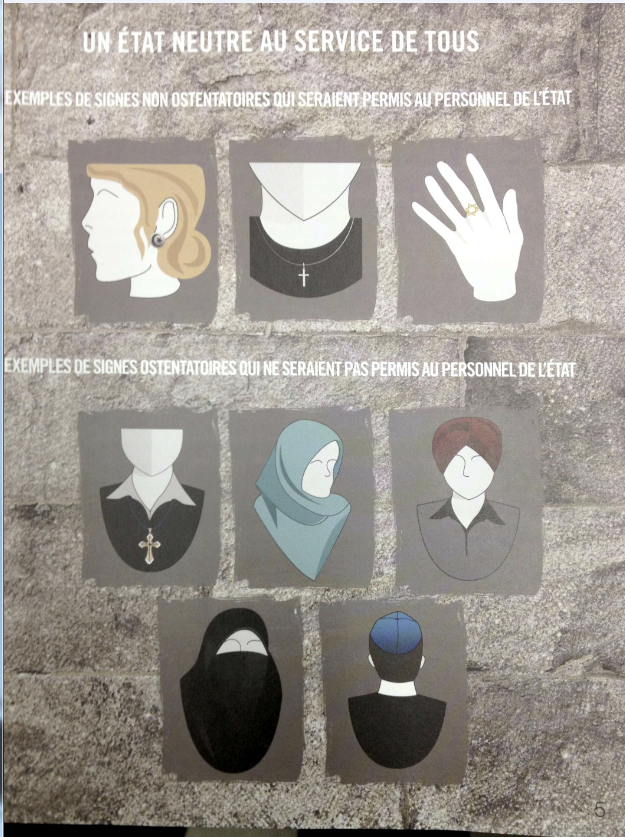
So, this is the first. It comes courtesy of Quebec's provincial government, which has drafted a "Charter of Values" that would ban public servants from wearing "overt and conspicuous" religious symbols. In the picture below, the bottom two rows show what constitutes "overt and conspicuous", while the top row shows, I dunno, examples that are presumably covert and inconspicuous. Or something. Some of the differences are obviously arbitrary, others are entirely too ambiguous, while the rest are just demonstrably racist.


Seriously, what's the difference between the first and second crucifix? One's small and one's bigger, sure, but what's the dividing line? At what point does a crucifix stop being small enough? Is there a particular length, mass, or volume? And, because there must be some standard that pertains to one or all three of these aspects, what is it and how did you determine that it achieved the necessary level of "conspicuousness"? And will the religious symbol police carry rulers and/or scales?

So, yes, this is obviously not actually about banning conspicuous symbols or defending Quebecois values so much as it is about putting the Other in their place and demonstrating who belongs and who does not. It really couldn't be any plainer.

And not just who belongs in Quebec. Because there's something very similar happening at a totally different level of government, in a totally different portfolio. Just check out some of these images from our new passports:


I think I spotted at least one person of colour, in an RCMP image. And Heather Mallick with the Toronto Star says that, across all the images, men outnumber women by a ratio of 16-to-1. These are terrible oversights. But they're also clear indications of hegemonic Canadian "values" - just as much as that poster is - and, in particular, of who and what counts as Canadian. That is, of who can comfortably call themselves Canadian. And it gets worse.

You might be wondering why I started with that Samuel de Champlain image. It's because the passport images are effectively placed in a chronology, with Champlain serving as the beginning of Canada. 'But it says page six, so surely there are other pages!', you say. 'And what about Aboriginal people?', you ask? Well, they do earn a token appearance on the previous page:


But that doesn't make them the origin of Canada in the narrative that the passport is advocating, oh no. This isn't presented as history, but as prehistory. In the logic of the feds, these aren't people or meaningful events, but symbols, artifacts best kept in a museum, representing some long-extinct community. There are no names or places or dates, here, and the symbols themselves are stripped of all context and specificity, reducing them to something generalized, depersonalized, and thusly unimportant. (Is that a particular inuksuk? Is it someone's approximation of one? Is it clip-art? Apparently, the answer doesn't matter.)

To add insult to the injury, of course, these are important symbols. They just aren't accorded any importance in the passport - at least, not enough importance to bother naming them or placing them within the narrative of the nation. And so appropriately, and depressingly, Aboriginal people are also absent from the rest of the passport images.

And so the Quebec that the "Charter of Values" from the Province of Quebec imagines? It excludes the same people that the Government of Canada does with the new passport. Hilariously - because Quebecois separatists and Conservative federalists imagine themselves ideologically opposed - they appear to be describing the exact same place.

And it's a place that requires a certain degree of hypocrisy and willful blindness. Because the Conservative Government of Canada actually opposes the "Charter of Values", which is motivated at least partly (and cynically) by the need to keep their lead among "New" Canadians. Because English Canadians get to respond with smug moral superiority, even as polls suggest that nearly half of us think the ban is a good idea. Because, ironically, Quebec's government fails to notice and condemn the conspicuous religious symbols contained in their own flag.

Monday, June 21, 2010

On the BP oil spill

"Gulf disaster needs divine intervention as man's efforts have been futile. Gulf lawmakers designate today Day of Prayer for solution/miracle."
-Sarah Palin, on Twitter

"Is God willing to prevent evil, but not able? Then he is not omnipotent.
Is he able, but not willing? Then he is malevolent.
Is he both able and willing? Then whence cometh evil?
Is he neither able nor willing? Then why call him God?"
-
Epicurus

Monday, May 24, 2010

Reflections on the Lost finale

It's been less than 12 hours since the show ended, so these will be a bit half-baked. I'll keep it to three general thoughts:

1) So the flashsideways is technically taking place after the mainstream timeline, insofar as it's an epilogue set in some limbo- or purgatory-like afterlife that the characters are sharing. I didn't really see that one coming. I'm wondering whether there's a bit of a joke hidden in there, since 'everyone is dead' was one of the theories first offered to explain the mysteries of the island. But the tone of the epilogue would seem to suggest that this isn't the case. (So my complaint that I had no idea what the stakes were ends up a bit off-the-mark, since there really were no stakes.) And it provided the happy ending that would have only been bittersweet otherwise. We know that Kate leaves, Jack dies, and Hurley takes Jack's place - and we don't know what happens to them afterward - but we're told that it basically doesn't matter.

2) Shockingly, and aside from the reveal of the flashsideways-as-afterlife, there were no twists in the finale. Everything we learned about the nature of the island, about the Man in Black and Jacob, turned out to be absolutely true and we really didn't learn anything new about the island. It was straightforward, epic-drama - the world would end if Locke escaped and if Jack couldn't restore the light. And I thought it was pretty effective stuff, too.

3) So whether the show was 'good' or not hinges, I think, on whether you buy the overtly religious ending. That the show moved in this direction wasn't a surprised - the science/reason v. fate/faith opposition that so strongly characterized the first couple seasons was indisputably won by religion/faith side this season, and was probably a foregone conclusion as soon as Jack started to believe he was fated to return there. (Which is to say that, unlike in Battlestar Galactica, it didn't come out of left field.) But the strength with which the epilogue pushed a very Christian - that multi-faith stained glass window aside - resolution to the series was a bit startling. (At least they had the sense to make a joke about it, when Kate comments on the ridiculousness of Christian Shepherd's name.)

I found myself liking how heartwarming the epilogue was, but after this much time I'm starting to feel a bit cheated. I was moved in the moment, but I think that the credit for that goes to the actors and my own substantial investment in the show - I could ignore or miss the larger spiritual politics because I found it so damned pleasant. (This kind of sleight-of-hand is the same complaint I had of the Sun and Jin death scene, in a way - a touching resolution to their story that is at once undermined by the realization that they're abandoning their daughter, and probably abandoning her to Sun's father. Once the emotion of the moment wears off, you realize that they're actually pretty selfish.) I don't know whether there was a way to offer viewers that happy ending without going in the direction of religion, but, as-is, it feels incongruent with the first five seasons of the show.

But the ending on the island, with Jack dying in the field where he first landed, Hurley and Ben panicked about what happens next, and Kate leaving someone behind, again? That seemed more apropos, more like the Lost that offers half answers and an unexpected new status quo. Maybe the pressure to offer an unequivocal ending was too much. Maybe Cuse and Lindelof thought the flashsideways was more subtle than it turned out to be. Maybe the show was so hopeless at points that we needed the finale to remind us that hope and love exist and that the characters really care for one another And maybe the whole afterlife thing was the only way to pull that off. I feel some satisfaction from the characters' happy ending and I'm simultaneously numbed by the particularly Christian-styling of the message. I'm not sure what else I can add.

Thursday, October 01, 2009

"Balance" and "theory"

I often watch The View when I feed Penelope her lunch, and turned it on this morning just as their panel was discussing the new Cameron/Comfort edition of On the Origin of Species. (The equally absurd and awful contents of which I blogged about a few days ago.) During the discussion, Heidi Montag and Sherri Shepherd (mis)used two words that, when deployed in these arguments, drive me absolutely nuts: "balance" (as in, the introduction provides "balance" to the evolution vs. creation debate) and "theory" (as in, both evolution and creationism are "theories").

1) To call the Cameron/Comfort edition "balanced" is outrageous - even if I agreed with Heidi's definition of "balance". Comfort is writing in the 21st century, Darwin in the 19th - genetics wasn't even a word when Darwin wrote, which makes Comfort's discussion of DNA both anachronistic and irrelevant. (Irrelevant to a debate about Darwin and/or evolution, but it's obvious that Comfort's actual target is science as a field, not Darwin as such.) Comfort can - and does - misrepresent Darwin's argument while Darwin, for obvious reasons, cannot refute his erroneous claims. Heidi also commits a sin that I'm all too familiar with as a teacher - she conflates complaint and critique, mistakes a wholly fallacious straw-man argument for rigorous analysis. Bringing balance to a debate requires, at the very least, some responsibility on the part of the commentator to accurately represent the position that is being critiqued. What Heidi calls "balance" would probably be libel if Darwin weren't long dead.

2) a. The "theory" bit is equally annoying. At some point, it became conventional outside academic circles to use "theory" as a derisive or pejorative term - the implication being that a "theory" is not simply unproven but is purely speculative, a mere hypothesis. Of course, if you can use Wikipedia, much less know anything about science, you know that a theory is far more complicated than this, that it's an analytic concept and that it proceeds from controlled observation - it's deductive - rather than preceding it, as would a hypothesis. It's on this basis that the Darwinian theory of evolution is astoundingly incomparable to the "theory" of creationism.

b. What's even more annoying, of course, is that creationists - and Sherri was doing this, implicitly - collapse i) the Darwinian theory of natural selection as the reason for evolution with ii) the fact of evolution. Evolution has occurred and we have a fossil record that proves it - hell, the non-fossilized remains of much smaller human beings from several centuries and millennia in the past are evidence of evolution, too. What remains is not for us to determine whether evolution occurs, but to determine how it occurs. And while the fossil record for the entire world is small, yes - the conditions under which organic material is fossilized are quite specific and rare - this shouldn't give us reason to doubt that evolution has occurred. It's a problem, yes, but insofar as it presents us only with the transitional forms - because all life is a transitional form that evolved from something else, which is transitioning to something else - and not with a roadmap of how it got there and where it was headed. And that's where the theory bit comes in.

The funny thing is, of course, that I'm actually quite critical of the way that scientific "truth" is produced and sold. Too often, scientists have encouraged us to conflate fact and theory just as eagerly the creationists do. But they get a well-deserved free-pass on this one.

Friday, September 25, 2009

The creationist's guide to Darwin...

Kirk Cameron and company are releasing a new edition of Darwin's Origin of Species, including a new introduction (by Ray Comfort) that's full of non-sequiturs, fallacious arguments, and anecdotes from scientists-turned-Christians*. (And, occasionally, something kinda useful - like descriptions of Darwin's more problematic premises about women and race. Totally eschewing the fact that Darwin was actually quite the anti-racist in his time. And ignoring the fact that the Bible is far more misogynistic and racist than Darwin could have ever hoped to be. But I digress...)

The hits come early and don't stop coming. Take this ill-conceived metaphor for natural selection:

Consider for a moment whether you could ever believe
this publication happened by accident. Here’s the argument:
There was nothing. Then paper appeared, and ink fell from
nowhere onto the flat sheets and shaped itself into perfectly
formed letters of the English alphabet. Initially, the letters
said something like this: “fgsn&k cn1clxc dumbh cckvkduh
vstupidm ncncx.” As you can see, random letters rarely produce
words that make sense. But in time, mindless chance formed
them into the order of meaningful words with spaces between
them. Periods, commas, capitals, italics, quotes, paragraphs,
margins, etc., also came into being in the correct placements.
The sentences then grouped themselves to relate to each other,
giving them coherence. Page numbers fell in sequence at the
right places, and headers, footers, and footnotes appeared from
nowhere on the pages, matching the portions of text to which
they related. The paper trimmed itself and bound itself into
a Bible. The ink for the cover fell from different directions,
being careful not to incorrectly mingle with the other colors,
forming itself into the graphics and title.

First things first - no scientist believes that there was ever "nothing", nor did matter come from "nowhere". And regardless, Darwin doesn't concern himself with the beginnings of the universe, so the relevance of this passage to his book could only be apparent to - and be written by - someone who doesn't understand the book or its theories. Or science, for that matter. "Mindless chance" hits closer to the mark, if "mindless" is meant to mean "without direction from on high". "Chance" a bit pejorative for my taste - insofar as an organisms competition for resources depends on factors beyond its own control, chance plays a big role. But
biology determined whether, say, dinosaurs would be wiped out by an unlucky encounter with an asteroid while alligators would survive, not random chance, which is what "chance" here seems to imply. And that bit about ink "being careful not to incorrectly mingle"? He's mixing up his theories - its creationism that thinks the universe can be correct or incorrect according to some mystical standard, not evolution.

Who proof-reads this crap, anyway? Certainly none of the scientists who granted them testimonials. But anyway...

To liken DNA to a book is a gross understatement.

Actually, it isn't. Because "understatement" implies that the analogy, on some level, works. It doesn't.
To liken DNA to a book is an exercise in absurdity.

After completing the mapping of the chimp genome in 2005,
evolutionists are now hailing the result as “the most dramatic
confirmation yet” that chimps and humans have common
ancestry. Their overwhelming “proof” is the finding that the
genetic difference is 4 percent—which is interesting proof,
because it’s actually twice the amount that they’ve been
claiming for years.

Those sneaky scientists - hypothesizing one thing and then, after years of research and testing, amending their position slightly. Damned flip-floppers, why can't they remain stubborn and unmoving in the face of new and contradictory evidence? You know, just like religion? Well, that's the scientific method for you.


In addition, even if the difference is only 4 percent of
the 3 billion base pairs of DNA in every cell, that represents
120,000,000 entries in the DNA code that are different!

And, oh, about 2.9 billion that are the same -
2.90 billion versus 0.12 billion.

Men and monkeys also have another fundamental
difference: humans have 23 pairs of chromosomes while
chimps have 24, so the DNA isn’t as similar as you’ve been
led to believe.

Who is "you" in this sentence? Someone who knows nothing about science and about how remarkably close, when compared to the rest of nature, this similarity actually is? Maybe someone who is easily fooled by the lack of context that's presented in this introduction? Because it can't be a "you" who knows anything about biology.


But I've wasted enough time. A commentator interlaces some hilarious refutations of Kirk Cameron's video introduction to the book here:


And a brief and hilarious rebuttal to Ray Comfort's video extolling the common-sense linkage of bananas and intelligent design. Except that common-sense ignores their actual origin and spread across the globe - their evolution, if you will - which is part mutation and part cultivation and is explained in more detail at the end of the video:


Scary stuff.

*
Remember how arguments would be resolved in team games when you were a kid? When there were no adults around, I mean. If someone on your team showed any indecision, much less entertained the thought that the other team was right, it didn't matter that he or she was the only one - a tiny minority - that thought so. Some jerk on the other team would take that as proof that you were wrong - even though the rest of your team was certain you were right.

This guy is that jerk.

(Besides, for every Antony Flew there's a Bart Ehrman. And even Flew, held up as evidence that science can lead a person to God, is a deist who believes in the existence of an unknowable, disinterested original force that he calls God, not the Judeo-Christian-Islamic God.)

Saturday, October 18, 2008

God probably wanted me to write this

There were a couple articles in Time, recently, asking whether evangelicals telling folks that God wanted them to be rich or wanted them to get a house were to blame for the financial crisis. In short - if God wants you to get a mortgage that you shouldn't be able to afford, then he'll "make a way" and it's beyond you to question the logistics. It's easy to see that this road leads to disaster, in retrospect if not in the moment. Especially when you're encouraged to avoid looking down that road in the first place.

Of course, the market meltdown will hardly prompt a crisis in faith. I'm sure that people will find a way to rationalize God wanting them to suffer a crushing setback. (I'm also sure hubris will factor in, though not in the way that I would think to apply it.)

It all reminds me of one of my favorite religious paradoxes. Two sports teams meet in some sort of championship, and both extol their faith in God and assuredness that he'll help then win. And then one team invariably loses. They find ways to rationalize it, but it simply comes down to God not wanting them to win - which they deal with shockingly well, considering how sure they were that God wanted them to win beforehand. (Again, it was probably Satan-induced hubris, right? As opposed the Christ-induced confidence of the other team, I guess. Too bad we couldn't tell them apart beforehand and skip this whole thing.) But they never seem to make either of the leaps from there that, to me, seem entirely logical: 1) God just doesn't fucking care about whether you win a trophy when he has stuff like, say, natural disasters to concern him; and 2) maybe God just doesn't like you.

But, then, I don't really get any of this religious stuff.

Thursday, May 22, 2008

Politics, prayer, and disingenuous posturing

It took far too long, but the Ontario Legislature finally moved to remove the recital of the Lord's Prayer from the opening of each daily session a couple months ago. I'm late to the party in commenting on this, I know, but that's because it's getting more popular attention now than it did back in February. (One question, though: it's easy to find petitions to keep the prayer, but where are the petitions to sign if you support getting rid of the damn thing?)

Largely, this is because there's a huge opposition to its removal from people who a) are Christian, b) are probably white, c) are probably not young, and d) have probably never set foot in the provincial legislature. And the logic they're using, if the blogosphere and various online petitions are any indication, is both absurd, inappropriate, often wrong, and very enlightening. I'll avoid adding my own commentary - although I'm tempted to say something about the person who invokes the "guilty white man", which is a tremendously interesting figure to me - and let the defenders of the prayer hang themselves.

(Okay, so at least two comments: I'd like to say that the racism, xenophobia, and Islamophobia contained in these messages is subtle, but that would be an outright lie. I'd also like to say that I had to search hard for these comments and that these are the most extreme examples of opposition to the move. That would also be a lie - a good one-third to one-half are engaged in something at least implicitly racist.)


"I can't believe [Ontario Premier] Mr. D. McGuinty not taking his mother's advice. What kind of role model is he for the children of Ontario? "The premier doesn't listen to his mother so I won't either.""

"Is nothing sacred anymore ?? Dalton, stop being a guilty white man. If those that come to Canada do not like it and it offends them, tell them to go back to their country, if it was so great."

"I would like it known that we are the country in which the imigrants chose, We are becoming a minority, in our own country. Land of Opporunity."Right" I'm not suppose to say Merry Christmas. I was born here and proud to be Canadian.Now we are not allowed to have the Lords Prayer. Will we loose all of our hynms as well? We do not interfere in their religon. They came here for what we stood for a land of opportunity and OUR WAYS OF LIFE."

"In trying to bend ourselves into pretzels to make other peoples feel welcome we have alienated ourselves. We have lost the "ownership" of our own country."

"Canada was founded on Christianity and it should stay like this. I am from the Netherlands, where there they are changing everything as well. The Dutch hate it. They are loosing their Country to Muslims. Don't let this happen to Canada!"

"
History needs to be presereved, regardless of country, changing social attitudes or the form of content in question - if you begin to remove the foundation, as small as each part seems, you'll be left with nothing in the end,"

"
I am CANADIAN and this matters to me."

"If we attempt to take God(Jesus) out of Canada, we may experience the same types of tragedies the U.S. experienced from 9/11 until now."

"
If we were to go to their country, do you think they would change their ways for us? No way. I know someone from Iran, he said Canada is a fool-his country would not change anything for us if we were entering his country."