Showing posts with label commercials. Show all posts

Sunday, February 09, 2014

Brief thoughts on a Conservative anti-drug radio spot

From a Conservative Party of Canada radio ad:
"There's so much I worry about as a mom. Justin Trudeau's plan to make marijuana legal certainly doesn't help. Imagine, making it available just like alcohol and cigarettes. He's sending the message that recreational drug use is okay."

Simply put, this is a terrible ad. Not just because it's cheesy and melodramatic (there's a minimalist piano backing track) but because it strikes me as both internally contradictory and totally wrong about its facts. To wit:

1) There's an implication, here, that we can/should send the message to kids that alcohol and cigarette use "is okay". I don't know if that was the intention, but it's the effect. Grouping these three "recreational drugs" together only really makes sense if you're suggesting that they should all be treated in the same way. If you aren't, it all looks a bit arbitrary.

2) If pot were available in the same way that booze and smokes are available, it would actually be harder for kids to buy. One of the things that makes pot so readily available - or, at least, made it really accessible when I was a teenager - is that the market is entirely underground. Thus, the only barrier for buyers is knowing someone who's selling. And when you're 18, finding another teenager at your school who's selling is a lot easier than finding someone who can buy stuff at a store.



Saturday, October 13, 2012

LHN: In 2013, the world will turn bronze

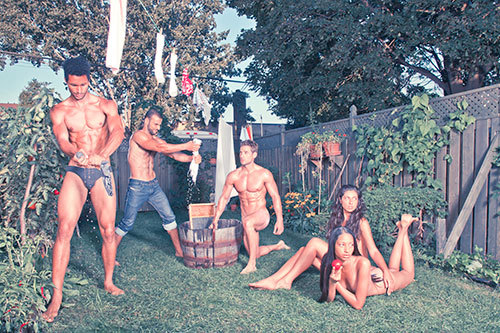
So, there was a fashion insert in NOW Magazine this week, and I saved it because it the ad on the back over unsettled me. And it unsettled me because, in spite of the obvious attempt to include a racially diverse group of lads and ladies, they are all the exact same colour:


The company, by the way, is called Look Hot Naked. And no, I have no idea what the product is - they're building the brand before they even tell us what they're selling. Which is effective, I suppose - earlier today, Victoria and I were talking about how well a similar approach worked for IOGO, the yogurt company. Personally, though? I find it annoying.

But whatever it is? It turns hot people into a uniform-bronze. (There's an academic paper here. And no, it's probably not flattering.)

Friday, October 23, 2009

Canada's Economic Action Plan and stimulus for actors

The Conservative government in Canada has been working hard on a recession-busting campaign that they refer to as "Canada's Economic Action Plan". There have been a lot of complaints about its efficacy - about how the money has been apportioned and how much of it has actually been paid out. Equally disturbing are the things that the government is taking credit for - what should be routine maintenance, like replacing old door-knobs, is being touted as Action Plan spending, complete with signage. That kind of desperation isn't inspiring. (Nor is the partisanship of it all - the Tory-blue website and signs are not particularly subtle.)

Most recently, the joke seems to be that the Action Plan's only obvious economic impact has been in its own promotion: in the past couple weeks, $100k on a press conference and $50k plastering ads the side of a train have gotten a lot of attention. In total, the estimates vary between $35 and $60 million.

What's been mostly unremarked upon, though, are the numerous slick commercials that have been produced. I can't embed the commercials, but follow this link and click on the very first video and pay particularly close attention to the bit that starts around the 34 second mark. "What does the Economic Action Plan mean to Canadians?", it asks? It means that an out-of-work actor from Student Bodies can find a job in propaganda.

Tuesday, October 13, 2009

When ads lie: frozen pizza

I have never eaten a good frozen pizza.

'Passable', sure; 'digestible', most often; 'not worth it' a good third of the time. But never 'good'. And all frozen pizzas are plagued by the same shortcomings: the cheese either isn't mozzarella or it's the cheapest possible kind, the frozen vegetables are identically tasteless, the crust can always be mistaken for cardboard, and it never heats evenly - sometimes the middle is still cold even as the crust is burnt.

So given that frozen pizza is generally quite bad, I guess it makes sense that frozen pizza brands often liken the quality of their food to that of a pizza delivery place. A couple of examples:


The problem is, to my mind, that they are always wrong - frozen pizza is never as good as the worst delivery or take-out place. And it's not just that they're stretching the truth. I'm sure that every pizza slice, for instance, is the "world's best" in someone's mind - someone surely must appreciate the cardboard crust, or at least think that the price-point and convenience outweigh the deficiencies in taste. But even those people could never confuse a frozen pizza with one that was never frozen, much less one made by a place that specializes in fresh-made pizza.

What's worse, the brazenness of their lie always reminds me that frozen pizza is just plain bad and will always be bad. Why not make more modest claims? Advocate for their brand on the grounds that it's cheaper than delivery? More convenient than take-out? McDonald's might as well claim that the patty in a Big Mac is better than veal cutlet.

Monday, May 25, 2009

The ongoing battle for Canadian identity: Ignatieff and the Tory commercials

With a federal election certain to be called in the next few months, the Conservatives have taken to launching pre-emptive attack ads at Liberal leader Michael Ignatieff, a public intellectual probably best known in North America for his work in Security Studies - work that he did, the Tories point out, almost exclusively outside Canada, in the UK and USA.

The Liberals contend that attacks, based on a 34-year absence from the country, are simultaneously an attack on all expat Canadians (Liberal strategist Warren Kinsella lists Wayne Gretzky, Neil Young, and Celine Dion as figures who must then be equally problematic) and naturalized immigrants, who may have also spent the majority of their lives outside the country. Tory strategist Tim Powers counters that it's not that he left, or necessarily the length of time, but rather "it's what he said when he was outside the country" - referring to his explicitly identifying as an American and a Brit while residing in those countries.

Kinsella's analogies are hardly perfect; neither is Powers' response convincing. Kinsella's examples include people who represent Canada in an official capacity at international events (Gretzky) and keep a Canadian residence (Dion), and all three actively and repeatedly assert their Canadianness - none of which could be said of Ignatieff during those three and a half decades. As for Powers' argument, it doesn't escape the latter charge made by the Liberals, as a huge number of Canadian immigrants (and, as has been my experience, even many 2nd and 3rd generation Canadians) likewise don't identify themselves primarily "Canadian".

That Ignatieff (and Gretzky, Young, Dion, I'm sure, if they were challenged in a similar fashion) can convincingly, if not unproblematically, liken himself to both the celebrity expats and the marginalized (and presumably non-white) immigrant is no small feat and has everything to do with which of those two groups he more closely resembles. Those same immigrants couldn't look to Gretzky and Dion in order to legitimate their own tenuous hold on Canadian identity - they were, after all, born Canadian ("natural" Canadians vs. "naturalized" Canadians) and, tellingly, are all white. Ignatieff can invoke an analogy of oppression but the reverse, an analogy of privilege that should theoretically be open to non-white immigrants, seems somehow a harder sell.

Consider, too, that Ignatieff is able to reinforce his own claim to Canadianness (though not without a certain element of danger, as I'll explain) by way of an appeal to people who are considered provisionally Canadian without reciprocal increase in their Canadianness. But were a non-white Canadian lobby group to attempt to increase their access to Canadianness by way of appeal to white Canadian figures like Ignatieff, I suspect that a) the simile wouldn't be as convincing, b) they would do little to advance their own cause, and c) that they would actually damage Ignatieff's own status as Canadian. Rather than improve their own standing relative to hegemonic ideas of Canadian identity, they would problematize his.

There's an analogy to be made here to American racial politics - the "one drop" rule of racial blood - which Canada has regrettably absorbed: Ignatieff's whiteness can't whiten the immigrants' non-whiteness, but the reverse - the loss of Ignatieff's Canadianness (which is bound to his whiteness) - remains an ever-present risk. And it's precisely that danger that the Conservatives are invoking - and that Ignatieff, in drawing out what the Tories themselves could not say explicitly, is inadvertantly reinforcing.

Tuesday, June 17, 2008

Indie rock and TV commercials: The weird continues

I'm a month or so late in getting to this, but I have a new entry to my earlier post about bizarre/inappropriate/disappointing marriages of indie rock and TV advertising. This latest features the Moldy Peaches' "Anyone Else But You", the song that most people probably know from Ellen Page and Michael Cera's duet at the end of Juno. And which we will now know as that-song-on-the-Atlantis-commercial. I can't find it on Youtube and so I can't embed it, but you can see the commercial in this Rolling Stone article.

What likely makes this song the most egregious misappropriation of any of the four songs that i've collected is that it's the first to actually change the lyrics. Silly but affecting lines like "You're a part-time lover and a full-time friend/The monkey on your back is the latest trend" is changed to "Let’s go ride a couple of dolphins/Or maybe play tennis or do some golfing", which is naturally accompanied by images of these attractions at the resort. It's been drained of its cute homey-ness, made painfully unclever, and so is entirely awful.

On another note, is the use of this song by Atlantis and the Weezer song by Beaches signaling some marketing shift by major resorts? Those early Weezer fans are now pushing or into their 30s, and the Moldy Peaches have new capital due to their association with Juno, which appeals to largely the same people. Is this a deliberate attempt to target the aging (and now working) hipster demographic, or is it just a coincidence that these two songs have popped up in very similar contexts and nearly the same time?

Thursday, May 15, 2008

Kids and/in commercials

Continuing on my TV spots riff... I had wanted to embed a bunch of videos to write about really briefly, all of them incorporating kids, but I'm having a hell of a time finding some. So I'll assume that others have seen the Ikea commercial showing the excited parents and the young daughter that's barking orders as if they're kids, or have seen the Burger King commercial where the parents beg and plead and whine with their very young son to let them go get some fast food.

They're part of a weird trend in commercials that appears to invert parent-child power relations and it's already been beaten to death - the commercials are somewhat amusing the first time but grate the second or third time before you realize that they're simply insulting - for parents and their children. There's something almost cute about the way that they ostensibly empower kids on the first viewing, but it is, of course, a patronizing sort of empowerment (the commercials are just ridiculous enough that adults will recognize these could not be real children) that they ostensibly hope kids will misrecognize as entitlement. (And if you know any children who have a tendency to act with unearned or undeserved entitlement, this is no pleasant thing.)

What's interesting, of course, is that even the non-profits use this strategy, albeit more subtly:


It's a far less patronizing commercial - as a friend pointed out to me, the "Please, David" is a surprisingly respectful touch - but I wonder if it's fair to reduce it to the same endgame: like Burger King, in the end they just want kids to badger their parents to buy stuff. Enviro-friendly stuff, of course, but... or maybe I'm just asking for too much from the format.

Of course, we can always count on anti-drug campaigns to come up with the most fantastically over-wrought, unsubtle, and totally thoughtless crap. This gem features kids exclusively but makes no effort to actually communicate a message to them, aiming the spiel explicitly at the parents. (So rather than talk to children, we're expecting their parents to write down or remember the website, visit it, read the stuff, and then retransmit it? Wha?) What makes it particularly entertaining and disturbing, though, is the palpable horror aesthetic. Truly bizarre:

Thursday, May 08, 2008

The commercial break in a commercial break...

I can't find a clip of it anywhere, but the Canadian hardware chain Rona has started doing something strange and bizarrely meta-televisual (though in only the most superficial sense) with its TV spots.

They split the commercials into two 15 second bits, though this isn't all that strange in and of itself. But in the first bit they ask a home-repair question, saying that the answer will follow after 'the break'. 'The break', of course, is another commercial, after which the second bit provides an answer to the question. It's a clever gimmick, though like all gimmicks one that I would surely despise if I saw it used more often than this.

Where these commercials actually become unintentionally interesting, though? In one instance, I noticed that the first half of one of these pairings aired as the last commercial before the actual TV show resumed - and so the second bit didn't air until after the program went to break. The commercial's 'after the break' line amusingly appears to invert, if ever so temporarily and weakly, the relationship between the program and its ads.

(Not that these line separating them was ever that clear to begin with, but its usually the programming itself that tries to seem more like a glorified advertisement than the commercial working the same angle from the other end.)

Saturday, April 26, 2008

Indie music + useless consumer crap = gold

Far be it from me to deny artists the chance to earn a living, but it seems that the number of formerly indie music acts cashing in on wildly ironic (in the woefully inappropriate sense) corporate deals has exploded in the past few years. My top 3 corporate rock commercials of the moment:

#3 The Flaming Lips and Kraft
On the plus side,
the commercial seems to indicate that these salad dressings are, like, healthy and natural. More negatively, they've taken a song about responsibility and the abuse of power by leaders - "The Yeah Yeah Yeah Song" - and allowed Kraft to apply it to the aforementioned salad dressing. But at least they've effectively castrated the song by deleting every lyric but the 'yeah yeah yeah' portion - it's less the song that they've sold than the beat and melody. More generally, this just the latest in a long string of songs that the Flaming Lips have licensed since they finally broke free of their long career of relative obscurity 6 years ago. This being the case, it's hard to hold such a carefully managed sale like this against them - at least in comparison to the other two artists on this list.

#2 Weezer and Beaches
Weezer almost manages to kinda salvage some dignity by selling the song - and not their recording from 'The Green Album' - of "Island in the Sun" to a tropical resort company in
this commercial. To their detriment, the cover version also reveals how painfully banal the song and its lyrics are. In Rob Mitchum's review of Weezer's dreadful Make Believe album, he asks if "Rivers Cuomo [lyrics were] always on the notebook-scrawl level of 'I don't feel the joy/ I don't feel the pain,' and did we not notice because scrawling in notebooks was the depth of our emotional knowledge at the time?" Mitchum eventually lets the early Weezer stuff off the hook, and while this song is not early Weezer, the pairing is offensive enough that the answer to his question doesn't even matter to me anymore.

#1 Le Tigre and Nivea
A feminist art-rock band that name-drops people like
Yoko Ono, Vaginal Davis, and James Baldwin in their songs, Le Tigre gave the rough-edged but undeniably dancy "Deceptacon" to Nivea (among others - but cell phone companies and jewelers, while strange choices, are not nearly so ironic) in 2006. Despite my best efforts, I can't locate this commercial, but suffice to say that a band that I can't be the only one who finds it unconsciencable that a group of feminists would sell out to the cosmetics industry, or that artists who count so many anti-racism figures among their influences would peddle their music to a company that sells skin-whitening cream. Few corporate pairings can destroy a band's worth for me as wholly as this one has.