Showing posts with label femininity. Show all posts

Saturday, February 15, 2014

AMC's The Walking Dead and the many ways in which it *ahem* bites

With the return of AMC's The Walking Dead, this week, here are my much-delayed but eagerly-awaited (or not!) reflections on why the show is terrible, and how it manages to screw up everything that the the comic does right. (Be warned! I will probably end up spoiling stuff.)

[A quick note: This is not to suggest that the comic is perfect, by any means. The prison arc drags and, more recently, characters have a habit of monologue-ing in such a way that I have to think Robert Kirkman is hoping to make some sort of serious social commentary that's well beyond his ability. But still, it's much better]

1) The Walking Dead are supposed to be the people, not the zombies


The show's biggest failing is that it thinks the zombies are the stars. It can't go an episode without a zombie sneak-attack, and it makes a zombie encounter part of every story. To pull some examples from this season:
  • The story about the flu, while ostensibly serving as some sort of banal contrast and reminder of the dangers of the everyday, devolved into just another surprise zombie rampage.
  • The visit to the grocery store was interrupted by bunches of zombies falling inexplicably from the ceiling. (I say 'inexplicably' not because it doesn't make sense that the roof is sagging, but because it appears they had been there for months, and somehow none of them had previously managed to fall through the roof)
  • Though it was understated, even Rick and Carol's half-decent foraging episode was interrupted by  zombies who carried away and ate the new people. (But even I'll admit that this was done with impressive restraint.)
  • In the latest episode, Carl is nearly bitten not just once but twice by zombies who either snuck up or sprang out from behind a door, both of which are lazy tropes that the show relies on with alarming regularity.
In the comic, the zombies have been largely reduced to background pieces that do little to move the plot forward. When they gather en masse, it's to serve some sort of symbolic purpose.
  • The zombies flood the prison as an after-effect of the battle with The Governor, not because he deploys them as a weapon. 
  • When a zombie herd pushes through the walls that surround Alexandria, it follows a gun-fight with outside bandits and parallels an internal struggle for the right to lead the town. When Rick is finally installed as leader, the town finally learns how to keep the zombies out.

It's not that the zombies disappear or are rendered harmless, but nor are they aggressors or malevolent. Rather, the zombies of the comic appear as a consequence of human folly - the wrath of god, a force of nature, a critique of social relations given undead form, or however you choose to explain it. And so there's a subtle moral element to it, too, at least in the past few years. Not that any particularly person deserves to be attacked by a zombie, mind you, but that we, more generally, have brought this upon our selves - and we're running out of chances.

2) Pacing

A friend of mine defended the story arc in the first half of this season by way of claiming that it was about the difficulty of re-establishing society. Which, if it were true, would've been great. Instead, having only just established the prison community in the previous year's season finale, this year's season premiere immediately introduced a mystery illness to destroy it. Number of full episodes spent showing that it's not all about the zombie attacks: 0

By contrast, the comic book spent dozens of issues in the prison and plenty of time showing that inter-personal conflict and power struggles were far more deadly than anything outside the walls. What my friend claimed/hoped the show was doing? That's what the comic book actually did. If you're going to make a show about humanity after the apocalypse, it probably behooves you to slow down and establish that they can still interact with other human beings.

3) Choreography that would make a pro wrestler blush

Again, the lazy tropes. There's a difference between the effective use of horror conventions and the poor use of them. While I expect the disorienting close-up or extreme that shields our view from a surprise, I expect what follows to be an actual surprise. When Hershel stepped slowly past a body in a dark prison corridor, I knew it would bite him. When, in the second season, Lori went after Rick in a car, I was reasonably sure that she would crash. When she held up a map and took her eyes off the road, I knew there would be a zombie in the way when she looked up. And that she would swerve. And that she would crash.

And when, earlier this season, Rick was outside the prison and got pinned against the fence, the camera angle suggested that someone was going to sneak up, unseen, from behind to save him. So, Daryl did just that:


It's one thing to anticipate a surprise, but to know exactly what that surprise will be? That's not a surprise at all. It reduces the anticipation to an expectation, and robs the scene of tension or excitement entirely.

4) The physics of sound

When they're off-screen, the zombies are remarkably quiet. Like, sooo quiet. But when they're on screen, they're incredibly noisy - gnashing and moaning and gurgling and growling.

But, you're saying, it's just that they're quiet when there are no humans around - obviously, they get noisy when there's meat in their presence.

Except, that's not what I'm saying at all. I literally mean that it's a matter of whether the camera can see them or not.
  • When, in the season premiere, the group arrives at a grocery store, the scene is totally silent. But, as the camera pans up, we see and hear dozens of zombies on the roof. (Which puts that whole 'the zombies are normally quiet' theory to bed.) Now, I'm not at all certain whether the humans would've heard the zombies, but it's pretty silly that the zombies fail to hear the humans approach - especially since their hearing is acute enough to hear a crash from within the building.
  • When Meghan is attacked in the Governor's RV camp, it is doubly ridiculous. Not only is it shot from directly in front, which immediately gives away the eventual zombie attack, but the zombie that she finds is standing totally stationary behind a bed sheet, of all things. A bed sheet that could, ostensibly, block both the sound of the zombie from ours and Meghan's ears, as well as the sound of the community from the zombie, who was turned in the wrong direction and thus oblivious to their presence. Dumb.
  • And the most egregious example, from the end of the second season, is when Dale is standing in an empty field - which we know to be empty because the establishing shot was from a distance. Yet, somehow, a zombie swiftly and totally silently sneaks up from behind him. Which is even more impressive because the field is, itself, totally silent. Until, of course, Dale turns around and the zombie appears on camera, its mouth all frothy and gurgling. Because, of course.

5) Rick

In AMC's version, everyone hates Rick. He's a reluctant leader who's largely incapable of making decisions, wracked by self-doubt and guilt. This might be a fine archetype to employ in literary fiction, but in the hands of lesser writers, Rick is simply annoying.


The problem is, the TV version of Rick is only a small fraction of a full character. Like AMC's Rick, the comic book version of Rick also has a period of self-doubt where he's paralyzed by guilt. But that's not how he begins, and that's not where he's been for a long time.

In the first few years of stories, Rick is instead characterized by a survive-at-all-costs ethos, an angry-at-the-world recklessness, and is intensely protective of his family. Just like TV's Shane. (The comic's Shane died after only a few issues - killed by Carl, rather than Rick.) And, in the comic, he finds some solace in rejecting his responsibility to others and disappearing for days at a time, setting out alone on his motorcycle like some sort of post-apocalyptic cowboy. Like TV's Daryl. (The comic has no Daryl.)

6) Didn't we see all this before? This is what passes for character development?

When the previous season ended, The Governor wanted the prison and was willing to destroy it if he couldn't have it, bringing with him a small army to demand its surrender and knocking its gates down. When The Governor returned at the midpoint of his season, he wanted the prison and was willing to destroy it if he couldn't have it, bringing with him a small army to demand its surrender and knocking its gates down.

Ugh.


In between, we were given two episodes that demonstrated how a shattered Governor rebuilt himself in order to become the exact same person he had been before, with a more or less identical purpose - he replaced his old community with a new one, regained his leadership role, even managed to find a new daughter. And this all served what point, exactly?

7) How gender influences your chances of surviving a zombie apocalypse

I haven't fully developed this point in my head, and it deserves a longer, fuller discussion. But regardless, it's something that needs to be covered. (That I've put it number last on my list isn't an indication of priority. Instead, it's an indication that it's the least rigorously formulated.)

One of the interesting tropes in The Walking Dead comic is the clash of male egos and its catastrophic consequences. Shane nearly kills Rick before the first story arc is complete; Rick and Tyreese nearly kill each other; Rick and The Governor destroy one another's homes; a group of cannibals become a particularly unsubtle metaphor for the direction that this is all heading in. The group's most brazen and direct actions also tend toward disaster: Shane pulls a gun on Rick and Carl shoots Shane in the neck; Rick's first confrontation with the Governor is memorable for Rick getting his hand chopped off; Tyreese's pre-emptive strike against Woodbury results in his capture and execution; Rick's first encounter with Negan ends with Glenn's murder.

Consciously or not, there is a clear and obvious indictment of hegemonic masculine aggression, ambition, and hubris. But this is also a violent story with characteristically violent consequences, so all of this might seem rather unconvincing and lazy - characters die all time, most of those characters are men, and it's easy to link any one death to any one man's reckless actions.

So, let's try this, instead: apart from the characters who were introduced in the current storyline of the comic, only one man who claimed any kind of leadership role is still alive: Rick.
  • Shane, who led the RV group before Rick arrived, is dead.
  • So is Tyreese, Rick's other early competition for leadership of the original group. 
  • And Hershel, who stepped up when Rick and Tyreese were trying to kill each other.
  • Glenn was also among the group that tried to replace Rick. Also dead.
  • Douglas, who preceded Rick as leader of Alexandria. 
  • Spencer, Douglas' son who plotted to replace Rick, is murdered by Negan. 
  • Gregory, who leads The Hilltop, is also killed by Negan.
  • And the bad guys, too, like The Governor and whoever led The Hunters. It's only a matter of time until Negan dies.

Now, it's not like women don't take risks or don't die. The comic book version of Carol kills herself. (Carol is the one major exception to the general rule that the comic does everything better. But even though it seems inevitable that she'll return to the show, the way they wrote her out was awful. And just reinforces the fact that Rick is a dick.) Lori and Judith are killed in the Governor's attack, which ultimately reduces them to a story function - the cost of Rick's pride.

[Quick aside, though. The female characters on the TV show? Some great steps have been taken to build them up into strong, independent people. But there's a reason that half of the early TWD memes relished in point out how annoying they were.]

But Andrea and Michonne have survived capture and physical abuse, and have grown into leadership roles rather than having taken them by force. Necessity plays a role, too: when Gregory gives his allegiance to Negan, a disgusted Maggie effectively takes command of The Hilltop.

And this is hardly an argument for some wildly different form of feminine leadership. Michonne is no less hot-headed and independent in the comic than she is on the TV show, and Andrea is remarkable for her level-headedness and killer instinct. Maggie probably most closely resembles a recognizable feminine trope, having become something of a mother bear to Carol's daughter.

Rather, it seems to be an argument for leaders who don't aspire to hold power but earn it and will take it when they must; fighters who don't seek fights but will fight when they're backed into a corner. As it happens, these sorts of characters are all women.


Women who, I should again add, have taken very different paths and achieved very different outcomes. It's not as if the book recommends one particular way of surviving the zombie apocalypse, even if it seems to suggest that, yes, that one other particular way leads unavoidably to death.

Monday, August 20, 2012

"Gotcha!" questions

I'm pretty sure that anyone reading this blog is familiar with Todd Akin and his stupefying comment that "legitimate rape" rarely leads to pregnancy because women's bodies are designed, somehow, (magically?) to prevent it. (The comment is rhetorical gold. It both begs the question - so, what's an "illegitimate" rape, then? - and invokes the authority of science where no supporting science exists.)


Almost as disturbing, though, is the media characterization of his stupidity as a "flub". Google is currently returning 178k results for "todd akin flub", two of the top three being from ABC ("Campaign flub by GOP Senate candidate...") and CNN ("A flub by a Republican Senate candidate..."). For the record, "todd akin  misogyny" and "todd akin misogynist" return 140k and 119k hits, respectively.

But this characterization is equally moronic. A flub is something that's comical, accidental, and virtually harmless. A Freudian slip is a flub. Tripping over my own feet and missing a ground ball in a game of softball is a flub. Outtakes or gag reels that are set to hilarious kazoo music. Consciously and pointedly verbalizing your misogyny and scientific ignorance, on the other hand, is decidedly not a flub. It is almost the exact opposite of a flub.

The choice of "flub" reminds me of Sarah Palin and her numerous complaints about "gotcha questions" from the media - another word-branding exercise designed to obscure the stupidity of a politician. Now, "gotcha questions" do exist, and journalists do try to catch people saying the wrong thing, contradicting themselves, or simply lying. It happens. But it's also totally legitimate. And it's also their job to do this. Good journalism should include gotcha questions. And just as those questions shouldn't be reduce to a game of "gotcha", which subsequently diminishes the importance of the question, we shouldn't reduce the answers to "flubs", which makes them seem awfully inconsequential.

(For the sake of levity, I'll include a link to a slideshow from New York Magazine that describes the various incidents that Palin has characterized as "gotcha" moments. Unsurprisingly, all of them are simply cases of journalists doing exactly what you would expect of a reasonably ethical journalist.)

Wednesday, June 13, 2012

Comic books and the impossible woman: people still don't get it

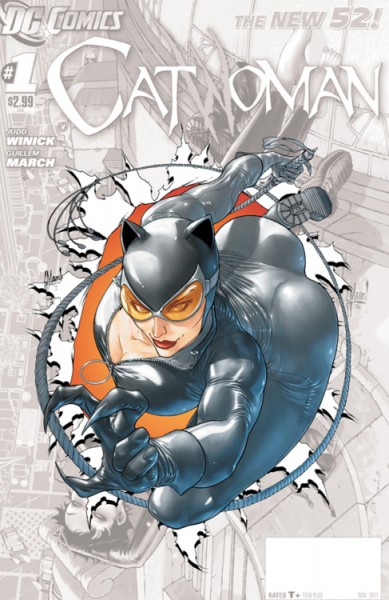
So, in the past few days, this picture of Catwoman has sparked a veritable shit-storm on the internet:

Catwoman #0, cover by Guillem March.

There's a lot to dislike, here, if you care even a bit about anatomy. (And since Catwoman's abilities do not involve the reshaping of her body to fit her whim, the "it's fantasy!" argument really doesn't hold water.) Her breast plate appears to be angled outward and upward(?!), which, given the position of her tailbone, would mean that her spine is bending at something like a 50 degree angle. And bending in the wrong place. And her abdomen is about 3 feet long. (Let's not even talk about how it's being simultaneously twisted, though.) I suppose that's theoretically do-able - gymnasts can certainly bend backward - but not under these circumstances. Catwoman's legs, arms, and neck are moving against the curve of her spine, whereas the gymnasts entire body needs to contributing to make it work. The movement of her jump doesn't make sense, either - she's leaping forward into space, but her body would have to be arcing backward for this to be even slightly plausible. And to make matters worse, if you were to map out the structure of her shoulders and collar bone, you'd need to conclude that her neck is actually popping out of left shoulder. (Well, either that or her head has been dislocated from her neck. Which is possible, because the angle of her face looks wrong, too.)

But perhaps surprisingly, the frothy-mouthed barking has not come from people who hate the cover. It's come, instead, from the people defending it.

Let me back up a bit, though. There have been critics of the cover, of course. But, y'see, one only has so much energy and disbelief to devote to these things when this is probably only one of a dozen gratuitous and impossible T&A comic book covers that will grace shelves this month. Which is why most of the responses - and this has been true of most comic art since Escher Girls was created, at least - have involved gently, and hilariously, mocking and parodying the image. And, in some cases, even correcting it. (Click those links. They're pretty great.)

But about the anger - this reaction, written by Jason Kerouac, to the re-draws and critiques appeared yesterday. And he's not at all happy that people are criticizing the cover. (He begins with "Grow the fuck up", so you know he means business.)

He suggests that the pose is plausible, but he's wrong and his photo comparisons aren't even close. He also suggests that it doesn't matter because it's art - money quote: "Y’know who else exaggerated anatomy? Picasso" - but ignores the fact that this artist is actually a realist, and some basic rules do apply. And he makes the classic recourse to reverse-sexism, arguing that men are exaggerated and sexualized, too. Except that they're not, really - idealized, yes, but there's no male equivalent to the fetishization of double-D breasts, peeking through rubber-catsuit cleavage. (Centuries of sexism and the resulting imbalance of representational power will do that.) So, he provides a lot of arguments, but they don't work so well together - he plays both the realism and surrealism cards, which is weird - and none of them work separately, either.

Part of the problem, I think, is that he doesn't seem to really understand why people dislike the cover. He thinks that the response has to do with anatomy, with Catwoman being a poor role-model, and with being a "cool kid" who can poke fun. And it might have something to do with each these. But what these reactions are really responding to misogyny - to a comics industry that still can't see why a female superhero or supervillain is worth reading unless her tits and ass are magically detaching from her body and flinging themselves at you - the 90% male readership of super-hero comics - while you read about them.

Did I say "them"? Sorry, I meant "read about her".

Wednesday, June 06, 2012

Too hot for the CSA: a book review of Anthony Synott's 'Re-thinking Men'

[A little over two years ago, I requested a review copy of sociologist Anthony Synott's new book, Re-thinking Men: Heroes, Villains and Victims from the Canadian Sociological Association. The review that I submitted to the CSA was never published, and no one ever told me why. The review that appears below, then, is the one that I submitted to them. (It's a second draft. The first was, frankly, much meaner - and by that I actually mean "honest" - but I don't have a copy of it.) It's not timely, but at least it's finally seeing the light of day.]


ANTHONY SYNNOTT, Re-thinking men: heroes, villains and victims. Farnham, UK: Ashgate. 2009, 297 p., index.

            In Re-Thinking Men: Heroes, Villains and Victims, Anthony Synnott argues for the need to recognize men’s “massive and heroic contributions to social life and to civilization” (4) within an “age of misandry” (102) which, he claims, has seen men and masculinity devalued. Misandry, Synnott explains, is to men as misogyny is to women – that is, the systemic promotion of the fear and/or hatred of men – and the past half century has seen an increase in the prevalence and acceptance of misandric thought, expression, and legislation. To this end, Synnott deploys a multidisciplinary approach that considers sources as diverse as television sitcoms and poststructural gender theory in the service of recuperating men and masculinity and admonishing the anti-male feminisms which, he argues, are largely to blame for misandry.

            Synnott’s book is perhaps most useful to scholars who are unfamiliar with the literature on misandry, as a survey of its chief proponents and concerns. Following a substantial literature review, Synnott builds his argument around the chapters on ‘Heroes’ (where he “praises” men), ‘Villains’ (about those who vilify men), and ‘Victims’ (which enumerates the ways in which men are made to suffer and are not recognized for it). In the chapter on villains – which is largely not, as the book’s title might suggest, about men-as-villains – Synnott traces the trajectory of what he dubs anti-male or female supremacist feminist literature, (Greer, Dworkin, Solanas, etc.) as well as the masculinist writers who emerged in response, such as Bly, Farrell, Tiger, and Nathanson and Young. Among the many concerns that he expresses in the chapter on victims, Parental Alienation Syndrome and the disproportionate number of men in prison and/or dying prematurely – he notes that “[o]ur cultural norms are more lethal than our germs and our guns” (191) – are increasingly visible outside of masculinist literature, and Synnott’s description of the problem of male suicide – “it is a civil war” (185) – seems particularly apt.

Many of Synnott’s critiques of particularly misandric feminisms and feminists are on-target, as are his suggestion that gender equality is not best achieved through the vilification of, and by ignoring the systemic issues afflicting, one gender. Synnott also makes a fine point when he notes that the emphasis on women’s victimization has made that woundedness central to certain feminist identities, and may very well infantalize women rather than empower them (184). However, this thread of his argument remains largely underdeveloped. I should also add that it is not particularly new - Wendy Brown was making similar, more nuanced points about identity politics nearly 20 years ago. 

The particular feminists that Synnott charges with misandry have been well-documented for their oppositional and sometimes hostile relations to men and masculinity, but Synnott’s analysis does not offer anything particularly new on this front. Nor does it acknowledge that some of the feminists he characterizes as misandric, such as Betty Friedan, have also spoken against misandry, and such misrepresentations damage the credibility of his argument. His case studies are also quite dated at this point, and ignore the third-wave feminist movement almost entirely. This is a particularly egregious error because Synnott’s call for intersectional research that links issues of gender with those of race and class is a tenet of third-wave feminist work. (Many, if not most, third-wave feminists also incorporate issues of ability and sexuality into their research, issues which are largely absent from Synnott’s critique.) I would have appreciated a survey of more recent – and intersectional – feminist and profeminist works, as it is not at all clear from Synnott’s choice of mostly decades-old texts that misandry is as rampant within institutionalized feminism as he claims.

This said, while Synnott’s arguments are firmly grounded in a political project, they are not so clearly grounded within a theoretical position or methodology, and so a number of his claims are particularly vulnerable to charges of ideological bias. Though Synnott expresses hope that his book “will contribute to our mutual empathy, admiration and love” (270), he also asserts a right to engage in what he dubs “competitive victimization”, since “the victimization of men has been ignored” (212). As such, it seems fair to characterize it as polemical. While Synnott does not dispute that (some) women are oppressed, he argues that male oppression is greater: that women’s objectification under the male gaze is less harmful than men’s objectification as production units or war machines (48), that “[w]omen are harassed” but “men die” (150). Synnott’s insistence on measuring men’s oppression against the oppressions suffered by women, a comparison which often has the effect of diminishing the importance of latter, is more likely to alienate feminist and pro-feminist readers than it is to create sympathy or empathy. His points about the various crises afflicting men would be better served if it were not made to seem that their recognition must come at the expense of women.

With respect to Synnott’s methodology and the parameters of his project, Synnott refers repeatedly to events surrounding the Titanic and 9/11 disasters as proof of male heroism – and they may very well be – but Synnott does not explain why these two examples should be regarded as such. Without a justification for the choice of these particular case studies – and one of them is nearly 100 years old – it is not clear why they should be understood as exemplars of maleness or masculinity. Similarly, it is not clear why it is only the heroes of the Titanic and the World Trade Center that should count, and why the men responsible for the tremendous loss of life are not simultaneously proof of men’s arrogance and/or villainy.  

            Many of the methodologies and positions that Synnott does deploy often appear to be premised on measurements of popular consensus. He notes in his introduction that “[m]en are surely associated with far more positives than negatives” (14), and corroborates the claim in the chapter titled ‘Heroes’ with reference to Time’s list of the 20th century’s most influential people – a list that is “mostly positive” – as well as lists of Greatest Britons, Canadians, and other lists of great men and humanitarian accomplishments. Whether all these associations are equal, regardless of number, or Time’s list is actually a reliable and critical indicator of men’s contributions to the good or ill of society are questions that go unasked. Elsewhere, and bizarrely, Synnott is not strictly consistent in applying this approach. He admits in his chapter on power that women comprise only a tiny proportion of murderers and serial killers, but sees fit to devote more pages to them than he does to any specific male murderers. It is probably fair to suggest, then, that the title of the book is not entirely apt – as much as Synnott would like you to re-think men, he equally wants you to reappraise women. 

            Synnott deploys a similar common sense logic in his chapter on ‘Men and Women: Models and Muddles’, dismissing Judith Butler’s theory of performativity with the suggestion that “most people surely do not believe that sex and gender are ‘radically distinct’” (87), and so Butler must be wrong to assert that it is so. Of course, Butler would agree that most people believe sex and gender to be synonymous – this is, in fact, central to her argument about the persuasiveness of performativity. Gender studies scholars will also surely take issue with the essentialism of Synnott’s definition of masculinity. Despite his admission that biological dualisms of gender are highly problematic (6), Synnott’s own model of masculinity grafts them on to Connell’s theory of plural masculinities, as he posits the existence of both it and a complementary “core masculinity” that “embraces both culture and nature, sociology and biology” (52). It is difficult to see how Synnott is not himself reproducing those biological dualisms that he decries.

Explanations of Synnott’s theory of power are mostly absent from the text, which is especially surprising given that ‘Power’ is the title of one of his chapters. He references Michel Foucault, but only so as to argue that power constitutes a “complex strategic situation” (213) – as opposed to simplistic notions of vertical axis of domination and resistance – and not because Synnott’s arguments are Foucauldian, because they are not. Like the chapter on ‘Heroes’, ‘Power’ is not oriented toward a theorization of gender and power so much as it is to surveying various fields – health care, education, business – and listing and counting the spaces that men and women occupy within them. Despite his statements to the contrary, Synnott repeatedly relies on these vertical expressions of power in asserting that men reside disproportionately at the “pinnacles of power” and “bottom rungs of the ladder” (5), thus claiming that men as a single class do not have a disproportionate hold on power. But such a reductive metaphor belies the reality of a “complex strategic situation” and hardly constitutes a systemic assessment of gender systems and power. 

To the detriment of his analysis, Synnott also uncouples power from three of his major topics: gender, heroism, and love. Synnott writes that the reason most occupants of his heroes and villains lists are male is “a function of power rather than gender” (141), as if one is not always already implicated in the other. Elsewhere, and somewhat contradictorily, he notes that “heroism is not about power, but love” – while becoming a hero is a function of power, the exercise of heroism has nothing to do with it. (And in this equation, love is evidently the opposite of power.) Synnott’s account of heroism as sacrifice and altruism – to say nothing of his accounts of gender and love – could also benefit from a more complex treatment.

Synnott’s argument is perhaps most compromised by his repeated dismissal of women’s historical oppression, his comments to this effect also often unfortunately paired with an all too patronizing tone. Synnott is fond of suggesting that patriarchy has “sometimes oppressed women” (58), and even suggests that it has “perhaps in the past been oppressive of women” (72), but does little to substantiate these claims. He also credits patriarchy with the liberation of women and while he admits that this “need not elicit much gratitude” (58), many will surely wonder why the liberation of women by patriarchy from patriarchy – if, indeed, this is an accurate assessment – should elicit any gratitude.

Synnott also does himself a disservice in his highly prejudicial characterizations of “victim feminists” who “continually carp and whine” (115) – as opposed to the heroes who “overcome horrendous difficulties” with “no self-pity” (117) – about “alleged obstacles to success”, such as glass ceilings, as opposed to “real obstacles to success” (131). Synnott’s dismissal of sexual harassment as “very rarely rape” (149) – as if sexual harassment is only a worthy concern if it is rape – is also troubling, as is his outrageous characterization of the damages awarded to a woman in a sexual harassment suit as “[n]ot a bad deal for early retirement” (150). In the rare instances where Synnott acknowledges queer and trans men and women and the ways in which they complicate his topic, his language can even be transphobic, as he insensitively and too jokingly notes that “thanks to surgery, we can change sex, and be a bit of both!” (81). Such a tone is unbecoming of scholarship that purports to be anti-oppressive.

While Re-Thinking Men: Heroes, Villains and Victims is aimed at scholars of gender studies in general, its polemics and tone are unlikely to ingratiate it with the feminist and pro-feminist scholars that tend to populate these fields. However, it may be of interest to precisely these scholars at least insofar as it serves as an effective introduction to, and overview of, a subfield of gender studies that is not going away. As well, it provides a useful summary of the dangers that come with being a North American man in the 21st century and these concerns are too often ignored. However, while Re-Thinking Men: Heroes, Villains and Victims may succeed in bringing additional attention to the costs associated with being a man – which are, as Synnott claims, substantial – it is more likely to harden the battle-lines rather than open or soften them.

Wednesday, May 30, 2012

Complaining about the race and gender politics of Game of Thrones

Victoria and I just finished the first season of Game of Thrones. I know, I know, it's shameful - we should've been watching a long time ago. (Though, I'll admit, we were even later in catching on to Mad Men and The Wire. The Wire had already ended by the time we started watching it!)

That said, Victoria had some perfectly reasonable, and very much political, arguments for why it wasn't worth our time. A lot of them have to do with problems that seem to be endemic to the fantasy genre itself, though it's not really clear why. And all of them question why it is that Game of Thrones, while set in some other fantasy world where magic is real and monsters exist, nonetheless makes use of some painfully familiar oppressions and prejudices.

Take, for instance, race. (I realize, of course, that I'm not the first person to write about GoT and race...) Fantasy, in general, gets a lot of criticism for its race politics; those criticisms also get angrily rebuked and denied by a mostly white audience that doesn't want to see them. The Seven Kingdoms, which appear to be rather technologically advanced, as well as politically and economically complex - that is, they bear the most obvious marks of "progress" - are entirely white. And, what's more, the class lines - with the notable exception of Robert Baratheon, at least - seem to follow some tacit racialized hierarchy, where the fairest characters are nearly all aristocrats and the darker ones tend to be grunts, servants, and peasants.

Jaime Lannister and Drogo. I probably don't need to tell you
which is the knight, and which is the horse king.

And the Dothraki "savages" across the sea who ride horses and live in tents? They are, of course, racialized in obvious and stereotypical ways - dark-haired, hairy, half-naked, violent, and really fond of their animals. Hilariously, of course, the actors have been chosen because they represent something non-white, rather than a coherent or consistent racial group - Khal Drogo is played by Jason Momoa, who is Hawaiian; the actor who plays Mago is Bulgarian; the guy who played Qotho is a Danish Arab. This is pretty sloppy stuff.

The same kinds of criticism can be made of the gender relations on the show, too. Every level of government - from kings, to lordships, to families - in every community or kingdom - Westeros, Essos, and even north of the wall - is intensely patriarchal, and male characters repeatedly demonstrate their total disdain for women. And unless a woman is married or going to be married to a powerful male character, it seems that the only way for her to gain a modicum of power is through sex work.

So, what's the point of this incredibly obvious summary? The point is that for all its cleverness and surprisingly rich characters, the show's politics are painfully unoriginal and its societies are, while seemingly exotic, are actually quite familiar. That's not to say that it's a bad show, of course - it's not - but to say that it's probably plays it too safe. Martin, like nearly every fantasy writer before him, is unable to imagine a world in which men don't rule women, and in which white people don't think themselves better than non-white people. And is that level of novelty just too much to ask?

Saturday, April 14, 2012

One Direction and subtle misogyny

As if it weren't bad enough that boy bands are back with a vengeance, these are the sort of lyrics that they're giving us:
You're insecure
Don't know what for
You're turning heads when you walk through the door
Don't need make-up
To cover up
Being the way that you are is enough
Everyone else in the room can see it
Everyone else but you
This is from One Direction's "What Makes You Beautiful", by the way. And this opening verse seems pretty innocuous, as if they're saying that the "you" should be more confident. Even the part about not needing make-up isn't necessarily judgmental, and could actually be a compliment that isn't saying anything specifically about make-up or what it signifies.

But, no, a subtly nefarious judgment does creep in, in the chorus:
If only you saw what I can see
You'll understand why I want you so desperately
Right now I'm looking at you and I can't believe
You don't know
Oh oh
You don't know you're beautiful
Oh oh
That what makes you beautiful
Because, as it turns out, the girl is beautiful precisely because she doesn't know that she's beautiful. That's the catch, and that's what makes those seemingly harmless lines about make-up a great deal more loaded than they first appear. A girl who doesn't wear make-up is, presumably, unaware and ignorant of her sexuality (ie. she's still pure and innocent) while one who does is comparatively world-weary and, ostensibly, has been around the block a few times.

So, that insecurity that they were complaining about in the opening line? That wasn't actually a complaint. It was actually a precondition for finding her desirable. And confidence? Well, if she should have it, it's clear that it should only come from the affirmation that the singer offers. And, by extension, that a girl's confidence only ever comes from guys. Which means that girls who are already confident and self-aware - the kind who wear make-up? Well, they must have gained that "knowledge" from other boys, and this, of course, means that they're not innocent and not actually beautiful.

One last bit on the logic of beauty, according to One Direction. Hilariously/disturbingly, the lyric holds that a girl can never actually know that she, herself, is beautiful. If unawareness of one's beauty is what makes them beautiful, then someone who is aware of their beauty would, ironically, no longer be beautiful. The only options are ignorance and self-deception. Super.


[These lyrics also reminded me of a story about a male high school student near Toronto who was suspended for distributing a letter that celebrated girls' "inner-beauty". Which he did, unfortunately, by not-so-subtly excluding the girls who "dress in revealing clothing". Who, clearly, couldn't possibly possess inner-beauty.]

Thursday, April 05, 2012

That Gaga/Foucault Meme

This has been circulating for months, (a year, even?) so my comments are beyond late. But anyway:


It's a cute joke. And it's right. But the meme only really works if you assume that Gaga's being totally sincere.

Now, I don't think she's being insincere. She's telling kids that they weren't born 'wrong', that they're aren't mistakes by virtue of being different than the norm. It's pretty basic stuff, but that's the audience it was written for, too - adolescents that have never heard of queer theory, kids in Middle America who aren't hearing this message from anyone else.

And seriously? Look at that picture. She has prosthetic spiky cheekbones and horns. I'm willing to guess that she wasn't actually born that way.

Tuesday, March 27, 2012

Quick "Hunger Games" Thoughts

1.

I read the complete Hunger Games Trilogy over the course of a few weeks, shortly before the movie came out. One of the things that no one seems to mention (granted, I haven't looked very hard) but that I actually find most interesting and unexpected are the politics of the book - Katniss is an anarchist. She's tasked with assassinating the Bad despot, murders the ostensibly Good dictator, and has a generally fractious relationship with every other person in a position of authority. Except Boggs, maybe, though he's really just a soldier. (Even her mom is criticized for being a poor family matriarch, though she redeems herself as the series goes on.)

That might feel like standard teen rebellion stuff, but, of course, the book shows her to be right to distrust them in pretty much every instance - and really gives her no figure of authority to trust, or who proves worthy of trust. (She trusts Haymitch, in a way, but he's certainly no authority figure; and she begins to mistrust Gale - again, we learn, with good reason - just as he begins to gain actual power and influence within District 13.)

And Katniss resists taking any leadership role herself, and resents being thrust even into the position of symbolic figurehead. It's not even until (SPOILER ALERT) the epilogue that she's willing to become a mother and the head of her own family, which she agrees to only after a decade of cajoling by Peeta.

The one desirable type of community, it turns out, is the post-war District 12 of the epilogue, which is populated by about a thousand people who do their own thing, each of whom appear to live there precisely because it's beyond the reach and notice of the government. That's one hell of a surprising lesson about society to take away from a book ostensibly written for an audience of teenage girls. And the same teenager girls, no less - at least, according to the marketers - that devoured the absolutely awful and unapologetically conservative Twilight books.

2.

What has been getting a bit of discussion - little of it in the mainstream media, though - is the gendered double-standard that's apparent from the "is this too violent for kids?!" fear-mongering. Because no one asked this about Spider-man, where Uncle Ben is shot and the Green Goblin impaled and Spider-man gets the shit beaten out of him. Really, no one asks this question (except for the obligatory and generalized "the question must be asked..." type articles that pop up every so often) at all about teen boys' movies. No, what the question doesn't state explicitly, but what it's actually asking, is whether this is too violent for girls.

Added the next day: All that said, the movie really isn't much less violent or graphic than the book itself. (With the possible exception of, say, the exploding boils that are produced by tracker jackers.) What they have changed, though - possibly because of the teen girl audience - is Katniss' relationship with Peeta. And by that, I mean that they downplay it to a huge degree - there's virtually no romance, here, and certainly very few suggestions that Katniss is only pretending to love Peeta. Which might strike people as counter-intuitive, I'm sure - why would a movie with a majority female audience eliminate the romance? - except that it isn't, actually. Because Katniss is, during many moments in the novel, thoroughly unlikable for her willingness to manipulate the audience and lie to Peeta. And that is probably why it had to go. (On the other hand, she's redeemed to a significant degree when, after they win, Peeta is dying and taken away from her and she screams for him to come back. But maybe they thought that was too disturbing to include in the film.)

In any case, the violence discussion is a red herring. Clearly, it wasn't the violence that producers felt might be problematic - it was Katniss' ambivalence, her Machiavellian streak, and her rage. They couldn't risk the possibility that tween and teen girls might find her mean or cruel, and might actually dislike her.

3.

And then there's the horrifying
Twitter responses of racist fans of the book who a) didn't read it closely enough to recognize that some of the characters aren't white, and b) are enraged that some of the actors are black. Not that it should matter if characters who are explicitly described as white happen to be played by black actors, (I've written about why this is even desirable, before) but it speaks poorly - sometimes hilariously so, but often just depressingly - of both their reading comprehension and the subtle ways in which racism and white supremacist thinking works itself into the most unconscious operations of our brains. From an article on Jezebel:

The ubiquity of whiteness in popular media is so overwhelming that, in the absence of any racial signifiers, I would guess that the majority of white people and a significant number of non-white people automatically assume that characters are white. I know I do. (To be clear: I am a white lady.) I mean, Jesus, the impulse to default to white is so strong that the above child prodigies defaulted to white even when explicitly told not to.
It's a good lesson to take away from this horrible thing, at least. That is, the recognition that a lot of us default to white when we're not told otherwise, and that this is not an unmotivated or unproblematic process, even if it is so automatic that we don't have to think about it. In fact, lemme rewrite that last part for emphasis: "especially because it's so automatic that we don't have to think about it". (And now the question is, what do we do about it?)

Tuesday, September 27, 2011

The DC relaunch: some reactions

1) DC Comics made waves - of the bad kind - in July when their co-publisher, Dan DiDio, got in an argument with a fan at Comicon. The fan had a legitimate beef: DC was canceling and relaunching all 52 comics in their superhero line, and in so doing was slashing their compliment of women from double-digits to just 2. And if this wasn't problematic enough, DiDio decided to chew the fan out, questioning whether it made a meaningful difference and demanding that the fan tell DiDio who they should have hired. It reflected pretty poorly on DC, especially given that women, in comics, have always been underrepresented as creators and problematically sexualized as characters.

2) I've picked up only two comics from the relaunch, including the very first one, the flagship Justice League title from Geoff Johns and Jim Lee, and Grant Morrison's Action Comics. (Though I've seen a lot of reviews and responses to other comics - but more on that later.) I don't know what the objective is with these new comics, but it seems to me that DC has actually rid itself of two of the things that gave its universe a unique character among the various superhero worlds - an optimistic outlook and bigger-than-big powers. Especially in relation to Marvel - where the world order is always tenuous, the situation is always dire, and the (anti-)heroes unliked and over-matched - DC has always seemed bright and bubbly. So, at least according to this guy's initial assessment, the newly brooding and irascible DC universe looks a whole lot like Marvel's. And this isn't a good thing.

3) In the past week, though, all of the attention has shifted back to the sorts of concerns that were, at least implicitly, being voiced back in July. Specifically, it's these comics, Red Hood and the Outsiders and Catwoman:


Now, admittedly, these are just small portions of bigger comics. But they're also pretty fair representations of the whole from which they've been taken. And they also seem to offer good evidence that the jokes that non-comic folks make - y'know, about superhero comics being filled with T&A and comic readers being horny fanboys - are well-founded. So rather than completely stealing someone else's thunder, I'll post some good quotes and refer you to the source - it`s worth reading it all:
"Most problematically, we are shown [Catwoman's] breasts and her body over and over for two pages, but NOT her face. [...] Can't you show us the playful or confident look in her eye as she puts on her sexy costume? Because without that it's impossible to connect with the character on any other level than a boner, and I'm afraid I don't have one of those."

"If you really want to support Starfire's 'liberated sexuality' like she's somehow a person with real agency, what people should really be campaigning for is more half-clothed dudes in suggestive poses to get drawn around her, since I'm sure that's what she'd like to see. But people don't really want that, do they? Because it's not about what Starfire wants. It's about what straight male readers want. [...] but let's be honest about what's happening and who we're serving (or not serving) and at whose expense."

Saturday, September 03, 2011

Baseball, hazing rituals, and Poe's law

What with the beginning of September being the part of the baseball season when rosters expand and teams are flooded with younger players, a bunch of news outlets are running their annual 'rookie players are forced to do embarrassing things' stories. (A Toronto Star story published today talks about how the youngest pitcher in the Blue Jays' bullpen is tasked with carrying all of the relief pitchers' snacks across the field in a kids' backpack, but I couldn't actually find it on the site.)


Of course, aside from mentioning that the juxtaposition of professional male athlete and Dora the Explorer is funny because it's unmanly, there's little by way of critical reflection. Which is why it was nice to see
a piece from Jezebel, where the author points out, of course, that there's certainly a sexist element to some of the choices. (Jason Isringhausen, for example, is explicit about wanting to find pink, flowery bags.) But Jezebel makes another point that's likely to be missed - that it also has to do with embracing childhood, especially in a number of examples (like Heath Bell's, who collects Star Wars bags that are shaped like the characters) where the older players are clearly not trying to emasculate their teammates.

Naturally, some people will take umbrage at any suggestion of impropriety, and so both a) the reply thread on Jezebel's site and b) the Jezebel Facebook page are loaded with people who think that the authors are taking things too seriously/seeing things that aren't there. (Because sexism is just good clean fun, am I right?) Here's one of the Facebook responses:
"Why do liberals have to ruin everything? It's baseball. LEAVE IT ALONE. Who gives a flying **** about gender politics in the game. Next you'll be saying how they should provide an equal opportunity for women to play."
To go off on a bit of a tangent (although "tangent" implies that I have a single, focused point, and I don't...): I think it's hilarious that I can't tell whether this guy is being sincere or ironic. The caps, the ***, the 'next you'll be asking for equal rights' rhetoric... this guy could be remarkably dense OR sarcastically clever, and one seems just as possible as the other. It's a great example of Poe's law - less a rule than an observation, it says that internet extremism and parody of that extremism are impossible to tell apart.

(It also behaves a lot like
Godwin's law, I'm realizing, insofar as every internet discussion eventually reaches a point where you can no longer tell whether what you're reading is an actual argument or the mockery of that argument.)

Monday, August 29, 2011

VMAs and Gaga

In what was an unsurprisingly awful show - Britney and Foo Fighters won the first two awards of the night, making it feel as if we had been transported back to the late 90s - Gaga managed to steal the spotlight at the VMAs, again. What was surprising was that she did it by completely abandoning her shtick - no costume changes, nothing absurd or abstract or excessive. She just played the role of her own ex-boyfriend, Joe Calderone, for the entire night. (A character who has mostly elicited comparisons to Bob Dylan but strikes me much more as Al Pacino-as-Scarface if he were also one of the T-Birds from Grease.)


Predictably, the tween and teenybopper response on Twitter has been a mixture of amusement, disappointment, and transphobic outrage (in a poll on EW, I'm told that Gaga was the number one choice for both the most and least favorite thing about the show). Here's what I just grabbed off the Twitter feed for the VMAs:
  • no offense lady gaga but if you are transgendered you are not BORN THIS WAY!!!! [this could be transphobic in so many different ways that i won't bother trying to unpack them all]
  • I think Lady Gaga has lost the plot
  • Lady Gaga is amazing!
  • Lady gaga looked messed up last night
  • The VMA's was more of a freak show than the Cantina on a Wednesday night. Only think missing was Gaga shooting first [it's a Star Wars joke - Gaga is being compared to a green, reptilian alien]
The great thing, though, is this - for the first time in years, Gaga has managed to unsettle and disturb people again. Her method of coming up with outfits and routines that were increasingly bizarre had become, well, routine. And so she did the only thing she could to recapture her audience's sense of wonder and horror: she wore a white V-neck and strapped her breasts down.

Monday, November 08, 2010

"Canada: Our time to lead: 8 Discussions We Need To Have"

The Globe and Mail, which fancies itself Canada's answer to The New York Times, has been running weekly features (the "8 Discussions We Need To Have" that are referenced in the title of this post) of ostensible national importance over the past month.

Luckily(?), these discussions are providing me with some pretty fantastic teachable moments for my students, who are learning about ideas of privilege, oppression, power, and politics. This is because the way the Globe is marketing this series is surprisingly (even shockingly) problematic: racist, sexist, classist... really, I'm just waiting for the inevitable homophobic discussion question.

The topics have been showing up on billboards throughout the city, and I've been writing them down or photographing them as I see them. Of course, I'm lazy, so I don't necessarily have those pictures in front of me as I type this. So with the caveat that I might get a word or two wrong, here's what's been discussed thus far, as captured on the billboards:
  1. "Multicultural mosaic or mistake?"
  2. "Do women need to leave Canada to be successful?"
  3. "Boys aren't failing. They just need lower standards."
  4. "Should our military be helping the good guys or killing the bad ones?"
  5. "Your weekend or your career. Choose one."
So when I showed this to my students, I asked "who is the 'we' who need to be having these discussions?" And I told them that they couldn't resort to the knee-jerk "it's Old White Guys" answer, which, while correct, is lazy - with this short list, you can actually prove that it's old white guys through deductive reasoning alone.

One other thing to note, here, is that the 'discussions' are actually 'problems'. So part of the task of identifying who is having the discussion is in identifying who the discussion is about - who or what is the problem that needs to be remedied, presumably by someone else?
  1. 'Multicultural mosaic' is a reference to Canada's framing of its officially policy on multiculturalism and immigration. Clearly, the people being addressed here are the people who would consider themselves neither multicultural nor immigrants, people who also feel entitled to decide whether Canadian immigration policy has been mistaken ('mistake' reads pejoratively, to me, as if to say that either assimilation or rejection are implicitly the other options). Only white, native-born, and English-speaking Canadians fall outside the scope of this discussion, so they're presumably the ones having it.
  2. And...
  3. ...both concern gender, and are far more revealing when taken together. As one of my female students asked, 'Why am I supposed to leave but we can fix things for boys?' The short answer is because boys are entitled to success, and expected to succeed, and women aren't. The long answer, though, would also have to consider that boys aren't failing in the first place - that, despite the fact that Canadian girls have performed better in school for over 30 years, Canadian men aged 25-40 still make 10% more than women of the same age. But to answer the "who's 'we'?" question, it seems like it's not boys or women, though boys would seem to be less of a problem (because their problem can be fixed) than women.
  4. While not obviously speaking to the -isms in the way that the first three and the last of the five topics do, the military question is no less problematic. First problem: Who's good, who's bad, and who gets to decide? Dunno, though, presumably, it's up to the white guys who were having the previous three discussions. Second problem: Arguably, peacekeeping has never been only about 'helping the good guys', and in its current incarnation as "peace enforcement" is now admittedly even less so. So one of the two options we're given doesn't exist, and probably never has.
  5. Is it even necessary to point out how ridiculously classist the question is? Just how many people even have "careers" at this point, and how many people can actually choose to not work on the weekend?
So the identity of the 'we' who need to have these discussions is, at the very least, as follows: white, non-immigrant, male, adult, middle-to-upper class. Like I said, it's the Old White Guys, but this way you can actually prove it.

(Edit: The sixth discussion is phrased thusly on the billboard: "Money can buy anything. Unless you have a lump in your breast." So we're going the classism route, again.)

Tuesday, August 10, 2010

Rihanna has made some strange (dumb?) choices

Rihanna is mostly famous for two things, and not necessarily in this order: "Umbrella" and being assaulted by then-boyfriend and fellow pop-star Chris Brown.

So it's a bit baffling to reflect on some of her recent song choices:

* From the first single following her break-up with Brown, "Russian Roulette":
And you can see my heart beating
You can see it through my chest
And I’m terrified but I’m not leaving
Know that I must must pass this test
So just pull the trigger

* From her recent duet with Eminem, "Love the Way You Lie":
Just gonna stand there and watch me burn
But that's alright because I like the way it hurts
Just gonna stand there and hear me cry
But that's alright because I love the way you lie
I love the way you lie

At my most optimistic, I could maybe see that the first song is trying to celebrate her survival - she's stronger for having had the relationship. (But it feels more like she's rationalizing what happened, almost trying to excuse his behavior, as if in 'testing' her he was ultimately helping her. I think it's fucked up.)

And the new song? I can't see anything remotely redeemable in it. If I'm trying to be optimistic, the best I can do is suggest that she's a masochist. But there's nothing more here that's even remotely recuperable.

Rihanna, though, disagrees: "He pretty much just broke down the cycle of domestic violence and it's something that people don't have a lot of insight on. [...] The lyrics were so deep, so beautiful and intense. It's something that I understood, something I connected with."

"Broke it down"? If she means that it's a wholly uncritical stream-of-consciousness first-person account of the ways in which misogynists explain and excuse their behavior, then yes, he did a good job of showing just how an abuser can twist things to try and make their behavior sound reasonable. But to call it "deep" and imply that he shows "insight"? No. There's none of that here. I mean, for fuck's sake - the song is about a guy who hits and threatens to murder his girlfriend, a woman who is seemingly okay with it because she "likes the way it hurts". Who "connects" with that?

(The video is even worse because it a) makes the abuse sexy and b) tries even harder to implicate both of them in the violence. "Deep" and "beautiful", indeed.)

Sunday, July 25, 2010

The Bechdel Test

I can't believe that I had never heard of this before: http://bechdeltest.com/

In short, it's a quick little test to assess a) whether women are actually present in films, and b) whether they are given a purpose outside of their relationships with men. It sounds like it should be easy enough for film studios to pull this off, right? And, yet, it's amazing to see how many films - especially the stuff that's not explicitly marketed at either men or women, and so usually taken to be gender-neutral - fail it miserably. (Just check out the link.)

Now, it's super-important to add that passing the test doesn't indicate that a film is feminist and failing it doesn't make a film misogynist. Nor does a particular result make a movie good or bad. It simply does what it purports to do - measure the presence of women in our movies.

The test has three questions:
1) are there at least two female characters with names?
2) do they talk to each other, and not only men?
3) do they talk about something other than men?

It's not the most rigorous criteria, and my memory isn't perfect, so there's bound to be some room for disagreement. But let's run the test on the last 10 movies that I've either seen in a theater or rented:

3/3
The Kids are Alright
The Lovely Bones

Zombieland

2/3
-

1/3
The Girl With the Dragon Tattoo
Kick-Ass
(I can't recall whether the teenage girls ever talk to one another)
The Messenger
A Serious Man (do the mom and daughter ever speak?)
A Single Man (though only Julianne Moore speaks, so it could just as easily be a 0)

0/3
Crazy Heart
Inception (imho, I don't think that Mol counts)

Fyi, if I changed the test to measure for men, every film would get a 3 out of 3.

Tuesday, May 11, 2010

The transgressive(?) Lady Gaga

I've been meaning to write about Lady Gaga for weeks. Unfortunately, what I wanted to write grew to this mammoth range of topics that became too daunting to even start. (This is a common problem for me.) So I'm going to try to pick out one specific element.

So for this blog, anyway, it's the recent hubbub over Gaga's lack of self-consciousness regarding her race and the role that race plays in the kind of appropriation that is central to her various art practices.

So why does Gaga get all the love? How much of it is because, as a small young blonde woman she appears to be transgressive in a way that artists like M.I.A. or even Trina cannot be transgressive, because to begin with they are already seen as non-normative, simply because they aren’t white?

This is probably an apt point. By virtue of her whiteness, Gaga is not 'naturally' transgressive - she has to work at it, has to adorn her body and performance with the markings of transgression, and so she gets extra credit for having had to make deliberate, intelligent, and artistic decisions that require her to extend beyond her own bubble of normativity. M.I.A., on the other hand, is already 'naturally' an Other - born into the body of an Other, with links to an Otherized culture, her Britishness notwithstanding - and so we give her less credit for having achieved something, since she presumably had something more transgressive to begin with. M.I.A.'s 9-month pregnant body on the Grammys a couple years back, versus Gaga's varied prosthetics on this year's Grammys, draws this implicit difference out perfectly - the former has an excess of body and nature, the latter an excess of intellect and artifice.

Which is all well and good - and wholly accurate, in isolation - but ignores Gaga's indebtedness to (mostly) white performers like Madonna, Bjork, Abba, Christina Aguilera, and even Britney Spears. My sense is that Gaga is taking a race-blind approach and stealing and mixing from every/any source available. And while race-blind appropriation is definitely problematic, we need to account for these white sources, too, especially when they're arguably more central to Gaga's art.

Clearly Gaga is not oblivious to her own “normativity”; she actually uses it as a weapon, drawing in the viewer with the expectation that she will be blonde and submissive, and then upsetting those expectations by doing intentionally weird, gross things. But while she’s playing with her whiteness, she (& her critic fans) seem somewhat oblivious to her white privilege. And the attendant attention she gets, while women of colour’s contributions to redefining music and gender performance are marginalised.

I'm not quite on-board with this one. The authors recognize Gaga's reflexivity and self-awareness to her normativity, but castigate her for failing to acknowledge that it's her privilege that allows her to subvert normativity in the way that she does. Okay, I'm with them on that - subversion that's undertaken by people who can still pass as normal, as opposed to people whose bodies preclude the possibility that they can be considered normal and so become subversive almost by default, is a particularly safe kind of subversion, and we should account for it. But there's an element of blame, here, too, where Gaga is being faulted for contributing to the marginalization of women of colour in the same field. I have to wonder what else Gaga could do - if she can't help but embody white privilege even as she attempts to subvert or ironize it, what options are left to her?

M.I.A.’s comments seem particularly spot on: while the spectacle of Gaga is dazzling, ironically as a singer, her music is the least progressive thing about her. Especially when you contrast it with M.I.A’s bonkers rhymes and bold call-outs to volatile political conflicts.

Victoria was annoyed particularly by this last section of the blog post, and I feel the same way. There's an assumption, here, that Gaga's pop-proclivities should invalidate the rest of her body of work - that her work in fashion, for instance, is somehow devalued or delegitimated because Gaga writes chart-toppers instead of inscrutable music with politicized lyrics. And that's really not fair, for at least two reasons: for one, we probably wouldn't even be discussing Gaga if her audience was the same (demographically and with respect to size) as M.I.A.'s because her fame and ubiquity are key to her appeal, and two, it just isn't reasonable to expect that every artist is transgressive or obtuse in every aspect of their artistic practice. And Gaga is certainly more obtuse than any other pop-queen, so that's worth something, isn't it?

Wednesday, November 25, 2009

This is just... wow

Not that you needed me to tell you this, but don't go looking at Oprah.com for intelligent reflections on the topic of feminism.

Case in point: a recent article that, in its single lucid moment, notes that the feminist label has been "corroded" and taken on a negative connotation that is difficult to shake, that its stereotype suggests "a woman who's basically unattractive both in looks and spirit". For most of us who call ourselves feminist - and who don't see ourselves as "unattractive both in looks and spirit", much less see that in our friends who identify as feminist - this is a problem. And feminists tend to respond in one of two ways: to try and recuperate the word or to continue being a feminist in practice without naming it as such.

Salmansohn, the author of the Oprah.com article, tries something else. And it's awful. The blurb under the headline sets the stage nicely: "Being a strong, powerful woman doesn't mean you have to be tough, overworked and unattractive. Karen Salmansohn explains how power and success come from being in touch with your feminine, sexy and loving side." Implicitly, then, we're meant to assume that feminists aren't unfairly maligned, but that they actually "have to be" unattractive. Salmansohn isn't just reporting the stereotype - she's validating it. Like I said, awful.

Writes Salmansohn: "We don't have to make a choice between feminine or powerful and successful. We can be all those things." Sure, sounds great. This attitude is, in fact, a premise that's central to pretty much every feminist movement - it is feminism. Except, according to Salmansohn, it isn't. Because this is what she wrote in the preceding sentences: "I find this negative connotation to be shameful and highly unhelpful. Women could truly benefit from finding a more inspiring word than 'feminism' to stand by, as well as stand for, when seeking to become our most powerful and successful selves." Apparently, it doesn't matter that feminism can already provide what she's looking for - she's been shamed into refusing it.

And where does this shame come from, anyway? Salmansohn opens the piece with a story told by a male friend who can't fathom that he was mugged by a woman and convinces himself that "he was a transvestite". And Salmansohn uses this anecdote to segue into her lament, opining that "there's still a disconnect between a woman being 'beautiful, leggy, sexy' and being powerful—even in a low-level career like mugger." Sadly, but appropriately, it's a man's failure to acknowledge female power that leads the author to declare feminism a lost cause - because, clearly, if some trans/homophobic guy has "a disconnect", what hope could women possibly have?

The problem here is not "feminism", the movement or the word, but the all too telling implication that feminism won't get anywhere unless it toes the line with the heteronormative men who still refuse to legitimize it. Except that looking for legitimation within the order that you ostensibly oppose isn't likely to change much of anything. "Empowering" women by encouraging them to play on men's terms, within a sexual economy that privileges being desirable to straight men, isn't something new - it's simply more of the same.

(I'll avoid taking many direct shots at the idea of "feminine-ism". It's a patently idiotic idea that, in its ignorance, steals from feminism as much as it claims to revise it, and reduces gender equality to calls to embrace your "male and female sides" - a bland pastiche of the second-wave and self-help rhetoric that needs only to add bits about 'actualization' or 'realizing your full potential'. And it reduces men's participation to that of an audience: "what's not for a man to love?" It's in this shameless reproduction of a heterosexual economy premised on men's desire for women, and women's requirement to be desired as objects, that it falls over that the line that separates the merely ludicrous from the ironically sad.)

Tuesday, July 28, 2009

Notes on reactions to MJ's death

I started compiling some notes on the reactions to Michael Jackson's death four weeks ago, and then never came back to it. (I had an exam to prepare for, a move coming up, and, you know, life. And so I forgot about it.) Here are those notes, since they'll otherwise just sit, unread.
  1. If discussions on Facebook and at softball (with other graduate students, mind you) are any indication, the response to Michael Jackson's death has been incredibly polarizing: among those who care too much and those who care not at all; those who find it newsworthy and those who wonder why we've suddenly stopped paying attention to Iran. (There is, of course, a minority of people who don't seem to think we need to fit one model or the other.)
  2. The people who decry all the attention seem to characterize the response to MJ's death in terms that seem like Bourdieu's notion of the 'carnivalesque' - a debased space of excessive affect and grotesque expression, the lowest of low cultures. (And, I would add, a hysterical space.) It's at once a liberating space of enunciation, on the periphery of culture, and a mode of containment by hegemonic culture - ejected from the center but nonetheless under its regulatory power. Importantly, the gesture of placing something within the carnivalesque marks it as illicit, and so both an object of repulsion and desire. It's also, as Gael Sweeney notes, a particularly apt model for theorizing the relation of ghettoized cultures to the middle-class mainstream - white-trash and black pop-culture in relation to the white norm.
  3. Charges of the grotesque and excess have, of course, been levelled against MJ himself for at least the past two decades. In his infamous interview with Martin Bashir, Jackson associates with 'taste' ('good taste', implicitly) those objects and artworks which Bashir deems gaudy and tacky. (And so MJ is also guilty of the sins of those who are 'new money'.) Jackson's obsession with plastic surgery and whitening, of course, are both grotesque and excessive, though they're also expressive of another element of the carnivalesque - its normative function in race politics. Just as those who think themselves universal must believe that the occupants of the carnivalesque would reject it if only they knew better, MJ's bodily transformation seems to express how non-whites aspire to whiteness - and how, because the non-white is carnivalesque in its essence, that transformation can never convincingly happen. (Though this is perhaps too obviously and problematically essentializing a gesture for anyone but the most racist of white people to admit of black people. Of white trash, though...)
  4. There's a gendered element to the response, too. As Victoria reminds me, the public performance of women's grief, seemingly irrespective of race, is made to seem less carnivalesque. I'm guessing that the ostensible naturalness of women's affective responses has something to do with this. And while the carnivalesque nature of non-white people is also naturalized, it's strikes me as a more pejorative description - the emotions of women are thought to serve a role in maintaining society that the carnivalsque simply can't and won't.
  5. Of course, white people (men, implicitly, since white women are a great deal more ambivalent when you need to consider their whiteness and womanness as positions that exist in some ambivalence) engaged in the carnivalesque are a far more problematic thing, given that they are the ostensible bearers of a rationalist tradition. (Appropriately, stereotypical funeral conventions, and gendered roles that people are expected to play, illustrate this rational/carnivalesque difference rather aptly.) And a hysterical response marks a rational subject as suspect - someone who should be marginalized, which is especially troubling if that person looks as if they belong at the center, and so makes visible the contingency of a racialized and gendered hegemony.
  6. And so this takes me back to 'guilty displeasure', which I wrote about - and others helped me develop - a long while back. For many of those (mostly white people) who are tired of hearing about Michael Jackson, complaining about his overexposure (or about the celebrity culture that he exemplifies, etc.) has become something of a worthwhile performance itself. And it's not about reveling in the displeasure that one feels toward MJ as it is about the displeasure one feels for the people who have reacted hysterically to his death - especially those people who mark themselves as either traitors to one's race (white women) or one's gender (white men).
  7. I'm overstating my point, I realize. I don't think that, for the most part, this is a conscious logic or even an unconscious one. But I'm trying to trace a tradition that I think these responses mirror in an eerie way.