Tuesday, February 11, 2014
Michael Sam and the talk about draft value
Now, the fact that this is news - that Sam would be the first out player in the history of the NFL - is obviously indicative of heterosexism. That all of the coaches, scouts, and such interviewed by Sports Illustrated confirmed that this would be a problem, that it would be a distraction to the team and hurt his own prospects is also unsurprising, and also an explicit admission of widespread homophobia. But these are not surprising findings in North American sports, even if they're still upsetting.
As recently as a year ago, baseball's Torii Hunter was saying that having a gay teammate would be "difficult and uncomfortable", and the comment - while widely criticized by media-types - was basically a non-issue among people who are actively involved in the sport. Or in all of North America's big four sports, for that matter. The NBA's Jason Collins, a mediocre player nearing the end of his career, came out in spring 2013 and has been unable to find any more work. The NFL's Chris Kluwe, considered more-or-less average among punters, became an outspoken advocate of gay marriage and critic of its enemies and he, too, has been unable to find a job.
That the NBA's only out gay player and pro sports' most vocal straight ally find themselves unemployed is not evidence of a conspiracy, but it's reflective of this fact, at the very least - homophobia is deeply entrenched in the culture of sport.
What makes things more interesting for Sam, though, is that he's not on the verge of retirement, (like Collins) nor does he play a relatively marginal position that's rather easy to replace (like Kluwe). Rather, Sam is the SEC Defensive Player of the Year - not just the best at his own position, but judged the very best among all players on defense among the 14 team, Division I Southeastern Conference.
So, if Sam is going to be punished for his admission, it might be useful to look at how former Defensive Players of the Year have been treated by the NFL draft:
2012 - Round 1, Pick 17 - Jarvis Jones, Linebacker
2011 - Round 1, Pick 6 - Morris Claiborne, Cornerback
2010 - Round 1, Pick 5 - Patrick Peterson, CB
2009 - Round 1, Pick 8 - Rolando McClain, LB
2008 - Round 1, Pick 5 - Eric Berry, Safety
2007 - Round 1, Pick 5 - Glenn Dorsey, Nose Tackle
2006 - Round 1, Pick 11 - Patrick Willis, LB
2005 - Round 2, Pick 33 - Demeco Ryans, LB
2004 - Round 1, Pick 17 - David Pollack, LB
2003 - Round 5, Pick 142 - Chad Lavalais, Defensive Tackle
(previous to 2003, a single Player of the Year was named, which included offense and special teams)
Even with the inclusion of 2003's outlier, that's an average of 25th pick. And Sam? The various sources I've looked at were guessing, even before the public announcement, he could go anywhere from 3rd to 7th round - the vicinity of Lavalais, the outlier, rather than the norm. Following the announcement, the consensus seems to be that he'll go even lower. That is, if he's drafted at all.
Now, Sam is considered small for his position, (he's 6'2", while DEs tend to fall in the 6'3"-7" range) which is a criticism that unavoidably, and reasonably, damages his draft value. Doug Flutie, notably, won the Heisman Trophy and was named the best player in college football, only to be drafted in the 11 round and 285th overall. So, these things matter, and it's entirely possible that he'd fall outside the first round, controversy or no. But now we're suggesting that he would likely be the lowest-drafted SEC Defensive Player of the Year, ever? That he could, conceivably, go undrafted unless a team with "a strong owner, savvy general manager and veteran coach" can "make [it] work"? (We could spend hours peeling back the layers of the language that executives have used to describe Sam. Likewise, in discussing how cowardly it is that they've all hidden behind anonymity.)
This makes it sound like we're talking about someone who is intentionally divisive, who makes his sexuality central to his public persona. You'd think we were talking about someone who wears political messages on the field, who makes controversial remarks to media, who very openly and often talks about his sexuality, and whose media profile creates a conscious "distraction." Someone like, say, Tim Tebow.
And for what it's worth? Even with that baggage and similar concerns that his game wouldn't translate to the NFL, Tebow was picked 25th.
Tuesday, January 14, 2014
Dangerously early guesses and questions about The Triple Package
The Triple Package comes out next month, but it's easy enough to get a sense of its argument. Some "cultural groups" are more successful than other cultural groups, and this has to do with three values - a superiority complex, insecurity, and impulse control - that those successful cultures share. The specific groups, they revealed in an interview with Yahoo, are Mormons, Cuban exiles, Nigerian Americans, Indian Americans, Chinese Americans, American Jews, Iranian Americans and Lebanese Americans.
Now, since it isn't out until February, I obviously haven't read it. And I don't know that I will ever read it. Because it sounds plain dumb. But, rather than claim to know what it's done wrong, I'll ask some questions that are prompted by what I have seen:
- Who came up with the eight "cultural groups", and how? The categories they've defined throw up some red flags. Some of her "cultural groups" are defined by religion, others by political status or country of origin, but categorical ambiguity isn't, itself, necessarily problematic - it's realistic, because that's how we self-identify. But I wonder whether the members of the groups would identify first as "Mormon" or "Lebanese", or about the particular contexts within which they'd do so. And with this kind of work, it is hilariously easy to create a homogenous group where none exists, to group people together based on your perception of their similarity, rather than on their own perception. Neither of the authors are trained sociologists, so it'd be interesting to see whether their methodology accounts for those sorts or risks.
- What role in their success do you attribute to American society? I don't see any indication that they're accounting for American society as a whole, much less the dominant ideologies that define success. Even if we concede, for argument's sake, that the American socio-economic system rewards these three values, the orientation feels wrong - why look at who is successful, rather than those systemic features that enable their success?
- That is, what about capitalism and racism? Or, put another way, you can't do this analysis without explicitly addressing the roles that capital and race (that is, whiteness) play. I don't see any mention of either of those things in the blurb on the site. For instance, your proximity to whiteness matters - there's a reason that the two white groups (alright, "Jewish Americans" are a bit more complicated than that, but I'm trying to be concise) aren't defined by their geography or nationality - it's because race matters, and the white groups aren't marked by visual difference from the American norm. Which is to say, I think it's difficult to argue that the same thing is happening to and within these groups.
- How is this disproving the existence of the model minority? The blurb on the site says that successful immigrant groups become less successful over time, and this disproves the model minority theory. But this looks like a misunderstanding of what a model minority is and does. The model minority is not a person or people so much as a function within in a society. It describes minority figures or groups whose success legitimates the system ("If a schlub like me can make it, anyone can...") and its unequal treatment of populations within that society ("...which means you just didn't try hard enough, you leech."). And it actually makes sense that a given group would lose their model minority status and another gain it - because that function doesn't belong on any one minority, and it'll shift. Chinese Americans have existed for 200 years; they've only been model minorities for the past few decades.
- When looking at immigrant communities, how did you avoid selection bias? I think there's probably a pretty simple explanation for why some of these groups are, on the whole, disproportionately successful. The blurb notes that Nigerian immigrants have a lot of PhDs, which strikes me as pretty common sense, given how immigration works. There's a selection bias at work: only the best are allowed to come to the country, so we'd expect them to do well. (And we'd expect their kids to regress to the mean.)
Ironically, I get the sense that this book, while claiming to disprove the model minority, is actually telling us what a model minority is, and who fits that definition, right now. Which would make it kind of useful, right?
Again, haven't read the book, and probably won't unless someone gives it to me and I'm struck by a mood. But, then, everything I've seen has me thinking that it probably isn't worth my time. Or yours.
Tuesday, July 30, 2013
A quick blog about Trayvon Martin and racist non-sequiturs
But why am I telling you this? Because this is arrived in my inbox a couple days ago, courtesy of the folks who rep Carol M. Swain, a Professor of politics and law at Vanderbilt:
"The people who are complaining about the Trayvon Martin verdict should turn their attention to the unacceptable levels of black-on-black violence that cripples urban communities. We should not be second guessing the jury. The jury examined the evidence and decided not to convict, despite the presence of a judge that seemed biased towards the prosecution. Folks, its time to move on to the real problems facing black communities. It's what we [black people] do to ourselves. It is imperative for the police to police in situations where disgruntled people are threatening violence over the not guilty verdict."
Wow. This is just... gross. Now, I'm not just using this blog to pick on Professor Swain. (Though I may want to use it to challenge the fact that the PR firm is representing her as a "race relations expert." Because no.) Because this is not the only time I've seen the black-on-black violence card played - I've seen it on Facebook, I've seen it in letters to the editor. But this blurb does make for an easy target, so there you have it. Carol Swain, you're guilty of deploying racist rhetoric, sure, but you're also guilty of being a convenient target, delivered straight to my inbox by the people who you're presumably paying.
I said this would be quick, so I'll try to keep it that way. This is why Carol Swain's little paragraph is, in a nutshell, emblematic of everything that's wrong with the response to the verdict in the Zimmerman case:
- We should second guess juries. Of course we should. We should second-guess every decision that's made at every level of government, even those made by people who are effectively conscripted. It's how a responsible citizenry accords itself. It's why we're empowered as citizens in the first place. Because mistakes are made by everyone, at every level of government, all the time.
- There's the implication that this case was a distraction - black people "should turn their attention", as if Trayvon Martin and raising awareness about racism wasn't worthy of it - from something more important. It's an insulting gesture, and it's in poor taste.
- The "real problems facing black communities" bit is a complete non-sequitur. The Zimmerman case had nothing to do with black-on-black violence. At best, this illogical jump is opportunistic sleight-of-hand; at worst, it's purposely deceitful. She might as well have said that the real problem isn't men hurting men, but men hurting women. It would've made just as much sense.
- Lastly, while Carol Swain is a black woman and this might strike some as unintuitive, I'd like to suggest that the argument she's making in that paragraph is also racist:
- The first obvious implications is that black-on-black violence has nothing to do with white-on-black racism. Without going on at length, it does - the criminalblackman is a white supremacist myth that has, to some extent, created what it had first imagined. You can't solve that problem without first addressing the root cause, which is the internalization of hundreds of years of racial hate and white-on-black violence of all kinds.
- The second second implication is less obvious, but still fairly clear. Swain's logic suggests that so long as black Americans don't value their own lives - after all, they can't be bothered with addressing the "real problems", right? - we shouldn't be surprised (or be outraged) when white Americans don't value them either. In essence, non-black folks get a free pass because she thinks the black community is worse. It's an idiotic line of thought. It's also surprisingly prevalent.
Tuesday, January 08, 2013
The Gun Lobby = my mind is blown
In case you're not interested in all of that, though, there's this awesome bit of inadvertent comic gold. Because it's not only Brits who are the enemy. It's also the nerds. Because, y'see, nerds know how to use their brains.
Friday, November 09, 2012
Assorted post-American election thoughts
This is a single article, but it seems rather indicative of general response to the Republicans' loss in the USA's presidential election earlier this week: "Win for Barack Obama is existential crisis for American right wing." Now, I would clearly prefer Obama to Romney, (though, as I've pointed out to numerous people over the last week, Obama would almost certainly qualify as a Conservative, here, so he certainly doesn't do a whole lot for me) and it's definitely true that, in a two-party system, a party which relies on white people and the rural vote - in a country where both demographic populations are slowly declining - needs to reorient itself.
But "existential crisis"? "Destroyed"? "Destroying itself"? (There's about 80 million Google results for "Republican party +" either of those two.) "In crisis"? (Another 80 million results.) Jesus, people, I know that the 24 hour news cycle is some sort of textual-diarrhea-monster that requires constant feeding and regurgitation, but let's get real. Romney scored 48% of the vote. The Democrats have the slimmest possible majority in the Senate. The Republicans still have solid control of the House. If you want a "crisis", look at our last election, where the Bloc Quebecois was reduced to 4 seats (from 47) and the Liberals, having previously led the country from 1993-2004, had fallen to third-place and only 18% of the vote. That's awful. But losing 50% to 48%? Get real.
2.
But it's still funny to see Republicans and their supporters totally lose their shit. And even funnier when they reinforce the stereotype of Republican-as-science-denying-neanderthal.
Here's one from Neil Stevens at Red State, who complains that the many polls that accurately predicted the outcome of the election where right because they were "rigged". (Which, I guess, is his way of saying they were biased against Romney. Because "rigged" is a hilarious non-sequitur, in the context of a poll.) The contentious bit - the "rigging" - was explained to The New Yorker by the director of Public Policy Polling thusly:
Jensen conceded that the secret to PPP’s success was what boiled down to a well informed but still not entirely empirical hunch. “We just projected that African-American, Hispanic, and young voter turnout would be as high in 2012 as it was in 2008, and we weighted our polls accordingly,” he explained. “When you look at polls that succeeded and those that failed that was the difference.”
Stevens jumps all over that word, "hunch". Which is stupid, firstly, because that's New Yorker writer Jason Zengerle's word, not Tom Jensen's. My guess - with word choices like "rigged" and "hunch" - is that neither Stevens nor Zengerle know a whole lot about statistics or, well, math. (Stevens also argues that "Jensen decided in advance what he wanted the electorate to look like," which appears to be totally unsupported and makes him sound completely unhinged.)
What pollsters like Jensen recognized is that there was bias in the raw data, (Republicans were over-represented, white people were over-represented, the demography of Independent voters was changing... and there's almost certainly more than they just didn't recognize) and the process of identifying and mitigating the effects of bias are not hunch-based or an act of rigging, it's entirely scientific - not precise or incontrovertible, mind you, but based in some sort of logical process, which is all you can ask for. (One of those biases had to do with party affiliation, which is actually kind of interesting and you can read all about here.) Now, you can argue with the methods they employ to identify those biases or the methods they employ to mitigate those effects, but Stevens' response - any alteration to the original numbers is witchcraft - is embarrassing.
3.
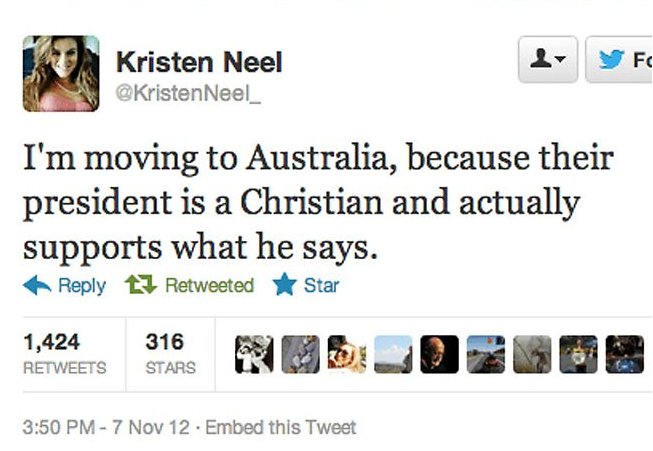
It was a bit silly when Democrats said they would move to Canada after Bush was elected (and subsequently didn't). It was even sillier when Republicans said they would move to Canada after Obama was elected (because your response to Obamacare is to move to a country with universal health care? wha?) But this tops them all: an American teenager who wants to move to Australia:
And why is this funnier? Because, as it turns out, Australia's Prime Minister is an atheist and a woman. Yowza.
Monday, August 20, 2012
"Gotcha!" questions
Almost as disturbing, though, is the media characterization of his stupidity as a "flub". Google is currently returning 178k results for "todd akin flub", two of the top three being from ABC ("Campaign flub by GOP Senate candidate...") and CNN ("A flub by a Republican Senate candidate..."). For the record, "todd akin misogyny" and "todd akin misogynist" return 140k and 119k hits, respectively.
But this characterization is equally moronic. A flub is something that's comical, accidental, and virtually harmless. A Freudian slip is a flub. Tripping over my own feet and missing a ground ball in a game of softball is a flub. Outtakes or gag reels that are set to hilarious kazoo music. Consciously and pointedly verbalizing your misogyny and scientific ignorance, on the other hand, is decidedly not a flub. It is almost the exact opposite of a flub.
The choice of "flub" reminds me of Sarah Palin and her numerous complaints about "gotcha questions" from the media - another word-branding exercise designed to obscure the stupidity of a politician. Now, "gotcha questions" do exist, and journalists do try to catch people saying the wrong thing, contradicting themselves, or simply lying. It happens. But it's also totally legitimate. And it's also their job to do this. Good journalism should include gotcha questions. And just as those questions shouldn't be reduce to a game of "gotcha", which subsequently diminishes the importance of the question, we shouldn't reduce the answers to "flubs", which makes them seem awfully inconsequential.
(For the sake of levity, I'll include a link to a slideshow from New York Magazine that describes the various incidents that Palin has characterized as "gotcha" moments. Unsurprisingly, all of them are simply cases of journalists doing exactly what you would expect of a reasonably ethical journalist.)
Friday, May 25, 2012
Counter-campaign, anyone? One Million Moms and their anti-gay superhero backlash
![]() |
| Progress! Also, how cool is it that Doop - the Cold War nuclear military experiment who is also a green floating blob - is front-and-center? |
Children mimic superhero actions and even dress up in costumes to resemble these characters as much as possible. Can you imagine little boys saying, "I want a boyfriend or husband like X-Men?"
Why do adult gay men need comic superheroes as role models? They don't but do want to indoctrate impressionable young minds by placing these gay characters on pedestals in a positive light.
Children do not know what straight, homosexual, or coming out of the closet even means, but DC Comics and Marvel are using superheroes to confuse them on this topic to raise questions and awareness of an alternative lifestyle choice. These companies are prompting a premature discussion on sexual orientation.
Earlier this year One Million Moms emailed Toys 'R' Us concerning the "Life With Archie" No. 16 with two gay characters getting hitched. Toys 'R' Us had the audacity to display "Archie- Just Married" at the front of the store by the checkout counters.
![]() |
| Cover to Life with Archie #16 |
I am sending One Million Moms this email urging them to change and cancel all plans to continue spewing homophobic venom against homosexual superhero characters immediately. I ask them to do the right thing and reverse their decision to publicize this puerile and misguided campaign, which serves only to demonstrate that OMM is totally out of touch with contemporary social attitudes and scientific knowledge.
Monday, May 07, 2012
Chocolate-covered Avengers (or, why i decided to stop worrying and love the Avengers)
The Avengers: super-fun, but entirely vacuous. We're talking about Michael Bay levels of depth, here. (But with better dialogue, 'natch)
— Neil Shyminsky (@neilshyminsky) May 4, 2012
And that's still true. The film is utterly unrelenting in its action - most of the movie is one extended, real-time, multi-site battle - but absolutely lacking in subtext.
The battle direction is superb, and one continuous shot where the Avengers work together to kill the invading alien horde is surely the single greatest teamwork sequence that I've ever seen. The storytelling is sharp and every seemingly arbitrary storytelling choice - is there any particular reason that Loki's staff must pierce them through the heart? why yes, yes there is - has some sort of satisfying purpose behind it. And the dialogue is written by Joss Whedon, so it's hilarious and wonderful.
But, yeah, it still has all the substance of a marshmallow. There's a shadowy global security organization that wants to nuke New York, but that's what passes meaningful political dialogue. Certainly, there's nothing that approaches the thoughtful engagements with international terrorism, American neocolonialism, and realpolitik that made the source material, Mark Millar's The Ultimates, so compelling. There's no character-work here, either, save for Cap's intro (which they never build on in any meaningful way - that's for his solo sequel, I guess) and a few throwaway lines from Bruce Banner and the Black Widow. In fact, as my friend Noa noted, there's nothing relatable about any of the heroes, and they're all larger-than-life demigods. (I think, again, that Whedon recognized this and tried to make the Black Widow more accessible. But it totally didn't work.)
All that said... I'm starting to think that I missed the forest for the trees. To quote some guy who I saw re-Tweeted on the internets:
Avengers backlash is silly. You can't overpromote chocolate-covered orgasms rolled in happiness.This.
— Gladstone (@WGladstone) May 6, 2012
Over on the facebook, Geoff Klock said that he "loved the Avengers as a tonic to the dread seriousness of Nolan's Batman". And he's right, because we do need movies like this - and that's especially clear when you see the trailers that precede the Avengers, which are for the next Dark Knight film and the new Spider-man movie. (Unfortunately, it looks like the new Spidey is taking its cues from the Nolan films rather than the Raimi Spider-man series. And I'm gonna make the call right now: that's a big mistake.)
If every other super-hero film is aiming for overwrought, despair-inducing gravitas, then we should applaud Joss Whedon for going in the total opposite direction. It might "only" be "chocolate covered orgasms rolled in happiness", but if you're going to eat anyway, you can do a whole lot worse than chocolate covered orgasms.
Tuesday, March 01, 2011
A joke that's making the rounds...
A public union employee, a tea party activist, and a CEO are sitting at a table with a plate of a dozen cookies in the middle of it. The CEO takes 11 of the cookies, turns to the tea partier and says, 'Watch out for that union guy. He wants a piece of your cookie.'
Wednesday, November 03, 2010
A quick post-American-mid-term elections post
"I'm a constitutional conservative and I do not ever approve of distribution of wealth, and I am not a socialist, this country is not socialist, we are founded on Judeo-Christian principles. I will riot in the street if I have to. I have never been so ashamed of the way Obama has diminished the Presidency. He calls certain people enemies. He doesn’t dress properly. He talks about certain networks. He is just what he is — a Chicago agitator."
1) "He doesn't dress properly."
He's too snazzy a dresser, I guess?
2) "I do not ever approve of [re?]distribution of wealth, [...] this country is not socialist, we are founded on Judeo-Christian principles."
What was it that Jesus said, again? "Greed is good. Greed is right. Greed works"? That was him, right? Not someone else?
Monday, June 21, 2010
On the BP oil spill
-Sarah Palin, on Twitter
"Is God willing to prevent evil, but not able? Then he is not omnipotent.
Friday, June 12, 2009
Sarah Palin is either a liar or a monster (or both? why not?)
And if he were joking about statutory rape, I'd actually share her indignance. But he wasn't - to all but the least discerning of people, it should be clear that he was making a joke about the older daughter, Bristol, who is already a teenager mother. (And given that Bristol's out-of-wedlock baby problematizes Sarah Palin's 'family values' schtick, also taking an indirect shot at Sarah.)
What amazes me about the entire exchange, though, are these three things:
1. The number of people (dozens, hundreds) who have the basic intelligence necessary to blog but are nonetheless convinced that a) Letterman actually knew which daughter(s) were present at the game, and b) that he would knowingly make a sex joke about a 14-year old. Sarah Palin herself called Matt Lauer "naive" for suggesting that Letterman was making a joke about Bristol (because Bristol has never been the butt of a joke, right?). When Lauer asked whether, in a press release, she was sincerely suggesting that Letterman couldn't be trusted around a teenaged girl (it's implied - and I'm willing to give Palin's people some credit and call it a joke, but a bad one - that he's a pedophile) she stumbled through her response and couldn't actually bring herself to tease out what was being implied. Because, at best, she's being completely disingenuous. At worst, she's being totally malicious.
2. Ironically, in refusing to admit the possibility that Letterman was making a joke at Bristol's expense, Palin actually endorses Dave's intended joke and its implied meaning - that, to put it plainly, Bristol is a slut. Palin has made it clear that she will rain down on Dave with hellfire for insulting her family and women in general, so one has to wonder why she uses no fraction of her outrage in support of Bristol. It's as if mom thinks that only one of her daughters is actually deserving of a defense - hence the title of this blog, because only a monster could behave that way.
3. No one seems to care that at least half of Letterman's joke was directed at A-Rod. In fact, if Palin is right, then the entire joke was at A-Rod's expense. That said, we should point out that the reason a joke about A-Rod impregnating anyone is at all funny is because he's infamous for being something of a (purported? confirmed? i don't follow him closely enough) serial adulterer. That level works if the joke is about Bristol but not if it's about Willow. If it's about Willow, then suddenly the joke is about A-Rod being a pedophile, an accusation that's never been raised against him. It seems to escape Palin entirely that her favored interpretation of the joke casts A-Rod as a pedophile, and that this is equally problematic. That she hasn't addressed this element of the joke whatsoever is probably worth thinking about - and I'd suggest that it's also an implicit endorsement of it. (One has to wonder whether A-Rod's ambivalent relationship to his American-ness and his race have some role to play in the ostensible obviousness of the joke's appropriateness, but that would be an entire post in and of itself.)
Tuesday, March 03, 2009
BSG: On symbolism, politics, and the triumph of individualism
But there's also some very good, and very apt, points in there that are worth repeating. For instance:
"it’s kinda dishonest when the great defining symbol of this culture-clash, the narrative linchpin of your ideological conflict, binds conceptually not to 9/11 but rather to the Holocaust."Whether or not the show's politics and message are reduced to incoherence, as Hal Duncan suggests, by this sloppy symbolism is almost beside the point. The show's juxtaposition of 9/11 and the Holocaust suggests that we're meant to understand the two as equivalent, and while this is hugely problematic, I think that what it says about American nationalism and identity is tremendously too interesting to dismiss because it makes for bad writing. We might even have to debate whether it necessarily leads to bad writing - while he and I might find the juxtaposition of these events distasteful and ludicrous, I think that the narrative manages to merge the two quite effectively for the purposes of storytelling. But regardles - even if it might be a narrative failure, that failure shouldn't preclude a discussion of it as a telling artifact of its time.
"that very act of symbolic hyperbole articulates, I think, something about 9/11, about how Americans in particular, but by no means only Americans, responded to it emotionally, ascribing it a grossly-exaggerated import. That narrative misstep of a dubious analogy is revealing of the degree of faith, the depth of the fall, the jawdropping level of… well… self-importance necessary to place an albeit horrendous act on that level."
But in defense of the narrative - I do think that Duncan is pouring it on too hard. If the historical resonances are multiple and contradictory, then in fairness you have to point out that it's even more varied and confused than this. Duncan admits this when he notes that the humans' internment on New Caprica reads instead like it is actually occurring in the Middle East, but this time with the Israeli/American role being played by the Cylons and the Palestinian/Iraqi spot by the humans. But the Cylon-human conflict, with the Cylons determining to wipe out their creators and former masters, doesn't fit terribly well into either any of these metaphors, nor does Cylon society (despite the fact that it is radical and monotheistic, sure) fit the usual associations of racial and religious Others with barbarism and incivility as would befit a 9/11 metaphor. So this stuff doesn't fit the above real-world references without ignoring huge and important parts of the story and so reducing them to absurdity.
"even the inherent tension in the basic dichotomy of militaristic autocracy versus democratic bureaucracy is dissipated quickly as Adama and Roslyn prove to be pretty much of a mind."Along the lines of 'thematic vagueness' - it seems clear to me that BSG is trying to do and say something about militarism and nationalism more generally (or, rather, within a plurality of specific references that is so varied that any attempt to limit the field just doesn't work), that it's trying to work additional metaphorical angles that resist placement among those major touchstones because they're not trying to speak to any event in particular over the course of the entire series. Whether this is a good or effective strategey is, of course, totally up for debate. And so while I agree that the show has reached a point where its thematics have become nonsensical - and I've admitted as much in past blogs - I think this has less to do with the ridiculousness or wrongheadedness of a hybrid 9/11-Holocaust metaphor and more to do with the too many references to too many sources that have accrued over four seasons.
"The result is a sort of thematic vagueness, where the show doesn’t really dramatise the ideological issues it’s pretending to deal with. It seems unwilling to really come down on one side or another and risk alienating viewers who might find such a stance challenging."
If I were to try and pin down an over-arching political message, I would probably push BSG's contradictory messages about autocratic militarism and democratic process aside and focus on its affection for heroic liberal individualism of a hegemonically masculine sort. If anything is consistently villified, it's the sense of collectivism premised on altruism that ostensibly underlies Cylon culture (and is eventually revealed to be rotten at the core and under the fascistic rule of Cavill/John), that is implied by the consensus-based approach of the Quorum of Twelve (who are shown to be spineless and completely ineffective), and which is attempted by various insurgencies (the union under Tyrell, but more aptly the mutiny as it is engineered by the hypberbolically crippled Gaeta and self-appointed man-of-the-people Tom Zarek) that find the autocratic rule of Adama and Roslin untenable.
If it's not already clear from my bracketed commentary, collectivism is always a sham or ploy in the BSG universe. What's curious, of course, is that while autocrats like the Adamas and Roslin are privileged, those sham collectives are usually being manipulated by their own - albeit evil-as-all-hell - autocrats. So maybe the difference is a qualitative one - the autocrat that rules transparently and unapologetically as opposed to the autocrat that rules by sleight of hand and claims, disingenuously of course, to not want to be the dictator that he is. Admiral Cain confuses this distinction because she clearly falls into the former category, and so would require us to make an additional and totally arbitrary distinction between good and bad Caesars, as it were. But her singularity makes it easier to consider her the exception that proves the rule, I think. Salvation is can only be achieved under the leadership of the right ruler. The problem is, aside from their transparency I'm not sure what makes the Adamas and Roslin so self-evidently 'right' in the minds of the show's producers.
Of course, with only a few episodes left, there's still time to up-end the apple cart.
P.S. I should probably also note that, yes, there is a racial subtext to an individualism/collectivism oppositionality. However, given the muddled political analogies that already confuse the ostensible real-world race correlates, I think that adding this additional layer would just make things messier and, so, doesn't contribute a whole lot to the discussion. Unless, of course, I want to argue that this is where the 'real' race politics of the show emerge...
Two final notes:
1) Ronald D. Moore - BSG's head-honcho and also one of the guiding voices on Deep Space Nine - seems to like muddying the politics of his lead characters to the point of unreadability as a rule. Look, for instance, at how Sisko changes on DS9. At some points, he's the fundamentalist protector of democratic process opposed to those who would violate the Federation's principles in order to preserve them - "Paradise Lost", 4.12 - and at others a Machiavellian schemer not unlike the characters he had previously opposed - "In the Pale Moonlight", 6.19. They're unreconcilable positions within the narrative logic of the show, which posits Sisko as civilization's saviour.
2) DS9 also showed a healthy mistrust for collectivism (the Founders) and shadowy autocrats (the admiral that Sisko takes down in "Paradise Lost"). And this might, in fact, go some way to helping us make sense of Sisko - he can get away with being an assassin and schemer because he doesn't desire to cheat his way into more power and influence. Likewise, he turns against that same admiral despite the fact that it costs him power and influence. There's something to be said in the DS9 and BSG universes for getting ahead the right way. Of course, what's right according to Ronald Moore and what's right to some of us in the audience isn't necessarily one and the same.
Wednesday, January 21, 2009
The curious case of the poet
Which causes me to ask - why is it that we always expect poets to read their own writing? That expectation seems non-existent for most other varieties of professional writer: lyricists don't have to sing (and singers don't have to write their own lyrics); playwrights and screenwriters aren't expected to be actors; novelists or writers of non-fiction sometimes read selections, but it's hardly given the importance of a poet's reading - and the book-on-tape is rarely read by the author. So why the different standard?
Tuesday, January 20, 2009
Atheism, feminism, and Obama - briefly
Obama: "We are a nation of Christians and Muslims, Jews and Hindus — and non-believers."I get the sense, actually, that all the debate over Obama being a feminist has actually lent feminism a mainstream legitimacy that it hasn't enjoyed in decades - for better or worse. But atheism? Not so much.
Me: "So 'atheist' is a dirty word?"
Victoria: "It would be like saying 'feminist.'"
Tuesday, November 25, 2008
Things I Don't Get
- Pro-Lifers. I don't get why pro-lifers appear to value unborn human life more than, well, born human life. They seem to go to often ridiculous lengths to protect fetuses but, for the most part, are the same people who oppose a secure welfare net and reliable public health care system that would see those same babies safely into adulthood. Or maybe this is why they simply call themselves pro-life rather than pro-good life?
- Lynda Barry. I find Ernie Pook's Comeek neither funny nor insightful.
- Why no one does anything about price fixing. Everyone knows that the price of gas is fixed. Everyone knows that it's bullshit when they explain that it will take 90 days to refine, process, and ship the oil that is now selling for half what it was only a few months ago, and so we'll only see the price drop 3 months from now. But no one seems willing to point out the contradiction when, in advance of a storm that is merely expected to reduce production, the price of gas anticipates the next 3 months rather than waits for them to pass and jumps dramatically.
- How to take a compliment from the other team in sports. I always think they're mocking me, even when they compliment me after I've done something good. I was traumatized as an undersized child, evidently.
- Why the news - on TV, on the internet, in the paper - is incapable of staking out a critical position outside of the occasional editorial. A timely example: Now that Christmas is approaching, we're met with a barrage of tips about bargain-hunting and getting the best deal. Some even pretend to be exercising a pseudo-criticality by making token mentions of "the economy" and charity. But why is it that no one is will to critique the quest for "bargains" as an ultimately futile one, to note how short-sighted and self-defeating this strategy is when it encourages us to spend money on businesses that aren't locally (or even domestically) owned and whose profits leave the country, who don't buy or produce their products locally or invest locally (or, again, nationally), and who don't produce sustainable jobs at a living-wage and thus create the need to find "bargains" as a means of surviving on one's meager earnings?*
Saturday, October 11, 2008
It's the same everywhere, depressingly
- An inquiry in Alaska found that Sarah Palin abused her power in attempting to have her brother-in-law fired from his job in law enforcement. The McCain/Palin team's response? It was "a partisan-led inquiry" whose findings can't be trusted. Which might hold water if it was a Democrat-led inquiry. Only it wasn't - the Republican members outnumbered the Democrats by more than two-to-one. So unless Palin's such a maverick that her own party would take a "partisan" position against her...
- An FBI expert confirmed that the relevant portion of a controversial audio tape, where the current Conservative Prime Minister, Stephen Harper, can be heard confirming to a biographer that he offered a dying independent Member of Parliament a bribe for helping to bring down the former Liberal government, had not been tampered with and represented an unbroken conversation. But the PM, who claimed that his response and/or the question had been doctored, has refused to address the tape, and his legal team is arguing that the findings somehow vindicated the PM. Because, y'see, at some point afterward the tape was stopped and rewound a bit, and used to record another piece of the same conversation. Clearly, they seem to be implying, the biographer erased the part where Harper said "Just kiddin'!" by recording over it - and in the PM's presence, no less.
Thursday, September 11, 2008
The curious coverage of election promises
Naturally, this is a fundamentally Bad Thing for the parties whose promises are staked on new social or cultural initiatives, rather than on reducing the tax load. In the Canadian election, the two major parties find themselves hilariously separated both in terms of their ostensible spend/cut philosophies and their transparency: but while the Liberal party has been, to my mind, quite explicit in explaining how they'll balance the new taxes with the new spending, little attention has been given to what the Conservative party will have to cut in order to meet their tax cut promises.
Take, for instance, a proposed cut to the diesel fuel tax. It'll remove a not-insubstantial $600 million from the piggy bank, but the Conservatives didn't even bother to suggest where that $600 will be struck from their spending. And no one asked.
I'm also amused by the underlying assumption that more fiscally conservative governments will necessarily be more fiscally responsible. The largest budget deficit ever posted by a Canadian government was posted by the Conservatives in the early 90s. (Which is, in part, attributable to a larger recession, but has also been blamed on PM Brian Mulroney's disastrous "zero inflation" economic policy. The Liberal government that followed him turned it into a surplus in less than 5 years, though at high cost to government services.) Likewise, the Reagan and Bush #1 years saw a combined $3 trillion dollars worth of debt and Bush #2 posted a record deficit in 2004 of $415 million. (Clinton's last year, by comparison, saw a budget surplus of $236 billion.) So where does this myth of conservative budgetary savvy come from, anyway?
Wednesday, September 10, 2008
Paglia on Palin
Camille Paglia thinks that Sarah Palin is a feminist. Camille Paglia is wrong.
Conservative though she may be, I felt that Palin represented an explosion of a brand new style of muscular American feminism. At her startling debut on that day, she was combining male and female qualities in ways that I have never seen before. And she was somehow able to seem simultaneously reassuringly traditional and gung-ho futurist. In terms of redefining the persona for female authority and leadership, Palin has made the biggest step forward in feminism since Madonna channeled the dominatrix persona of high-glam Marlene Dietrich and rammed pro-sex, pro-beauty feminism down the throats of the prissy, victim-mongering, philistine feminist establishment.
In the U.S., the ultimate glass ceiling has been fiendishly complicated for women by the unique peculiarity that our president must also serve as commander in chief of the armed forces. Women have risen to the top in other countries by securing the leadership of their parties and then being routinely promoted to prime minister when that party won at the polls. But a woman candidate for president of the U.S. must show a potential capacity for military affairs and decision-making. Our president also symbolically represents the entire history of the nation -- a half-mystical role often filled elsewhere by a revered if politically powerless monarch.
Paglia's making the exact same mistakes that I listed in my earlier comments on this same topic of Palin's ostensible feminist credentials: she doesn't realize that it's problematic - and decidedly unfeminist - to suggest that a woman needs to become a masculine-feminine hybrid in order to succeed when a man need not be anything buy masculine, nor does she seem to realize that Palin's rise, while undoubtedly important for its symbolism, confirms her exceptionalism rather than her exemplariness.
For this reason, the Madonna comparison is an unexpectedly good one - Madonna is so singular and unique that she strikes us as very nearly unreal or artificial. She's a woman that has built a career out of projecting a future-woman or counter-cultural sexuality rather than reflecting the mainstream. If this is Palin's metaphorical match, then she hardly proves Paglia's point.
Madonna also offers the mainstream a sort of cultural catharsis - having allowed her threaten the center with her saucy lyrics and cone-shaped bras, conservative media bodies can point to their acceptance - even promotion - of Madonna as proof of their tolerance. And this is especially effective when we try to judge the sort of material effect that Madonna has produced: sincerely, now, what sort of socio-cultural change - beyond those to high-fashion or the producing and selling of pop music - has Madonna actually managed?*
And Paglia's implicit suggestion, that getting a woman to the president's office is somehow de facto feminist, is also totally wrong-headed. And not just because Palin is not a feminist. As an example: A woman, Kim Campbell, became Prime Minister of Canada for six months in 1993 and every Canadian got to pat themselves on the back for their increasing tolerance and sensitivity to gender inequality. And Canadians have been so impressed with themselves that in the 15 years since only one woman has even had the chance to lead one of our four major parties. (And she never had a realistic chance of winning control of Parliament.)
Some powerful symbolism offered by those six months in 1993: they allowed us to go back to excluding women from the boys' games without having to even admit that we were doing so.
*I fully expect that my casual dismissal of Madonna will get me in trouble with someone at some point in the future, and I'm probably be unfair in failing to consider all of the people that she's inspired. Granted. But I do think it's important that there hasn't been a Madonna-like figure since Madonna - that 25 years after Madonna's debut, no one has arrived to take the pop-feminism crown from her and run with it.
Tuesday, September 09, 2008
Selling Sarah Palin: on post-feminism and the misuse of "feminist"
The first suggestion is, to anyone who knows anything about the broad philosophy of feminism, total bullshit. Feminism is not a politics that aims for the exceptional and symbolic advancement of a single woman, nor can it be reduced simply to the success of women - their ability to perform masculinity while preserving a recognizable femininity - in a man's world. Rather, a feminist and feminist politics are oriented toward gender equity and equality, and accomplishing that 1) by recognizing larger social structures and institutions that produce and reproduce this "man's world", and 2) doing something to change those same structures and institutions. Palin's politics are in no way feminist for the simple reason that she fails to recognize her exceptionalism as a woman who can play the boys' game, and so makes no effort to change that boys' game in order to make it inclusive. (Contrast this with Obama, who acknowledges historical and systemic race barriers - even if he can't explicitly call the USA "racist" - as well as his own good fortune to have been able to access systems of power that are only rarely available to other black men in the USA. Sarah Palin disingenuously describes herself as just a "hockey mom"; Obama would never reduce himself to just an "Afro-American dude".)*
The solution to the problem of the second argument is less obvious - which is merely to say that it's not completely fucking clueless - but equally misdirected. Marketing Palin as the end product of feminism or as a woman who will usher in a "new" feminism is actually a post-feminist position. Hillary Clinton got it right when she, like Obama, marketed herself as a pioneer - her run at the president's office was not indicative of feminism's success, but of its continuing gains and potential to succeed eventually. Conversely, Palin's nomination to the vice-president's office is seen by Republicans as just another reason to declare feminism dead and the feminist movement irrelevant - if a woman can be one step from the highest political office in the country, then surely gender discrimination is a non-issue. (And if you need me to tell you how and why this opinion is woefully misinformed, then you probably realized that I'm one of those self-hating feminist men and stopped reading this a long time ago.)
* In fact, the ways in which pundits describe Palin's feminist achievements actually serve to illustrate the persistence of gender inequality. Note how Palin is lauded for her ability to balance family and work - as if she could not be "feminist" if she focused on only one. Conversely, male politicians are rarely celebrated for their ability to be both good fathers and good leaders, nor are they decried for their perceived parenting failures. In fact, it's not really expected that they should have to parent- it's a mostly unspoken expectation that primary parental responsibilities will fall to their spouse, to whom most of the child-rearing questions are directed by the media anyway.


Is he both able and willing? Then whence cometh evil?
Is he neither able nor willing? Then why call him God?"
-Epicurus