Thursday, July 22, 2010

Scott Pilgrim's Finest Hour is decidedly not

There's a moment toward the end of the final book in the Scott Pilgrim series when Stacy asks where Scott, Ramona, and Gideon disappeared to during their battle, adding, "What was that all about?" Scott provides a rapid-fire response that sounds nonsensical (because, frankly, the battle was nonsensical), and his friends give the only appropriate response - silence, and a quick change of topic.

They might have been reading my mind - between fights on the astral plane, characters dying and then returning to life via free lives accessed in some space of purgatory, "the glow" on the subspace highway, swords being pulled from chests - twice (but in the real world, not in a psychic one), and Gideon's "cryogenic chamber", it's hard to tell whether there are any rules in the world of Scott Pilgrim. But it's a telling moment, too. Like the cliché says, when the characters seem to be complaining about the plot...

I've made it known that I haven't liked the last few issues of Scott Pilgrim. And I'll go on record in saying that this one is easily the worst - it is, as the kids (ie. me, when I'm pretending to be cool) say, a hot mess. But it didn't have to be. So, at the risk of repeating what I've already written elsewhere, I'll restrict myself to three complaints - two of which encompass the series as a whole, and one of which is the new detail that makes this book the poorest of the series. (My apologies in advance for poor spelling and wonky grammar - this entry seems to be more error-laden than most. That's what I get for not re-reading these things in their entirety.)

Complaint the first - Scott

Okay, I get it. Scott is supposed to be a cipher for the (presumably) nerdy and emotionally-stunted target-readership. He's purposely shallow because it allows us to project ourselves on to him. Because we also realize that we're our own worst enemy (Nega-Scott was a nice touch, though the set-up was awful) and we all want the mysterious hot girl. This is why people see Judd Apatow movies - the lead is usually a loser and a bit of a dick, but there are millions of young guys that find that relatable and want to believe that they can be dickish losers and still get the hot chick. But managing a good approximation of hetero-male-geek wish-fulfillment does not good writing make. And cipher or not, he's also the main character in a 1200 page story. I need something more than wish-fulfillment.

Because Scott is a dick. I was complaining about his character arc to some people yesterday, and said that he gets less likable as the series progresses - and then corrected myself because, in fact, it's more accurate to say that he gets more dislikable. He doesn't just squander the naive-lovable-loser charm of the first book, (or maybe it would be better to say that he tries to hold on to it well past the expiration date) he actually transforms into a willfully ignorant and insensitive prick. When Scott begins shouting at Knives about having casual sex, I want to reach into the comic and punch him in the face. He was a jerk to her when he dumped her in the first issue, but it was at least somewhat forgivable - or, rather, though he handled it badly, I wanted to forgive him. He was torn between his girlfriend and his dream-girl and, while he screwed it up, it seemed like he did it as well as he could have. These are, after all, the sorts of awkward break-ups that one stumbles through in their youth and is supposed to learn from.

Instead, Scott's come-on in the new issue takes insensitivity to new heights - knowing that Knives has never stopped loving him, that he hurt her horribly, and that everyone knows he's still hung up on Ramona, he asks her to sleep with him. That makes him an incredible douchebag, and not someone that I want to root for. At all. (Granted, this is when he has been separated from Nega-Scott, and I think we're supposed to understand that this is also responsible for his douchebaggery. But, a) that's not at all clear at this point in the story, which is a problem, and b) using a device from out of left field in order to undercut the emotion in the intimate personal exchanges that constitute the entire first act of the book is deceptive and annoying.)

I realize that, in real-life, people don't grow linearly - we change, we regress, we grow, we relapse. But books aren't beholden to these requirements, and most would be horrifically boring if they were. That Scott doesn't become a better person - and, in fact, seems even less self-aware and more malevolent - does nothing to recommend this book.

Complaint the second - magic realism/fantasy

When Scott Pilgrim's more fantastic elements are at their best, they're working with the more mundane elements of the story and not against or in-place of them. My favorite stuff is the most dream-like and ethereal magic realism - warp doors and Legend of Zelda dreams that lend atmosphere and depth, respectively. When they're at their worst, they suffocate the story and re/displace it - not magic realism at all, but magic absurdity. Magic nihilism, even. (On Geoff's blog, Dan suggests that it magic so totally overwhelms the realism that the book fully crosses over genre-lines and into fantasy. And so, rather than the magic sometimes encroaching on reality, as in the early books, the book features "realism encroaching on fantasy". I think he might be right, too.)

Take the Save Point from book 3 - faced with an unavoidable and horribly awkward meeting with his ex Envy Adams, Scott looks around desperately for an out of some kind. When Scott's supporters call him relatable, this is the kind of scene that they have in mind - one in which we've been forced into an uncomfortable situation and wish that we could have saved in advance, because a) we know it's going to go badly, and b) we wish we had a do-over. So the Save Point, while seemingly silly and random, is actually wholly appropriate to the scene - it enhances the pathos of Scott's situation and it increases our nervous anticipation, because we are keenly aware that Scott doesn't have a do-over. (And this is important, too - the Save Point 'exists' but Scott isn't able to use it. He, like us, wishes he could, but he can't - because the damned things don't exist!)

But the magic is the story in this final book: from Nega-Scott appearing seemingly out of nowhere to Gideon's cryogenic chamber to Scott's return to life from death to the psychic battle in Ramona's head... the book isn't grounded in recognizable human drama, much less remotely realistic settings. Which, I suppose, I saw coming because the series has tended increasingly toward absurdity and fantasy - so I shouldn't be surprised. Where the clever subtlety in the first book was in using the magic realism to represent what we couldn't have, that subtlety is deployed for wholly different ends, here: instead of failing to reach the Save Point, Scott uses a Free Life to return and fight Gideon again. Magic realism functions as deus ex machina with all the subtlety of a sword to the torso - Scott is killed and ends up in some Purgatory-like space (why? dunno.) where he meets up with Ramona again (how? dunno.) and uses his Free Life. (well, at least that wasn't pulled out of a hat - it was set up several books ago, as O'Malley reminds us.)

And, despite this, I actually don't mind the fight scenes being ridiculous and fantastic - because, at least in the earlier books, it works. But I would like for that ridiculousness to be somehow internally consistent, beholden to some set of self-defined limits, and contained. When it isn't contained, it threatens to turn the entire exercise into some snark-filled, self-reflexive, post-ironic joke.

Take, for instance, the narrator's increasingly explicit presence. Early in the book, Scott has a particularly awkward scene with Knives outside the Cameron House. When Knives and Scott kiss, we can tell for ourselves that it's awful and that they've made a mistake and feel terrible for it. Why the narrator has to tell us this, and tell us in as obnoxious a way as possible, I'm not sure. To undercut its emotional impact, certainly - because it's a painfully uncomfortable moment.

I'm wondering, actually, whether O'Malley's narrator is a sort of reaction to the author's earlier stuff (including Lost At Sea) after finding it, in retrospect, a little too emo, a little too precious. How else to understand his increasingly incessant need to assert ironic distance from the material, to undermine its emotional resonance and make fun of damn near everything? When the narrator appears in book 1, it's to cheer Scott on - to say 'Way to go' when Scott and Ramona kiss the first time; when he appears in book 6, it's to depress us and poke fun - to say that Scott and Knives' kiss was horrible "for everyone" and "that includes you". The problem, here, is that O'Malley isn't just poking fun at his characters - he's also poking fun at me for wanting to be invested in the characters and their feelings. And so it just feels mean-spirited.

(That really wasn't just one point, was it? It kinda veered into a point about self-reflexivity and irony. But there's a connection there, right? Ah, well.)

Complaint the third - Ramona

In my blog on the last book, I said that Ramona had clearly supplanted Scott as the central and most interesting character in the book - and had probably done so a long time ago, too. Ramona is mysterious and seductive where Scott is superficial and obvious. (This is not with the potential for problems, too, though - as Sara suggests on Geoff's blog, Ramona represents "[p]robably exactly how 20-something hetero men (and beyond?) feel about [women]. Complex, interesting/alluring/scary etc... but... vague." She's not really a real person, but more a projection of what a hot girl should be.)

So, clearly, this inequity had to be redressed. The obvious answer would be to elevate the hero, Scott, somehow - to have him grow, make him worthy of his dream-girl. That doesn't happen, though. Instead, O'Malley takes Ramona down a notch. When Ramona is asked, near the end of the book, where she's been the past four months, she says that she's been "dicking around" by watching The X-Files and playing on the internet. Nothing mysterious, no - she's been just as aimless as Scott, doing equally banal things instead of trying to fix her life. And we know that she's been dumbed-down to Scott's level because all the other characters sigh and sarcastically ask when the wedding will be. Here, it feels like the readers are being flipped off, again: "Oh, you guys! You thought that Ramona was all mysterious and deep, but she's not - she likes the internet and X-Files and dicking around and SHE IS JUST LIKE A DUDE."

The thing is, we didn't need Ramona to be reduced to a joke in order to understand that she's flawed. We already know that she's frightened of commitment, that she has a pathological need to drop her entire life when it grows too comfortable and start a new one elsewhere, and that she doesn't particularly like herself very much. This is the stuff of a tragic heroine, and the above reservations aside, Ramona is easily the deepest character the series has (though maybe this says more about the dearth of deep characters in the series...) - why squander that so needlessly?

And lastly

Despite these complaints, I actually have some hope for the movie. Because part of my problem is that Scott has something like 1300 pages within which to stagnate, and O'Malley had 6 years over which his dreamlike magic and precious optimism slowly turns into fantasy-overload and cynical irony. The shorter run-time of a film should make Scott more bearable, even if he similarly learns nothing, and the briefer turnaround of the movie project should at least bring some thematic and stylistic consistency, even if it is consistently absurd and cynical. But that's a worst-case scenario.

Sorry for ranting so long, and probably sounding so grumpy. Was it clear that I was disappointed? Because that's the short version of this review/critique/essay: I was disappointed.

Friday, July 09, 2010

World Cup rules and fitting the penalty to the infraction

Unless you've been deliberately avoiding the World Cup, you've probably heard that Ghana was eliminated from the World Cup a week ago when they should have advanced to the semi-finals. With minutes left, the presumptive game-winning goal failed to count because Suarez, a Uruguayan player who is not the goalkeeper, jumped and batted it out of the air with his hands just before it crossed the goal-line.

Unlike in the NHL, where a non-goaltender's illegal stop of a near-certain goal results in the awarding of an automatic goal, FIFA awards a penalty kick - which Ghana missed. Suarez was tossed out of the game and earned an automatic suspension, but the move was a no-brainer. If he doesn't stop the ball, his team is ejected from the tournament - sportsmanship aside, (and it seems like there's very little value placed in sportsmanship during the World Cup) there was no reason that he shouldn't have had it in his mind to stop the ball by any means necessary.

Over at The Book blog, which is largely a baseball analysis blog but it occasionally covers other sports too, a commenter named Greg Rybarczyk wrote that,

the game has rules, and with respect to those rules, there are violations, and for those violations there are prescribed consequences/penalties/sanctions. [...] If one is outraged at the fact that the Uruguayan player used his hands to stop a goal (which is agianst the rules, and has a prescribed consequence), where is the outrage when a player intentionally kicks the ball out of bounds (which is also against the rules, and also has a prescribed consequence)?

I wrote in response to Greg, and wanted to write here, too, that Greg is wrong because he doesn't account for the degree of the infraction - is it likely to directly affect the score/result? - and whether the penalty to the guilty player/team is of a similar degree - if it is likely to affect the score, does the penalty/reward adequately redress that affect?

Giving possession of the ball to the opposing team when it’s kicked out of bounds in soccer seems like a totally appropriate response - the team awarded the throw, by virtue of gaining possession, has almost certainly improved their chances of scoring. A quick look at the World Cup stats tells me that teams typically turn the ball over about 150 times per game - and if they're averaging about 1.5 goals per game, that means they only score on about 1% of their possessions - so we're talking about an improvement in scoring likelihood, in most cases, that's under 1%. Conversely, the team that committed the infraction has taken a small penalty - not a significant one, given how easily and often the ball is turned-over in soccer, (and even only 70% of throw-ins are successfully corralled by the team throwing the ball in) but it wasn't a significant infraction in the first place.

But the 'penalty' against Suarez, and the kick awarded to Ghana, doesn't make sense when we apply the exact same logic. While the illegal stop was made against a ball that was 100% likely to score, the 'penalty' given to Paraguay was a penalty kick for Ghana that’s only about 80% likely to score. That's a huge difference - clearly, since it led to Ghana's eventual elimination - and should be an obvious indication that the penalty is not appropriate to the infraction. To say that Ghana was 'awarded' a penalty kick or that Paraguay was 'penalized' is euphemistic, at best - in taking a 20% hit to their chance of scoring, Ghana was effectively penalized for Paraguay's cheat. That's just twisted.

Quick update: FIFA has apparently said that they won't review this rule, which is asinine. But they will review goal-line technology of the sort that would have awarded a goal to England when they were eliminated by Germany. One has to wonder whether the rule would be reviewed if Ghana and England were each in the other's position, and England had lost certain victory due to a handball...

Thursday, July 08, 2010

Gandhi and 'Terrorism and Espionage'

I wrote just a short while ago about how media coverage in the lead-up to the G20 had likened protesters to animals, non-Torontonians, and, just generally, the Other. I didn't write about it on my blog, but I also noted on Facebook that CTV news used the descriptor "known activist" in a clearly pejorative way, as if it meant the same thing as "terrorist".

But this isn't exactly new or unique and news media is just reflecting wider-held attitudes. Case in point: my friend Sue was at a bookstore - Chapters, at Richmond and John in Toronto - and was looking at their 'Terrorism and Espionage' section. She found Che there, which is unsurprising given his violent opposition to American-backed dictatorships - he fits, and is maybe even a model for, Western images of what a terrorist looks and acts like.

A bit more surprising was Frantz Fanon, who is implicated, I guess, because of his writing on decolonization and his association with the revolution in Algeria. (But Fanon is still primarily a theorist, a thinker and writer - not a revolutionary leader or guerilla-figher like Che. One wonders why Marx doesn't somehow make it into this section, too.) Clearly, though, there's evidence here of a major slippage between a particular sort of revolutionary and terrorism. And to the extent that a difference exists at all, then these guys end up in this section because they're not white and their interests are opposed to those of capitalism.

Because, certainly, the grounds for making it into this section had nothing to do with the advocacy and/or exercise of violence - how else to explain why and how Martin Luther King Jr. and Mahatma Gandhi were included in the 'Terrorism and Espionage' section? Seriously. Are there any more famous activists than these two? And they're catalogued under the heading of 'terrorism'? And do we need any further evidence that activism - especially non-white activists - and terrorism are being effectively collapsed into a single entity?

It's no wonder that the casual public has so little sympathy for activists who take their cause to the streets, and for the hundreds of activists who were beat up and jailed by police during G20, only to be released without charge. They were terrorists, after all, weren't they?

Thursday, June 24, 2010

A break from politicized posts...

We've lived just on the edge of Toronto's Greektown for almost a year now, and I only just noticed something strange about the strip-mall at the end of the street.

Conventionally speaking, the strip-mall runs north-south. But since it's on the west side of the street, the strip-mall 'reads' from south-to-north. And so the combination of the restaurant on the far left and the one of the far right is suspiciously unlikely and geographically appropriate.

The extreme left/south:


...and the extreme right/north:


What California or Florida have to do with places that serve mostly Greek food, though? I have no idea.

Wednesday, June 23, 2010

Constructing 'the protesters'


"protesters...are beginning to flood the downtown core" (Toronto Star)

"protesters descend on the city" (CTV)
"Feeding the protesters" (Toronto Star)


I was talking to my students last week about how the G20 protesters are figured as people on the fringe, non-Torontonians, and, implicitly, non-Canadian. The first two quotes make the non-Torontonian and non-Canadian claims, I think. The protesters, who we know to be a menacing collective because the media's occasionally using the definite article ('the'), are not from 'here' because they are flooding or descending from some shadowy place of anarchy to transform the ostensibly safe-haven of Toronto into a zone of danger. (Euphemistically referred to as the 'security zone', of course, because Toronto cops surely aren't prone to violence, and dropping thousands of cops into an urban setting to quell protest has always had a calming effect. Clearly.)

The bit about feeding them also reinforces the sense that these people live dangerously on the margins. 'Feeding the protesters' not only frames a benevolent act of community as somehow brutish - it immediately recalls 'feed the animals', as in 'do not...' - but reminds us of the poverty (and all the things that poverty connotes - laziness, criminality, etc.) that characterizes many of the people who are protesting.


"Dress like a militant protester, you run the risk of being tear gassed" (Toronto Star)
"What the demonstrators are saying" vs. "What the public is saying" (Globe and Mail)


These distinctions also reinforce the split between protesters and the mainstream media's implied audience - non-protesters who are voyeurs and might have a perverse interest in the protesters, but can't possibly identify with them. The first article playfully infantilizes the protesters by reducing them to fashionistas ("militant and fabulous") who can be imitated as if they were Halloween costumes, while the second is even less subtle in drawing a clear distinction between the law-abiding citizen-readers and the fringe.

Because, clearly, one cannot oppose any aspect of the G20 Summit while also being a law-abiding citizen who reads the Globe and Mail or watches the CTV news.

Monday, June 21, 2010

On the BP oil spill

"Gulf disaster needs divine intervention as man's efforts have been futile. Gulf lawmakers designate today Day of Prayer for solution/miracle."
-Sarah Palin, on Twitter

"Is God willing to prevent evil, but not able? Then he is not omnipotent.
Is he able, but not willing? Then he is malevolent.
Is he both able and willing? Then whence cometh evil?
Is he neither able nor willing? Then why call him God?"
-
Epicurus

Sunday, June 20, 2010

Marketing Canada: fake lakes and 'pristine natural beauty'

1. In the lead-up to the G8/20 summit at the end of the week, most of the Canadian media is focusing on a $2 million space for foreign journalists, where the centerpiece is a fake lake and beach so that the journalists who can't attend the G8 meetings can still 'experience' some approximation of their natural setting.


Needless to say, most people who aren't members of the ruling Conservative party aren't impressed. From The Globe and Mail:

[NDP leader Jack] Layton asked how the Prime Minister can justify the costs. [...] "We’ve got a government here that has to create an artificial lake when Canada has more lakes than just about any other country in the world.”

2. The Conservatives are defending it as a marketing ploy, though it's not clear what they're selling - is Canada a source of plentiful artificial lakes? And do the journalists covering G8/20 even care about Canada's lakes, real or not? From the CBC:

"The Experience Canada space will host over 3,000 media and other guests, and will serve to highlight Canada's pristine natural beauty, as well as promote leading Canadian businesses and industries," according to a statement issued by the Prime Minister's Office.

"In fact, it's a $2-million marketing project," [Prime Minister Stephen] Harper said, "We must not miss this opportunity."

3. But the real goal is probably to use the fake lake as a sort of distraction object. Because if you're trying to market Canada, you certainly don't want foreign media to be looking at the streets of Toronto, where the G20 is actually being held. A lot of concrete barriers and chain-link fences, sure, but not much "pristine natural beauty" here:


Unless, of course, the government is trying to sell Toronto as a police-state-themed amusement park.

Saturday, June 19, 2010

Does FIFA have any credibility at all?

1.

From the Toronto Star: 'FIFA is preparing to monitor the World Cup’s most vulnerable matches for match-fixing threats. [...] FIFA’s monitoring of legal and illegal betting markets suggests the World Cup has been “clean and clear” so far, with no suspicious wagering patterns identified.'

2.

From Tom Tango on his The Book blog: 'This is FIFA’s recap of the USA Slovenia 2:2 game. You will notice the controversial missing 5th goal is not there. If you want to see the goal, you need to see it on Youtube. And the message board at FIFA is totally devoid of discussions of the non-goal goal.'

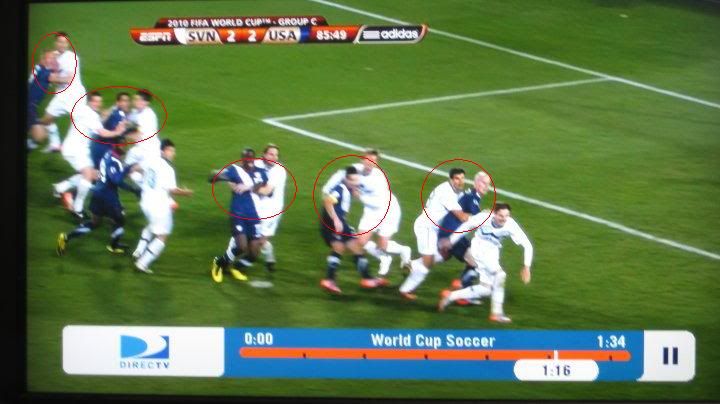
Me: A lot of people have also pointed out that the offside wasn't called by the linesman, who typically makes this call, but only by the referee. And this is a problem because while the linesman is positioned so as to have a nearly perfect line of sight, this was the ref's perspective:


If he could see evidence of any foul, one would have to wonder why he didn't appear to notice all of the Slovenian defenders who were restraining the Americans - which were very easily seen from where he was standing. (And there were more of them than are visible in this picture.)

3.

It's possible that the referee is just terrible at his job and made a mistake. It's also possible that there's something shifty going on. And it's possible that FIFA is covering it up - mistake or not - and cares more about not looking bad than they do about entertaining the possibility the ref made the wrong call. Despite the claims they've made regarding match-fixing and how much they want to stop it - which, after all, have to do with betting patterns, right? Regardless, it all looks bad.

Wednesday, June 09, 2010

A letter to the Toronto Star

Re: New copyright law would cut artists’ earnings (June 9)

I'm not really sure where Sophie Milman sourced her legal advice, but she's wrong when she writes that "just as with vinyl-to-cassette prior to 1997, ripping songs to a DAR is actually against the law". It's generally agreed that ripping music from a CD to your computer constitutes 'personal use' under the law. [Exclusive to the blog!: Nor is it technically illegal to file-share in Canada, as courts have shown unwillingness to find defendants guilty and the police lack the resources or desire to pursue music pirates, especially those who do so for personal use.] It may not be explicitly legal - neither, for that matter, is abortion - but it's certainly not illegal. If Ms Milman was looking to make a legal argument, she probably should have made sure that she knew the law, first.

I suppose that it isn't surprising that the music industry would play the levy card again, but the old suggestion that we be charged repeatedly for the exact same recording is indicative of the lack of creativity that got the recording industry into this mess in the first place. And just as the industry tried (hopelessly, and with still dubious legal grounds) to shut down file-sharing rather than find ways to profit from it, their efforts to police personal use is likely to only further alienate their customers. If only they spent as much time and resources in making these new formats into a unique and value-added experience worthy of our money...

Thursday, June 03, 2010

MIA and ethics in interviewing

Really quick bit on the MIA and Lynn Hirschberg interview controversy that's been smoldering for a week or so (in short: Hirschberg portrays MIA as a hypocrite who styles herself as a revolutionary but lives in a mansion with her rich husband). From the New York Observer:

In the published piece, M.I.A. is described as "eating a truffle-flavored French fry" as she mused about what type of artist she is. According to the tape, it was Ms. Hirschberg who introduced the concept of fry-ordering.

"They have, like, truffle, they have like three different kinds, it's very elaborate," Ms. Hirschberg says on the tape, explaining the menu to M.I.A. at the Beverly Hills Wilshire Hotel. M.I.A. said that, yes, she would like a starter. "Can we order the French fries that come on the bar menu, the basket?" Ms. Hirschberg instructs the waiter.


This only came out because MIA was more canny than Hirschberg expected - she secretly taped the interview, probably because she knew Hirschberg has a reputation for doing seemingly innocuous interviews that turn into scathing character-assassinations.

Hirschberg is either lying or being disingenuous when she says that "I don't think the French fries illustrate that much about her character", because it's clearly meant to illustrate something. I would call it Dickensian in its upper-class-is-morally-defunct symbolism, except that I think Hirschberg's unsubtlety would make even Dickens blush. (Hilariously, Hirschberg criticized MIA's immediate response to her profile - MIA posted Hirschberg's phone number on Twitter - as "unethical".)

As a brief aside: The Observer also notes that we might be at a point where journalism needs to tighten its standards, since every interviewee now has the potential to publicly call them on their bullshit. And that might be the most interesting development to follow.

Thursday, May 27, 2010

Categorizing Lost's 'mysteries'

This is a cute post from BuzzFeed mocking people who are frustrated that Lost didn't answer many of its questions. It has a point, of sorts - not all mysteries are worth solving, nor are all answers satisfying - but I think that it's worthwhile to separate out the legitimately frustrating questions from those that either don't require a solution or would simply be better off without one.

So here they are - split into 3 larger groups and 6 smaller categories, 2 categories of which are within each group:


GROUP ONE: Questions that don't need to be answered, and may not have answers anyway

1) Questions that shouldn't be answered because we might as well ask why bad things happen to good people:
* Where did The Island come from? What is The Light? Who created it?
* Where did the Island Guardian powers - like hiding the island or granting Richard immortality - come from? And why, if these powers are so wide-ranging, are they also limited - why couldn't Jacob raise the dead? And, for that matter, why and how was Man in Black able to resurrect Sayid when Jacob couldn't?
* Why is Desmond special?
* Why does the Island heal some things - like Rose's cancer and Locke's spine - and not others - like Ben's cancer?
* How does the donkey wheel work to move the island?
* Why do the sonic fences work against Smokey? How was the ash able to keep him at bay?

2) Questions that shouldn't be answered because it really doesn't matter, does it?:
* Did the bomb go off?
* Was it really Desmond's delay in entering the numbers that caused the plane to crash?
* Was the sideways-universe created by The Incident or the bomb?
* What's the origin of the Ben/Charles feud?
* Was Sayid really turned evil, or, as Hurley said, did he simply become what people expected of him?
* Did the psychic know that Claire had to get on the plane? How?


GROUP TWO: Questions that could use answers, and might have answers, but don't require them

3) Questions that don't need to be answered because the answer seems to already be implied:
* Why can't babies be born on the island, and why was there no such problem in the 70s?
* Was Christian always Christian? Was Smokey sometimes impersonating him? Was he always impersonating him?
* Why wasn't Sun transported back in time?
* Why did Juliet's husband die after she wished it?
* What's the deal with the four-toed, Egyptian statue?
* Was the Dharma Initiative a force of good or bad?

4) Questions that probably don't have a good answer, but whose answers probably aren't important, would be contradictory or needlessly confusing, or simply wouldn't be very illuminating:
* Who was shooting at Sawyer and company's boat when they were being chased across the water during all the time-flashes?
* How was Juliet's sister's cancer cured if Ben's cancer couldn't be?
* Was there really a box that granted wishes? And what is it, really?
* What is the Temple, where do its occupants sit in the Others' hierarchy, and what sort of magical powers does Dogen have that could repel Smokey?
* Why does Sayid, who killed dozens of people as a torturer and then as Ben's lackey, get to go into the Light when Michael, who killed two people - one out of desperation and one accidentally, and only to save his son - but also seemingly redeemed himself, get stuck on the Island?


GROUP THREE: Questions that should be answered (even if they can't be answered)

5) Questions that can't possibly have a good answer, and are probably just evidence of bad planning/writing:
* Why would Chang - or whoever else built The Swan - include Egyptian hieroglyphics in the timer, which are displayed only after it reaches zero?
* If Smokey can only appear as dead people, how did he appear to Locke and Shannon as Walt?
* Why was Richard surprised that Ben could see him when they first met? And why was Harper, who was bringing orders from Ben, able to sneak up on Juliet and disappear just as quickly? Were we meant to understand that the Others could become invisible or travel magically?
* Who was asking Locke to 'help me' in the cabin? And why wasn't he asking Ben, who admitted that no one - Jacob, or someone trying to pass himself off as Jacob - ever spoke to him?

6) Questions that have been dangling for so long or were made to seem so important that we deserved an answer, dammit!:
* Why did small animals die when Walt got angry, and what was so wrong with him that even The Others wanted to get rid of him?
* And relatedly - why are the kids so important? Why do we want to kidnap Walt and Aaron? Why did we kidnap those other children? (It can't just be that they can't procreate on the island, right? And it's not like they knew about Candidates at that point...)
* What's the deal with Eloise and her seeming omniscience, in both the living-day present and in the afterlife?
* What's the deal with the Hanso family, who were the financiers behind both The Black Rock and Dharma and were featured prominently in the Lost Alternate Reality Game?
* What's the Man in Black's name? And if he doesn't have one, why? (Because deliberately not mentioning it seemed significant, at first, and just annoying, later.)
* Do The Numbers refer to the Valenzetti Equation or the final six Candidates? Or both? And how are they related? Is it mere coincidence (?!) or fate that the final six Candidates are assigned the same numbers that appear in the Valenzetti Equation? And if it's the latter, how does that compromise Jacob's whole 'i want you to have a choice' speech, or diminish the centuries-long process of finding a suitable replacement and watching most of the Candidates die in the process?

There are probably other categories that we could invent, and some people can probably take issue with where I've slotted particular questions. Let me know.

Monday, May 24, 2010

Reflections on the Lost finale

It's been less than 12 hours since the show ended, so these will be a bit half-baked. I'll keep it to three general thoughts:

1) So the flashsideways is technically taking place after the mainstream timeline, insofar as it's an epilogue set in some limbo- or purgatory-like afterlife that the characters are sharing. I didn't really see that one coming. I'm wondering whether there's a bit of a joke hidden in there, since 'everyone is dead' was one of the theories first offered to explain the mysteries of the island. But the tone of the epilogue would seem to suggest that this isn't the case. (So my complaint that I had no idea what the stakes were ends up a bit off-the-mark, since there really were no stakes.) And it provided the happy ending that would have only been bittersweet otherwise. We know that Kate leaves, Jack dies, and Hurley takes Jack's place - and we don't know what happens to them afterward - but we're told that it basically doesn't matter.

2) Shockingly, and aside from the reveal of the flashsideways-as-afterlife, there were no twists in the finale. Everything we learned about the nature of the island, about the Man in Black and Jacob, turned out to be absolutely true and we really didn't learn anything new about the island. It was straightforward, epic-drama - the world would end if Locke escaped and if Jack couldn't restore the light. And I thought it was pretty effective stuff, too.

3) So whether the show was 'good' or not hinges, I think, on whether you buy the overtly religious ending. That the show moved in this direction wasn't a surprised - the science/reason v. fate/faith opposition that so strongly characterized the first couple seasons was indisputably won by religion/faith side this season, and was probably a foregone conclusion as soon as Jack started to believe he was fated to return there. (Which is to say that, unlike in Battlestar Galactica, it didn't come out of left field.) But the strength with which the epilogue pushed a very Christian - that multi-faith stained glass window aside - resolution to the series was a bit startling. (At least they had the sense to make a joke about it, when Kate comments on the ridiculousness of Christian Shepherd's name.)

I found myself liking how heartwarming the epilogue was, but after this much time I'm starting to feel a bit cheated. I was moved in the moment, but I think that the credit for that goes to the actors and my own substantial investment in the show - I could ignore or miss the larger spiritual politics because I found it so damned pleasant. (This kind of sleight-of-hand is the same complaint I had of the Sun and Jin death scene, in a way - a touching resolution to their story that is at once undermined by the realization that they're abandoning their daughter, and probably abandoning her to Sun's father. Once the emotion of the moment wears off, you realize that they're actually pretty selfish.) I don't know whether there was a way to offer viewers that happy ending without going in the direction of religion, but, as-is, it feels incongruent with the first five seasons of the show.

But the ending on the island, with Jack dying in the field where he first landed, Hurley and Ben panicked about what happens next, and Kate leaving someone behind, again? That seemed more apropos, more like the Lost that offers half answers and an unexpected new status quo. Maybe the pressure to offer an unequivocal ending was too much. Maybe Cuse and Lindelof thought the flashsideways was more subtle than it turned out to be. Maybe the show was so hopeless at points that we needed the finale to remind us that hope and love exist and that the characters really care for one another And maybe the whole afterlife thing was the only way to pull that off. I feel some satisfaction from the characters' happy ending and I'm simultaneously numbed by the particularly Christian-styling of the message. I'm not sure what else I can add.

Thursday, May 13, 2010

Quick update on Lost and the Theory of Everything (now at version 3.0)

Once again, I've re-revised my position on how the flashsideways relate to the main Lost U: I'm thinking, again, that the flashsideways follow, narrative-wise, after the resolution of the main story.

The short explanation: If Jacob's Mother was telling the truth when she said that it's bad for humans to capture/harness The Light - and it seems reasonable to suspect that this much, at least, is true - then it's probably also bad that Mother (and Jacob and Smokey) should have it, too. (In brief: Even if they're well-intentioned, there's no reason to think that they're somehow the only people in existence who can't be allowed to have it - that no one else should be allowed to find it or use it because bad things will happen, but these people are an exception. And given all their magical powers, they definitely have it.)

And this is why Jack is a particularly good target to be convinced to accept the mantle - he still wants to fix things, and replacing Jacob essentially makes him the most important fixer in the world. Like Jacob in this past episode, his benevolent intentions make him the ideal, and entirely self-deceiving, candidate.

Why self-deceiving? Because I suspect that The Light should be allowed to leave the island - that the ostensible source of what's good and life-giving probably shouldn't be confined to a cave on an island. So when Smokey-as-Locke finally escapes, it'll be like Pandora's Box, only in reverse, and this is why, for example, the universally bad parents of the main Lost universe will become good parents in the sideways universe, and so on.

And, having written this, I'm at least 95% sure that I'll be proven totally wrong.

Robinson Cano, baseball, and racism

It's been a rather recent development in baseball blogging to note the contrary ways that white and non-white players are generally talked about. I'm actually pretty surprised that sports bloggers would pick up on this, especially since it's relatively subtle stuff. (Or, at least, much more subtle than what typically passes for 'racism' in mainstream journalism.)

Take this bit by ESPN's Jerry Crasnick, in describing the New York Yankees' second baseman, the Dominican-born Robinson Cano:

"[Cano] learned an even more enduring lesson in September 2008, when [manager Joe] Girardi benched him for lollygagging after a ball in short right field against Tampa Bay. Cano, seven months removed from signing a $30 million contract extension, needed someone new to prod him after third-base coach Larry Bowa left the Yankees to join Torre in Los Angeles."

What exactly is Crasnick adding to the story with that second sentence? Why does a report on Cano's benching require that we be told Cano's new financial situation unless we're meant to understanding that getting rich has made him lazy and complacent? And what's his rationale for the claim that Cano requires someone else to keep him focused, as if an elite athlete needs this kind of babysitting?

Moshe Mandel at the baseball blog TYU notes how the subtly racialized characterizations of Cano are especially apparent when he's compared to his white counterpart on the Boston Red Sox, Dustin Pedroia:

The Bronx incumbent is smooth, super-cool and has a hitting DNA to die for. But Pedroia plays harder and has a greater emotional investment in the day-to-day outcome of his team. In other words, he cares more than Cano. From Fox Sports' Bob Klapisch:

"The Bronx incumbent [Cano] is smooth, super-cool and has a hitting DNA to die for. But Pedroia plays harder and has a greater emotional investment in the day-to-day outcome of his team. In other words, he cares more than Cano."

How do we know that Pedroia cares more? That Cano is "super-cool"? That Pedroia "plays harder"? Or that Cano has "hitting DNA"? Who knows? But what we do know is that these associations of success with hard-work and intelligence (Pedroia) or else biology and natural talent (Cano), and the privileging of the deliberateness and accomplishment involved in achieving the former - that is, the natural talent can backslide or grow complacent because he hasn't earned it, whereas the learned talent knows failure and is less likely to take success for granted - are undoubtedly racialized assumptions. (Obviously, I'm thinking about this because of my Lady Gaga post from a couple days ago.)

And this is especially true given that these assumptions rely on supposed 'information' about the players that would be virtually impossible to locate or verify - have the writers run Cano's blood through tests to quantify his ability, or are their assumptions about Pedroia based on the way that he gets down on hands and knees with a toothbrush to clean the kitchen floor? (Though I suppose that being able to 'evaluate' or 'assess' these players is what supposedly makes these writers experts in their fields. Supposedly.)

Mandel also supplies this quote from a baseball talent evaluator, assessing which of two young pitchers who've recently been signed to big contracts - the white Justin Verlander and the Hispanic Felix Hernandez - is a safer bet:

“Now we’ll see what the contracts do to both guys. It won’t faze Verlander, but I guess it’s possible Felix could get a little complacent. His makeup doesn’t suggest it, but you never know."

This quote requires a little less explanation, I think - if his 'makeup' doesn't suggest it, then what does? And why does the white guy get a free pass?

Baseball commentators on TV, I should add, are routinely terrible. (This is why the website FireJoeMorgan was created: because the former players who dominate the jobs, in particular, have a surprisingly poor understanding of how the game works - success rates, probabilities, likelihoods, percentages - outside being able to offer glimpses into player psychology.) That they should be terrible at their job and racist? Ugh.

Wednesday, May 12, 2010

Lost: stumbling to a conclusion

So I didn't like the last episode of Lost - "Across the Sea", the one that that was purportedly going to fill us in on where Jacob and the Man in Black came from. Two of my friends, though, liked it well enough, and supplied the following comments:
  • Alex "finds it incredibly amusing that Lost viewers get disappointed when 'nothing was made clear,' as if that was something that has *ever* happened. From where do they derive this expectation of clarity?"
  • Geoff writes that "It would not be Lost without the messy. If you have not come to enjoy the messiness, I am surprised you still watch the show."
These are fine points, but I don't think that either really addresses my problem with the episode. And simply, it was this - if this is the big mythology-information-dump leading up to the finale, it should have left me certain that I know what the stakes of the final showdown between Jack's group and the Man in Black are. And it didn't.

Sure, it told me that Jack and MiB are brothers, that the mysterious power source at the center of the island is a light, that MiB simply wants to leave for the sake of leaving... but these were hardly the burning questions that I wanted answered. What I felt that I needed to know was what would happen if MiB were to leave, and why he needed to be stopped. (If, in fact, that needed to happen.) And not only is the 'why' not clear to me, but MiB is made so sympathetic - and Jacob's mission is made so doubtful due to the unreliability of the character whose job he has taken - that I feel less certain that MiB has to be stopped at all.

I should add that Geoff uses gnosticism to provide a plausible answer to my most burning questions. This is what he writes:

the energy at the center of the island is the light of creation, or something like that. The Smoke is the opposite number, split off when the light was disturbed by someone corrupted by men — this is pure Gnostic mythology. Somehow the smoke is or has the light now and if it leaves the island everything goes out everywhere.

Okay, I can buy that. But even if Geoff is right, that particular thought never occurred to me until I read Geoff's review. I didn't even notice that the light went out in the cave, nor did I think, when it was first pointed out to me in an article elsewhere, that a) this would necessarily mean that MiB now has/is the light, and b) the world should end if he leaves with it. If this is true, it actually becomes the entire point of the show. And if I need someone's blog or a thorough understanding of gnosticism to point out something so fundamental to my understanding of the show, then it hasn't been made clear enough.*

* [What's especially annoying about this is that the connection made between 'Adam and Eve' from season one and the bodies of Mother and Brother was drawn in the most hamfisted and patronizing way - with horribly incorporated cut-scenes. Why be so painfully clear about such a minor detail, when you so badly explain something so much more important with the creation of the smoke monster and disappearance of the light?]

Tuesday, May 11, 2010

The transgressive(?) Lady Gaga

I've been meaning to write about Lady Gaga for weeks. Unfortunately, what I wanted to write grew to this mammoth range of topics that became too daunting to even start. (This is a common problem for me.) So I'm going to try to pick out one specific element.

So for this blog, anyway, it's the recent hubbub over Gaga's lack of self-consciousness regarding her race and the role that race plays in the kind of appropriation that is central to her various art practices.

So why does Gaga get all the love? How much of it is because, as a small young blonde woman she appears to be transgressive in a way that artists like M.I.A. or even Trina cannot be transgressive, because to begin with they are already seen as non-normative, simply because they aren’t white?

This is probably an apt point. By virtue of her whiteness, Gaga is not 'naturally' transgressive - she has to work at it, has to adorn her body and performance with the markings of transgression, and so she gets extra credit for having had to make deliberate, intelligent, and artistic decisions that require her to extend beyond her own bubble of normativity. M.I.A., on the other hand, is already 'naturally' an Other - born into the body of an Other, with links to an Otherized culture, her Britishness notwithstanding - and so we give her less credit for having achieved something, since she presumably had something more transgressive to begin with. M.I.A.'s 9-month pregnant body on the Grammys a couple years back, versus Gaga's varied prosthetics on this year's Grammys, draws this implicit difference out perfectly - the former has an excess of body and nature, the latter an excess of intellect and artifice.

Which is all well and good - and wholly accurate, in isolation - but ignores Gaga's indebtedness to (mostly) white performers like Madonna, Bjork, Abba, Christina Aguilera, and even Britney Spears. My sense is that Gaga is taking a race-blind approach and stealing and mixing from every/any source available. And while race-blind appropriation is definitely problematic, we need to account for these white sources, too, especially when they're arguably more central to Gaga's art.

Clearly Gaga is not oblivious to her own “normativity”; she actually uses it as a weapon, drawing in the viewer with the expectation that she will be blonde and submissive, and then upsetting those expectations by doing intentionally weird, gross things. But while she’s playing with her whiteness, she (& her critic fans) seem somewhat oblivious to her white privilege. And the attendant attention she gets, while women of colour’s contributions to redefining music and gender performance are marginalised.

I'm not quite on-board with this one. The authors recognize Gaga's reflexivity and self-awareness to her normativity, but castigate her for failing to acknowledge that it's her privilege that allows her to subvert normativity in the way that she does. Okay, I'm with them on that - subversion that's undertaken by people who can still pass as normal, as opposed to people whose bodies preclude the possibility that they can be considered normal and so become subversive almost by default, is a particularly safe kind of subversion, and we should account for it. But there's an element of blame, here, too, where Gaga is being faulted for contributing to the marginalization of women of colour in the same field. I have to wonder what else Gaga could do - if she can't help but embody white privilege even as she attempts to subvert or ironize it, what options are left to her?

M.I.A.’s comments seem particularly spot on: while the spectacle of Gaga is dazzling, ironically as a singer, her music is the least progressive thing about her. Especially when you contrast it with M.I.A’s bonkers rhymes and bold call-outs to volatile political conflicts.

Victoria was annoyed particularly by this last section of the blog post, and I feel the same way. There's an assumption, here, that Gaga's pop-proclivities should invalidate the rest of her body of work - that her work in fashion, for instance, is somehow devalued or delegitimated because Gaga writes chart-toppers instead of inscrutable music with politicized lyrics. And that's really not fair, for at least two reasons: for one, we probably wouldn't even be discussing Gaga if her audience was the same (demographically and with respect to size) as M.I.A.'s because her fame and ubiquity are key to her appeal, and two, it just isn't reasonable to expect that every artist is transgressive or obtuse in every aspect of their artistic practice. And Gaga is certainly more obtuse than any other pop-queen, so that's worth something, isn't it?

Friday, April 23, 2010

One of the reasons that Bon Jovi drives me nuts

Bon Jovi has this annoying habit (and it's not limited to them, sure, but their examples seem particularly egregious) of just recycling their old songs. I realize that plagiarism, while still technically occurring here, is usually ignored when you're plagiarizing yourself, but geez...

This first example is the subtler of the two, and it relates to the chorus - they have incredibly similar intro lines where the title is shouted over three beats, and the fade-out back into the chorus is structurally similar, too, and again repeats the song title. The chorus on the whole is rather similar, (I lack the vocabulary to describe it - I have absolutely no training in music) though I suspect that has to do with both being so utterly conventional rather than one being derived from the other. (And I'm sure I could find two if I actually listened to their music. I picked up on these only because Bon Jovi is ubiquitous.) Bizarrely, they're on the same album, too - wouldn't it be better to just cut one of them, rather than repeat yourself?

"It's My Life"


"One Wild Night"


This pair is far worse, I think. "We Weren't Born to Follow", which was released just last year, sounds - on the whole, but especially during the chorus - like a slightly slower version of "Born to be Your Man", which predates it by more than 20 years. Seriously, just listen to the chorus of each (about 50 seconds into WWBtF, and 90 seconds into BtbMB) - they are the exact same song, with virtually the same melody and structure. The newer one is just a bit slower, and so sounds a bit deeper - and I suspect that if you slowed the older song down, they would match almost perfectly.

"We Weren't Born to Follow"


"Born to be My Baby"


Sure, John's voice has a pretty limited range, but are they really so creatively defunct that they need to shamelessly recycle songs?

Tuesday, April 20, 2010

Adventures in TAing, case 7 (in a ? case series):

The best question I have ever been asked during a final exam:

"I don't know if you can tell me, but I forget which it is: Joan of Arc or Noah of Ark?"

What makes this question even better? Neither Joan nor Noah (of Ark?) appeared in any course reading or lecture.

Tuesday, April 06, 2010

Lost's theory of everything, revisited

So following this week's episode of Lost, it would seem that I was not only wrong, but that the relationship between the regular Lost universe and the so-called flashsideways universe is the EXACT OPPOSITE of what I had guessed after the season premiere. Oops.

That is, it looks like the alternate reality in which the Losties never went to the island takes place, in our story, before the ongoing saga on the island. And that Desmond, having gained a vision of the reality that was erased when Juliet set the bomb off, is going to convince them that the universe is wrong and they need to (somehow) reestablish the previous one. So, presumably, at the end of the series they'll choose to go back, ending up - diegetically, if not temporally - back where we began the season in the main universe, with our heroes in the crater, not realizing that they had succeeded, only to undo what they had already gone and done. We might even learn that the Man in Black was unleashed in this alternate reality, that he's given everyone what they (thought) they wanted - Hurley is lucky, Desmond has Widmore's respect, Jack is the father he wanted his father to be - and that they'll have to reject it in order to save the universe.

So here's my proposed order for how things unfold:
1) Juliet hits bomb and sets it off in 1977.
2) Island implodes/explodes, but does so with enough time for Chang and Widmore, at the very least, to escape.
3) MiB is freed.
3) The Losties get what they want from MiB in the ensuing years. This is an important difference from my earlier supposition, which was that they get a happy ending. Jack gets to be a good dad, and this is happy; Desmond is Widmore's right hand man and has his approval, which is a bit less obviously happy because he doesn't have Penny; but it also looks like people who are carrying a lot of guilt - Sayid, Kate, Sawyer - are being allowed to punish themselves, which is decidedly not good.
4) Desmond will convince the Losties that what they want isn't as important as what needs to be done. They'll restore the previous timeline, somehow.
5) Everyone wakes back up where they were in 2007, when the season premiere began with Jack and company in the crater.

So that ties things up. I'm not sure that I like it - that there needed to be an alternate reality where they never went to the island, especially when it feels like the wind-up might be unsatisfactory in the mainstream universe - but at least it hints at the ultimate meaning of alternate reality. And it made this other universe appear to have a purpose, which it had been lacking for a few episodes.

Thursday, February 18, 2010

Chaos and 'success' at the Olympics

From the Guardian:
It is hard to believe anything will surpass the organisational chaos and naked commercial greed of the 1996 Summer Games in Atlanta or the financial ­disaster of the 1976 Games, which ­bankrupted Montreal, yet with every passing day the sense of drift and nervousness about the Vancouver Games grows ever more noticeable.
There are plenty of good reasons to hate on the Olympic Games, and this one in particular - though I'd put the destruction of 1800 units of affordable housing and an accompanying process of gentrification which has made Vancouver the most expensive city in the world to live in right at the top, instead of the 'chaotic... transportation system' - but it's amazing to me that everyone is taking the spit out of Vancouver after the relatively free pass that Beijing was given.

Remember the Beijing Olympics. Y'know, the one that featured city with such unsafe air that they pulled cars from the roads in the weeks leading up to it, that faked the opening ceremonies several times and in several different ways, that destroyed the housing of tens of thousands of people to build their venues and 'relocated' them outside the city to live in places and with people they didn't know and couldn't choose, that said they would allow protesters to apply to protest but heavily discouraged applying and then disallowed every application that was made, and which built a $450 million stadium that's been used for only one (!) sporting event since the close of the 2008 Olympics and so is going to be turned into a shopping mall (!).

And we're meant to sincerely believe that Vancouver's Olympics might be worse than that? Wikipedia tells me that the cost of 2010 games is $1.6 billion for operations and $6 billion when including all infrastructure costs. And the city is expected to lose something in the neighborhood (or at least this is what I was hearing a couple weeks ago, before they started canceling events and flying extra extra snow in) of $150 million. The Beijing Olympics, on the other hand, were very roughly estimated to cost $15 billion for operations and $40 billion in total. (Though I've heard $65 billion, elsewhere.) There's no way they avoided losing billions - or tens of billions - of dollars.

But, again, according to Wikipedia, the 2008 games were a "logistical success". That's reassuring.

Saturday, February 13, 2010

Quick comments on the Opening Ceremony of the Winter Olympics

  1. The opening show devoted huge amounts of attention to the First Nations traditions of the west coast. I've read a couple of complaints about this focus, (and I commented on early complaints about the branding of the Vancouver Olympics in general) but they largely - the latter link more than the former - miss the mark. It's telling that there was no real attention paid to Aboriginal people in their particularity: they spoke and danced as a mostly undifferentiated collective, while the spotlight and starring roles fell exclusively on/to the white celebrities. I don't know whether to describe the role of the Aboriginal people in this show as a fetish or a reflection of white guilt. Maybe it's both.
  2. At one point in the show, while representatives from all the participating First Nations, Metis, and Inuit communities danced in the center of the stadium in some orgasmic fantasy of exoticized pre-historical (that is, pre-European) peace and love - this part was definitely in the 'fetish' category - I snarkily asked Victoria when the white guys were going to show up with guns. And then, with no intended irony, a bunch of mostly white people in entirely white outfits encircled them and stood, watching. It turned out that they were security, providing a barrier between the athletes, who were about to parade in, and both the dancers and the audience. That didn't lessen the creepiness, though.
  3. The head of the Vancouver Organizing Committee made note of the various peoples of Canada: "Aboriginal Canadians, new Canadians, English Canadians, and Francophone Canadians." I'm thrilled to hear he's caught up with the 40 year old Official Multiculturalism discourse that says Canada is a state with 'three founding nations' rather than the older 'two founding nations' rhetoric. Too bad that he managed to toss everyone else into the ridiculously inadequate "new" category.
  4. On a kinder note, the choice to use five athletes in lighting the cauldron - when it's customary to use one - was nice. VANOC said that when we found out who was lighting the cauldron, we'd say 'of course'. And they're right, this time. It was also nice to see people running alongside the truck that carried Wayne Gretzky to the outdoor cauldron. After 106 days where I was unable to escape hearing about the torch relay, this was the one moment that felt genuine and not wholly contrived.

Thursday, February 04, 2010

The Theory-of-Everything: Lost season 6 version

To start: Let's call the Lost timeline where the plane crashed on the island Lost-Prime. And let's call the one where the plane lands Lost-X. And we'll call the gimmick that had us moving between one and the other a flashsideway, because that seems to have already caught on.

My need to find a theory of everything comes from Jacob's line in the season 5 finale, which was repeated in the recap: It only ends once. What this means (I think) is that Lost-Prime and Lost-X can't be separate timelines or alternate realities - we can't be witnessing what would have happened versus what did happen because that would allow for two endings.

So this is my either very right or very wrong answer: Lost-X is actually happening (within the story) after Lost-Prime. Something will happen at the end of the series in the Lost-Prime timeline that will send them back and make it so that they never crash - and what follows will unfold in the flashsideways, which we're meant to think are totally unconnected but actually provide us with the various characters' resolutions.

Here's where I'm coming from:
  1. The very first detail: the mysterious cut on Jack's neck. They made too big a deal out of this for it to be a meaningless detail. It can't possibly matter within Lost-X, but I have a feeling that we should be watching out for Jack to see if he acquires a neck wound toward the end of Lost-Prime.
  2. Juliet says "it worked". Ostensibly, we're meant to understand that she somehow knew that Lost-X had been created, but I think that it's more than that. Recall that Desmond was similarly close to the pocket of energy when the hatch blew up, and that his consciousness was dislodged and began to shift in time. My guess is that what we were supposed to understand was throwaway dialogue - the bit about going out for coffee sometime and Sawyer saying sure - is dialogue that we'll hear her speak in Lost-X, when she and Sawyer meet again for the first time.
  3. Subtle character changes. Sure, Hurley saying he's lucky and Sawyer appearing to be nice are probably red herrings - it'll probably be made clear when they get character-centric flashsideways that Hurley was being sarcastic, which is not unusual, and that Sawyer is casing Hurley. But the Jack and Locke scene was weird and not easily dismissed. Locke was an angry guy before the island, but that anger seemed to motivate him. This Locke is a cynic and a skeptic - not angry, just defeated. And this Jack is surprisingly open-minded. Sure, he's tried to fix the unfixable before, but it was out of some pathological need to fix things and people. You don't get the sense, though, that the suggestion that he can help is about him.
But why does it matter? Well, regardless of who they are and where they come from, Jacob and the Adversary appear to be playing some sort of cosmic game to prove the other wrong. (As suggested by the season 5 finale, they've played this game before.) Ostensibly, Jacob believes that people are good and his adversary that people are bad. Periodically, one assumes, they cause a group of folks to wash up on shore so that they can play a game with them.

Whether the ship/plane is itself full of despondent people or they choose to focus on them in particular and remove the rest from the field of play is up for debate - surely, the various lists play a role in this process - but the key figures in the game are all very much damaged*. As he tells Ben, the Adversary thinks that they're pathetic, whereas Jacob thinks they can be redeemed. (This is not unlike an issue of
The Sandman, from the 'Brief Encounters' trade, where Dream and some of his siblings have a wager about whether Emperor Norton can be corrupted, and whether it's enough to dream.)

So my guess is that the Lost-Prime line will get dire and depressing: people will die, the Adversary will appear to win. And meanwhile, things will turn out okay in the Lost-X line and those pathetic lives won't look quite so pathetic at all. (There will be clues, too, even if they're as subtle and the Jack and Locke clues.)

Next week's episode is titled 'What Kate Does', and I suspect that Kate will do something important in both of the timelines/dimensions - it may even be the case that her story appears to end in both - and maybe one will be happy and the other one sad. Except that it only ends once. The ending she gets in Prime? To paraphrase Jacob, that's just progress on the way to hitting the reset button/bomb.


[* This is why Jacob responds to Ben's pleas with 'what about you?' Ben may be damaged, but he isn't in play, and that literally makes him inconsequential. (No one said that Jacob isn't a dick.) Except that Ben isn't, because he's still a variable and can do stuff like, say, kill Jacob - who knows whether the parameters of their game and the players they've chosen will be an issue in the end, though.]

Thursday, January 21, 2010

"Just"

I got an email his morning that began "Just a quick reminder..." about a report that I was supposed to have submitted last week. I get a lot of emails like this, and I send a lot of them too, usually in the summer to people on my softball team - "Just wanted to remind you that I haven't been paid for registration..." - or during the rest of the year to my students - "Just wanted to let you know that there was no document attached to your email..."

There's something very passive-aggressive about the "just". Ostensibly, it's supposed to indicate that you're not angry or annoyed - the email is "just" about this or that, even if the reader might have immediately assumed otherwise. But it's never "just" about the topic and the fact that the sender has to deny being annoyed right off the bat is usually a good indication s/he is, in fact, even more annoyed than you initially thought.

The only worse and even more passive-aggressive opening to this kind of email? "Just a friendly reminder..."

Sunday, January 10, 2010

...of the decade

On any given day, I'm sure that at least half of these would still appear on each 'favorite' list. So this is hardly definitive, but I'm kind of wishy-washy that way.

I'm also not offering any rationale - lists like these seem self-indulgent enough already. So just imagine that I've written 'because i say so!' beside each one.

SONGS
'My Girls' - Animal Collective (2009)
'Golden Age' - TV On The Radio (2008)
'I'm Not Going To Teach Your Boyfriend How To Dance With You' - Black Kids (2007)
'Lovestoned/I Think That She Knows' - Justin Timberlake (2006)
'John Wayne Gacy, Jr.' - Sufjan Stevens (2005)
'What You Waiting For?' - Gwen Stefani (2004)
'Lover's Spit' (Bee Hives version) - Broken Social Scene (2004)
'Take Me Out' - Franz Ferdinand (2004)
'Danger! High Voltage' - Electric Six (2003)
'Maps' - The Yeah Yeah Yeahs (2003)
'B.O.B' - OutKast (2000)

ALBUMS
Sound of Silver - LCD Soundsystem (2008)
In Rainbows - Radiohead (2007)
Silent Shout - The Knife (2006)
Supernature - Goldfrapp (2005)
Let It Die - Feist (2004)
Thunder, Lightning, Strike - The Go! Team (2004)
The Slow Wonder - A.C. Newman (2004)
Funeral - Arcade Fire (2004)
Your Blues - Destroyer (2004)
Is This It - The Strokes (2001)

FILMS
Wall-E (2008)
The Wrestler (2008)
Children of Men (2006)
Eternal Sunshine of the Spotless Mind (2004)
Lost in Translation (2003)
Adaptation (2002)
Ocean trilogy (2001-07)
Moulin Rouge! (2001)
High Fidelity (2001)
Almost Famous (2001)

I would do TV, too, but I think I would end up listing at least 6 or 7 shows that end up on every other list I've seen. (Lost, Mad Men, even Survivor...)

Saturday, January 09, 2010

Last post on Avatar (maybe?)

Saw this on Facebook - it's pretty damn funny, so I'll let it speak for itself.


Friday, January 08, 2010

Ke$ha and white trash aesthetic

I don't have cable TV, so I was late to the game in being exposed to Ke$ha, the latest pop-tart-of-the-moment. (I'm sure that some would be tempted to give this title to Lady Gaga, but I have a feeling that Gaga's career will actually have some longevity and/or artistic relevance.) She's notable, thus far, for two things: providing the female vocals to Flo Rida's embarrassingly awful "Right Round" and her own painfully annoying debut single, "TiK ToK". Which you can see right here:


So when I saw this, my immediate reaction was that someone - or some company- has discovered that a white trash aesthetic is commercially viable. (I didn't realize that there's a 'white-girl rap' scene, which I suspect plays up this look.) And so the video struck me as hugely exploitative - some label found a trashy girl with whiny vocals and is mocking her while appearing to celebrate her. (As opposed to, say, Britney or LiLo, whose trashiness the label tried to hide.)

And then I looked Ke$ha up on Wikipedia and visited her website. She calls her style "garbage chic" and explains that the dollar sign in her name is ironic, and describes the album to Maxim as "a cross between Beastie Boys and a tranny with a hangover". (What that actually means, I'm not sure.) And the website with all the howling wolves and web 1.0 design quirks? That simultaneous celebration/revulsion for white trash culture is pretty much the calling card of more-clever-than-thou hipster humor. So it's not some evil corporation that's (wholly) appropriating the white trash aesthetic - it's Ke$ha herself.

A slightly related note: When I first started reading the sociocultural lit on white trash, I picked up the rather obviously titled White Trash. One of the rather interesting things that emerged from it was that none of the authors actually laid claim to the identification, nor did they really comment on their personal aversion to the topic - most of them said that they either were white trash or feared being white trash, but all of them distanced themselves from it to a large extent. (One article seems to be an exception, in which the author lauds country music, but it's also an exception in that she's possibly the only author in the collection that doesn't feel/fear that she was white trash.) It led me to remark to some friends, in a play on subaltern politics, that 'white trash can't speak' - that only reformed white trash can speak of white trash in an academically meaningful sense. Even in pop music, it seems, it can only be ironic.

Friday, January 01, 2010

More on Avatar

  1. I found myself thinking at one point that the make-up was fantastic. It takes some pretty impressive effects work to make you forget that it's computer-generated.
  2. I hated the story, for so many reasons. It's incredibly generic, as far as the mechanical details are concerned. There's the grizzled war-veteran lead-baddie, who is obsessed with killing stuff for no clear reason; the amoral CEO who explicitly notes that he's answerable to the shareholders, not his conscience; the angry young prince who needs to learn that his rage will destroy him; the romantic interest who is at one with nature and must nurture the lead; the main character who is damaged and needs someone to help him put it all back together, but has to find that help in the wrong places before finding it in the right one. And the actors are serviceable - Col. Quaritch is fantastically camp as the villain, though I'm not sure that this should qualify as a 'good' thing, necessarily.
  3. The two most popular ways to interpret the film are as environmentalist fable (this seems to be how Cameron is pushing it and what most mainstream critics privilege) or a neocolonial narrative, those who seize on the former often doing so to the exclusion, implicitly or explicitly, of the latter. But it's not necessary to separate them out like this - ostensibly primitive people have always been associated with nature and their comparative lack of technology with environmentalism, even if the associations don't hold upon closer examination. But the point is that the two themes have been so entirely conflated that one always implies the other.
  4. The fact that whole groups of people can be given a symbolic weight that doesn't necessarily coincide with their lived reality is not a new argument, but it's one worth reiterating here. Jan Pieterse's collection of European images of black people over the past 500+ years is particularly good at illustrating how the representation of alien people says more about "us" than it does about "them". He traces how representational strategies of Africa, to focus on a tiny section of the larger book, change dramatically to reflect tensions at home - the 'noble savage' was popular among reformists who wanted to critique their peers indirectly, while the ignoble or devilish savage gained currency in advance of and during periods of imperial expansion. But accurate or not, those representations are read as truthful in some sense, and romanticizing the noble savage is just as problematic as demonizing them.
  5. Which strikes some people as counter-intuitive, I know. The 'good' stereotype is preferable to the 'bad' one, right? Not so much. Among people who think they know better, the bad stereotype at least has the advantage of being obviously false. But the romantic noble savage, of which the Na'vi in Avatar are a perfect example, is not so obviously fake. Worse, in reality the people who are idealized as noble savages tend to be punished for failing to live up to these impossible expectations. Again, Pieterse notes how the transformation in representations of Africa was also due to the disappointment of the Europeans who failed to find the characters they expected, and so came to assume that the people they did encounter had fallen from a prior grace like Biblical devils.
  6. I should also add how annoying it is that these native vs. conqueror stories always feature a parallel romantic story. It ends up making it unclear whether the hero has actually came to sympathize/empathize with the natives or whether that's only a secondary result of having fallen in love with the female lead. And it only contributes to the whole romanticization/exoticization of the natives on the whole - they would be less sympathetic if they weren't also worth lusting after. (And this is another way to think about how their depiction reflects us rather than some other, how they exist for us as viewers looking to be entertained rather than for oppressed peoples striving for liberation.)
  7. On Facebook, someone asked me whether the native vs. conqueror narrative could have a happy ending and not be problematic. I suspect that it can, though nothing that I've seen comes to mind. A poetry professor during my undergrad once said that he hated how the Toronto Transit Commission placed poems on the subway, suggesting that they weren't invitations to read poetry but, rather, were inoculations against poetry. I have the same feeling about the happy ending in these sorts of movies. Rather than motivate people to action, they console us - rather than encouraging white people to confront their guilt, they forgive it. Avatar is especially egregious insofar as it goes a step further and tries to erase race altogether - unlike the male leads in Pocahontas or The Last Samurai, Jake is literally transformed into one of Na'vi. Similarly, while the return of the Europeans and the industrialization of Japan hang over the endings of those other films like a dark cloud, there's no suggestion that the humans will come back with more soldiers and bigger guns to start what they've finished. Because massive corporations are known for having a conscience, no doubt, and people who fancy themselves civilized have always backed down when the indigenous populationthreatens to revolt. Right. You have a problem when even Pocahontas could be said to be more politically progressive.